THE NEW YORK TIMES MAGAZINE (January 26, 2024): The new issue features ‘America’s 21st-Century E-Commerce Economy Has Stoked A 19th-Century Form of Crime: The Train Robbery’….
Prospect Magazine (March 2024) – The latest issue features ‘How The Government Captured The BBC’ – A faceless fixer – and a broadcaster in a state of ‘permanent cringe’…
We do not choose where we are born. That creates rights—and obligations—that we should all seek to honour
Conflict, human rights abuses and climate change have led to a doubling of the global refugee population in the last seven years, and yet the response of many wealthy countries has become increasingly insular and myopic. Constant demands to slash international aid, along with punitive immigration policies and hateful rhetoric, mark a shift away from humanitarian values. The UK’s Rwanda scheme epitomises this trend: it would normalise the mass deportation of asylum seekers and undermine prohibitions on returning refugees to dangerous countries. At the same time, citizens of wealthy countries appear increasingly indifferent to the plight of those who perish in the Mediterranean or along other perilous routes.
THE NEW YORK TIMES MAGAZINE (January 19, 2024): The new issue features ‘The Whale Who Went AWOL’ – How do you solve a problem like Hvaldmir?; How Group Chats Rule the World – They quietly became the de facto spaces to share dumb jokes, grief or even plans for an insurrection…
Hvaldimir escaped captivity and became a global celebrity. Now, no one can agree about what to do with him.
By Ferris Jabr
On April 26, 2019, a beluga whale appeared near Tufjord, a village in northern Norway, immediately alarming fishermen in the area. Belugas in that part of the world typically inhabit the remote Arctic and are rarely spotted as far south as the Norwegian mainland. Although they occasionally travel solo, they tend to live and move in groups. This particular whale was entirely alone and unusually comfortable around humans, trailing boats and opening his mouth as though expecting to be fed. And he seemed to be tangled in rope.
They quietly became the de facto spaces to share dumb jokes, grief or even plans for an insurrection.
By Sophie Haigney
I am texting all the time. I am, at the very least, receiving texts all the time, a party to conversations in which I am alternately an eavesdropper and an active participant. This is because I am in a lot of group chats — constant, interlinked, text-message-based conversations among multiple friends that happen all day long. I dip into and out of these conversations, on my phone and on my computer. Sometimes I will put both away for two hours and return to find 279 new messages waiting.
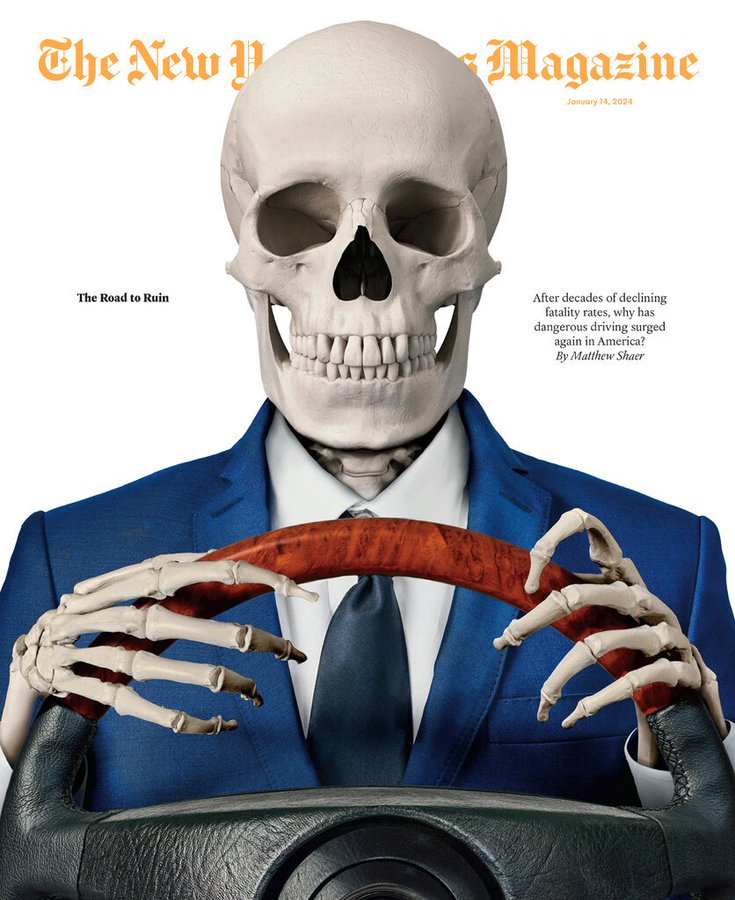
THE NEW YORK TIMES MAGAZINE (January 12, 2024): The new issue features ‘Why Are American Drivers So Deadly’ –After decades of declining fatality, dangerous driving has surged again….
After decades of declining fatality rates, dangerous driving has surged again.
By Matthew Shaer
In the summer of 1999, a few years after graduating from medical school, Deborah Kuhls moved from New York to Maryland, where she had been accepted as a surgical fellow at the R Adams Cowley Shock Trauma Center in Baltimore. Founded by a pioneer in emergency medicine, Shock Trauma is one of the busiest critical-care facilities in the country — in an average year, doctors there see approximately 8,000 patients, many of them close to death.
Andy Reid’s diligence and sense of mischief have made him one of the game’s best-ever coaches. Can he get his struggling Chiefs back to the Super Bowl?
By Michael Sokolove
Andy Reid, the coach of the Kansas City Chiefs, has won more than 250 games in his career, fourth all-time, which puts him high on any list of the N.F.L.’s greatest coaches. Most of the others in that pantheon are men who personify the sport’s militaristic soul — Vince Lombardi, for example, the fabled coach of the 1960s-era Green Bay Packers, or Reid’s contemporary, the grim Bill Belichick of the New England Patriots. But Reid is no Lombardi or Belichick; he’s Steve Jobs. He’s a designer, a tinkerer, a product engineer who imbues his football with creativity and even an occasional touch of whimsy.
I rode west with a childhood friend who was driving to a job in California. We passed through Tennessee, Arkansas, Oklahoma, and still there was no sign of the Commander. My friend placed a bag of chocolate-covered espresso beans on the console between us, jumble of rich dark gems, glittering like they were wet. I crunched them in my teeth without thinking. Sometimes I drove and let her sleep. When clouds clotted the sun her hair still glowed, some mix of orange and yellow and pink. Toast, or the honey for it, or the cinnamon.
After we spent a day and a night in a certain desert town, I told my friend to go on without me. I’d stay. The town was bordered by empty hills and endless sky: room to disappear. I found an unopened pack of Juicy Fruit gum on the sidewalk, which I took for a sign.
THE NEW YORK TIMES MAGAZINE (January 5, 2024): The new issue features “Letting Naomi Die” – Treatment wasn’t helping her anorexia, so doctors allowed her to stop, no matter the consequences. But is a ‘palliative’ approach to mental illness really ethical?
Treatment wasn’t helping her anorexia, so doctors allowed her to stop — no matter the consequences. But is a “palliative” approach to mental illness really ethical?
By Katie Engelhart
The doctors told Naomi that she could not leave the hospital. She was lying in a narrow bed at Denver Health Medical Center. Someone said something about a judge and a court order. Someone used the phrase “gravely disabled.” Naomi did not think she was gravely disabled. Still, she decided not to fight it. She could deny that she was mentally incompetent — but this would probably just be taken as proof of her mental incompetence. Of her lack of insight. She would, instead, “succumb to it.”
What If People Don’t Need to Care About Climate Change to Fix It?
By David Marchese
“It seems like we’ve been battling climate change for decades and made no progress,” Dr. Hannah Ritchie says. “I want to push back on that.” Ritchie, a senior researcher in the Program on Global Development at the University of Oxford and deputy editor at the online publication Our World in Data, is the author of the upcoming book, “Not the End of the World.” In it, she argues that the flood of doom-laden stats and stories about climate change is obscuring our ability to imagine solutions to the crisis and envision a sustainable, livable future.
Louisiana Channel (January 4, 2024) – When writing, Joyce Carol Oates writes about people, often about a family, because “the family unit to me is like the nexus of all emotion, and people derive their meaning from the position in families,” she says.
Video timeline:0:00 On preferred subjects for writing 3:20 On Karen Blixen /Isak Dinesen 4:24 On families 6:54 On the mother figure 9:00 On the novel ‘Babysitter’ 17:27 On the novel ‘Night. Sleep. Death. And the Stars’ 22:48 How traveling resembles writing 28:47 On Donald Trump
“What is so exciting about the novel is that it mimics life and that you end up doing something you never thought you would do,” says Joyce Carol Oates, one of America’s greatest living novelists, when looking back on a life of writing.
It might be a violent event or something politically relevant, or it could be a racist experience that sets off a novel. In her storytelling, Oates finds it interesting to focus on girls at the beginning of puberty: “There’s a kind of wonderful neutrality of childhood that gets conditioned out when girls get to be 12 – 14 years old. And then, from that point on, when they’re so shaped by what we call the male gaze and the expectations of others that they grow into being someone who is this female image.”
But today, the family is very different and there are all kinds of families: “There are families of same-sex couples who got married and they may adopt a child or they may have a child of their own, but then there may be families that are like communes where people are living, sharing a house, but they are a family and they may have dogs and cats who know who they are. […] The so-called nuclear family – which is just a father, mother, and children – still exists, of course, but it’s not the only example of any longer, which is wonderful. It all begins with the emancipation of women”, Joyce Carol Oates concludes.
Oates feels attracted to writing because writing is storytelling and “what’s interesting about storytelling is that you have to have revelations. That you start off with a situation, and a little bit of a mystery evolves, and then you have to follow the tendrils and the roots of that mystery, like an investigator. And then there has to be a revelation.” This means that Oates focuses a lot in her writing on the pacing and the suspense and the movement, like “how long is a paragraph, how short is the dialogue, and how much dialogue is there in proportion to the exposition, and the craftsman side of writing is actually where many people write.“
She fell in love with a future president at 17. Marriage never waylaid her dreams.
By MICHAEL PATERNITI
Three miles lie between this life and another, between their two houses, hers in downtown Plains, Ga., and his family farm in the country surrounded by peanuts planted in red clay. Three miles between the ordinary and extraordinary.
Uncovering the unlikely story behind the singer’s first album.
By JOHN JEREMIAH SULLIVAN
To say that Sinead O’Connor never quite regained the musical heights of her 1987 debut album, “The Lion and the Cobra,” is not to slight the rest of her output, which contained jewels. There is no getting back to a record like that first one. It was in some sense literally scary: The label had to change the original cover art, which showed a bald O’Connor hissing like a banshee cat, for the American release. In the version we saw, she looks down, arms crossed, mouth closed, vulnerable. The music had both sides of her in it.
CBS Mornings (December 23, 2023) – After writing “The Grapes of Wrath,” author John Steinbeck explored the Gulf of Mexico in a famous boat called the Western Flyer.
Since then, the boat has inspired adventurers and scientists for generations, but the original ship was nearly lost. CBS News’ Jeff Glor reports on the person determined to give it new life.
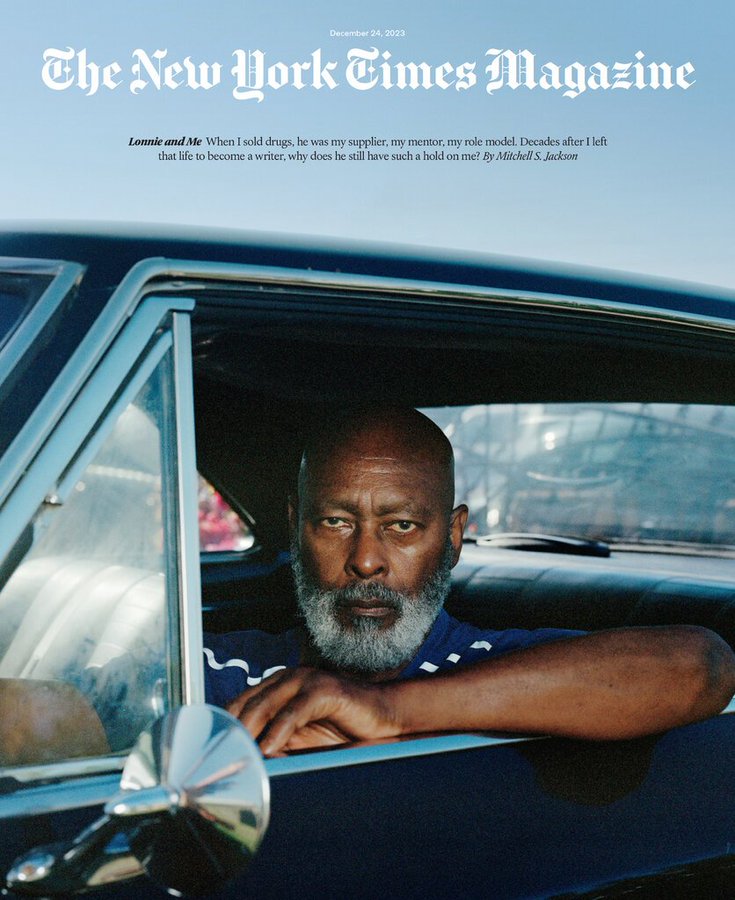
Decades after I left hustling to become a writer, why did I seek out the man who drew me into that world?
By Mitchell S. Jackson
O.G. rings me in the a.m. to say he’s just touched down in Phoenix. It’s the day before he said he’d arrive, and while there was a time when I’d treat the seeming opacity of his plans as par, the call’s a minor surprise. He asks for my address and tells me he can drop by as soon as he grabs his rental car. “Cool,” I say, as if the call ain’t ramped my pulse, as if my crib is presentable for guests. It isn’t. So I shoot out of bed and get to cleaning and straightening the first floor, going so far as to light a candle. It’s been umpteen years since I’ve seen O.G. — Lonnie’s his name — and God forbid he judge me anything less than hella fastidious.
The story of 2.3 million Palestinian refugees in Jordan has been shaped by generations of war and exile.Photographs
by MOISES SAMAN
How Do You Make a Movie About the Holocaust?
With “The Zone of Interest,” Jonathan Glazer is just the latest director to confront the problem.
Poetry makes nothing happen, W.H. Auden said in 1939, when words must have seemed especially impotent; but cinema is another matter. For several decades after the end of the Second World War, what’s come to be seen as its central catastrophe — the near-total destruction of the European Jews — was consigned to the status of a footnote. The neglect was rooted in guilt: Many nations eagerly collaborated in the killing, while others did nothing to prevent it. Consumed by their own suffering, most people simply didn’t want to know, and a conspiracy of silence was established.
News, Views and Reviews For The Intellectually Curious






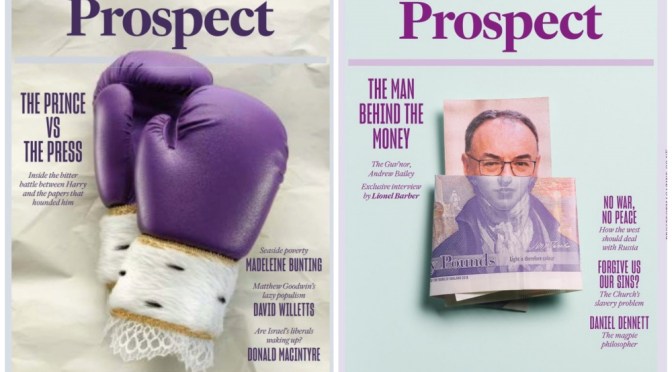

 Prospect Magazine (March 2024) – The latest issue features ‘How The Government Captured The BBC’ – A faceless fixer – and a broadcaster in a state of ‘permanent cringe’…



















 Intellicurious