

London Review of Books · 26 November 2026
Renoir, Ruin & Reason
Vol. 48 No. 21: Barnes on Renoir, de Waal on El Fasher, Davis on the Stoics
The 26 November issue of the London Review of Books pairs consolation with catastrophe. Lydia Davis turns to Marcus Aurelius and the Stoic promise that reason can master the fear of death; Alex de Waal shows how a massacre in Sudan was predicted, in detail, to the governments that might have stopped it. Between them, Julian Barnes interrogates Renoir’s charm, Fiona Green listens to Denise Riley on the voice of the poem, and Christopher Clark finds the Nazis rehearsing in Weimar.
Here are all 23 pieces, grouped by theme, with our notes on the threads that run through them.
The Cover
Scraps on a Lilac Ground
Cover · Vol. 48 No. 21
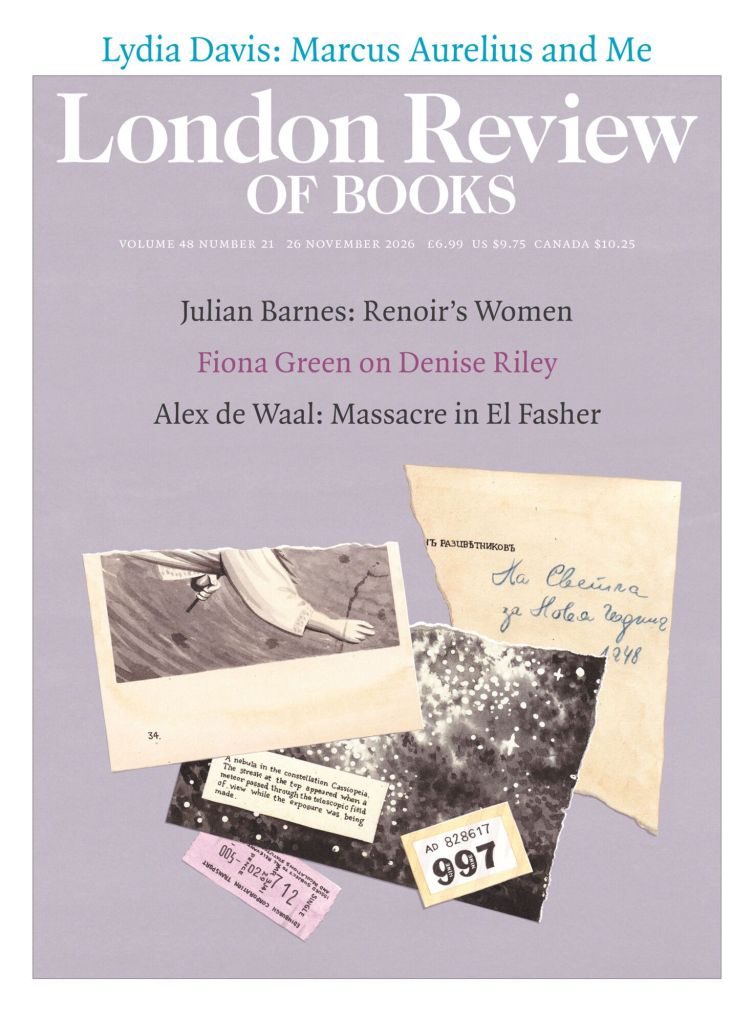
The cover is a little archive of torn paper on a lilac field: a sepia illustration numbered 34, showing a sleeve and a hand gripping something small and dark; a photograph of a star-thick nebula in Cassiopeia, its caption explaining the streak a passing meteor left on the exposure; a page inscribed in Cyrillic for the New Year of 1948; a pink single ticket from Edinburgh Corporation Transport; and a stub numbered 997. Ephemera, kept for reasons only their owner knew, set beside the issue’s four cover lines: Lydia Davis on Marcus Aurelius, Julian Barnes on Renoir’s women, Fiona Green on Denise Riley and Alex de Waal on El Fasher.
Cover Stories
1. Dying, or Doing Something Else
Lydia Davis · Marcus Aurelius and Me
Davis finds no comfort in the prospect that humanity might disappear while other species carry on, yet she enjoys testing the thought that the distant future could still be kind to them. Her faith is in the Stoic claim that a trained reason can overcome pain, grief, superstition and the fear of death, a discipline its own teachers admit is difficult.
Julian Barnes · Renoir and Love, National Gallery
Barnes concedes everything to Renoir’s charm: the paintings, their sitters and above all the children, who know exactly how winning they are, with no trace of satire anywhere. What he presses is whether the work avoids the label Renoir most feared, “sentimental”, and whether honest pictures can still manipulate the viewer, perhaps more so with time.
3. Foxiness
Fiona Green · A Chorus of Ears by Denise Riley
Riley’s book on “the voice of the poem” ends by asking what lyric voice is made of and what it is like inside a poet’s head. Green follows her to the strange image at its close: how there could be any room for a self in a skull that modern anatomy shows to be packed tight with the folded whorls of the brain.
Alex de Waal · Massacre in El Fasher
Rarely, de Waal argues, has a massacre been forecast so precisely to so many governments, international bodies and forums, Britain among them. He cites Nathaniel Raymond of the Yale Humanitarian Research Lab, who says the intelligence handed to the Foreign Office was timely and detailed enough to support policies that could have prevented the killing in El Fasher.
History & Politics
Christopher Clark · Weimar by Katja Hoyer
For Clark, Weimar holds the contradictions that make “Why Germany?” such a compelling question. It was the laboratory where the Bauhaus tried out bold new forms of expression, until the cultural establishment drove it out, and also a stage on which Nazi rule held its early rehearsals.
Florence Sutcliffe-Braithwaite · Disclosure by Kate Wilson
A review of Kate Wilson’s account of the “spycops” files, the undercover police operations that for decades infiltrated British protest movements, written by one of the activists caught up in them.
Richard Seymour · The Cultural Marxism Conspiracy by A.J.A. Woods
Seymour reviews a study of why the right blames the Frankfurt School for the decline of the West, and how “cultural Marxism” hardened into a conspiracy theory.
Alexander Zevin · Pax Economica by Marc-William Palen
Palen’s book recovers the left-wing visions of a free-trade world, when open markets were championed as a road to peace.
Travis Zadeh · Becoming Arab by Yossef Rapoport
Zadeh on Rapoport’s history of how an Arab identity took shape in the medieval Middle East.
11. Short Cuts: Sinking the ‘United States’
Richard J. Williams · Short Cuts
Williams on the fate of the SS United States, the record-breaking ocean liner bound for the seabed off Florida as an artificial reef.
Theory, Film & Fiction
Hal Foster · The Frenchmen by Emily Eakin
Foucault traced scholarship back to monks squabbling over manuscripts, but, Foster recalls, there was nothing monkish about the French theorists: they went at one another in public with sweeping pronouncements, fuelled at times by sibling rivalry and at times by Oedipal frustration. Derrida was 36 when he deconstructed Lévi-Strauss in 1966, the opening shot of poststructuralism.
13. Faster than You’ll Ever Be
David Bromwich · Clint by Shawn Levy
Bromwich reviews Shawn Levy’s life of Clint Eastwood, the man and the movies.
Tim Parks · The Anniversary by Andrea Bajani
Parks reviews the Italian novelist Andrea Bajani’s The Anniversary, in Geoffrey Brock’s translation.
15. The Magic Number
Harriet Baker · Gaining Ground by Joan Barfoot
Baker on Joan Barfoot’s novel Gaining Ground.
16. On Natalie Scenters-Zapico
Stephanie Burt · Poetry
Burt on the poetry of Natalie Scenters-Zapico.
Art & Museums
John-Paul Stonard · Kurt Schwitters
Stonard visits the Musée Picasso in Paris for its show of Kurt Schwitters, the collagist who made art from tickets, scraps and the litter of daily life.
18. On Deaccession
Anna McGee
McGee on deaccession, the practice by which museums remove works from their collections.
Nature & the City
19. Snail Eat Snail
John Whitfield · Ecological Explosions by Daniel Simberloff
Whitfield reviews a history of biological invasions and of the science that grew up to study them.
Sam Wetherell · Up in the Air by Holly Smith
Wetherell on Holly Smith’s history of high-rise Britain.
Diary, Poems & Letters
Zoe Dubno · Diary
Learning to drive proved harder than Dubno expected. The mechanics were manageable; the trouble was the sensation of hurtling forward while sitting still, like the rush of a drug coming on. Intrusive thoughts followed: losing control, flooring the accelerator, blacking out into a bus.
22. Two Poems
Rae Armantrout · Poems
Two new poems, among them “Cascade”, which opens on the idea that thoughts arrive without a name attached and deserve to be handled with care.
23. Letters
Correspondence
Letters from Anil Gomes, Sam Knights, Andrew Hobbs, Lisa Gorton, Christian K. Melby, Benjamin Letzler, David Miller, Caroline Walker, Jeffrey Susla and Will Hill.
The Threads
Warnings unheeded. A massacre forecast in detail to the governments that could have stopped it, and a Weimar where Nazi rule was rehearsed in plain sight. (4, 5)
Consolations of reason. Davis leans on the Stoics against the fear of death; Dubno, at the wheel, finds reason no match for intrusive thoughts; Armantrout counsels caution with the thoughts that come unbidden. (1, 21, 22)
Theory’s afterlives. The French theorists who fought in public, the Frankfurt School recast as villains by the right, and Riley’s question of what a lyric voice is made of. (3, 7, 12)
Charm and its suspicion. Barnes asks whether Renoir’s charm shades into manipulation; Bromwich weighs a screen legend; Wilson exposes officers who charmed their way into protest groups. (2, 13, 6)
What we keep, and what we let go. Schwitters made art from scraps like those on the cover; museums deaccession; a great liner is sent to the bottom. (17, 18, 11)
Before You Close the Issue
If a massacre can be foretold to every forum and still happen, what consolation is left in reason?
Drawn from the London Review of Books, Vol. 48 No. 21, 26 November 2026. Visit the homepage at lrb.co.uk.
— The Editors, Intellicurious —

