Bloomberg Businessweek · December 2026
Rise, Riches & Reckoning
“The Chinese Miracle”: twenty pieces on China, 25 years after it joined the WTO
Twenty-five years ago this December, China joined the World Trade Organization. Bloomberg Businessweek’s December issue marks the anniversary with a single question running under twenty pieces: how did a poor country become a modern superpower so fast, and what happens now that the easy part is over?
The issue moves in three acts: the past 25 years, a day in the life of ordinary Chinese, and the next 25 years. Here it is in that order, with our notes on the threads that tie it together.
The Cover
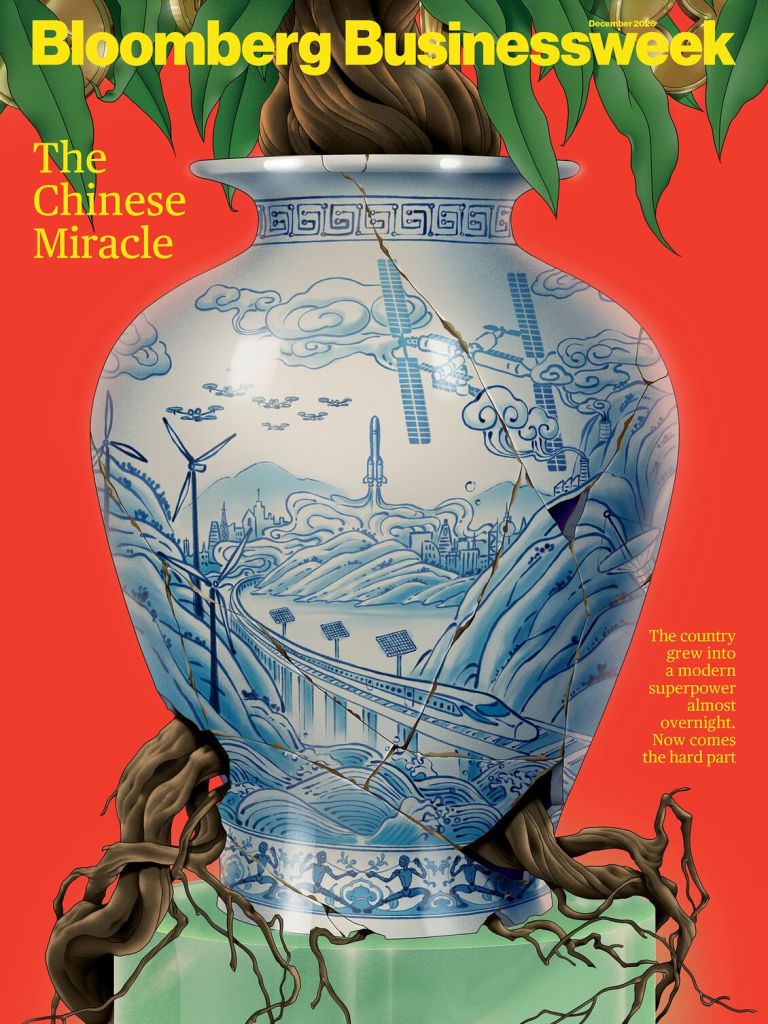
The Chinese Miracle
Cover · December 2026
A blue-and-white porcelain vase stands on a jade-green plinth against a red ground. Painted on it, in the old style, is the new China: wind turbines, a swarm of drones, a rocket lifting off, a space station, solar panels and a bullet train, with a frieze of robots around the base. But the vase is cracked, its fractures traced in gold, and roots are bursting out through the porcelain while a canopy of leaves hung with gold coins spreads overhead. The cover line puts it plainly: China grew into a modern superpower almost overnight, and now comes the hard part.
Remarks
1. China’s Extraordinary Path to Power
By Brad Stone · Remarks
The issue’s opening note traces China’s growth back to the spark that lit it: the deal that brought the country into the World Trade Organization a quarter-century ago.
The Lead Feature
2. The US Thought It Could Change China. Instead, China Changed the US
By Tom Orlik · Feature
Washington backed China’s entry into the WTO expecting trade to make China more like America. Orlik, a Bloomberg economist, argues that the influence flowed the other way, and that the deal ended up reshaping the United States.
The Past 25 Years
3. The Negotiators Who Brought China Into the World Economic Order
By Bloomberg News · Feature
The officials who sat at the table recall, in their own words, how China was brought into the global trading system.
4. Why Soft Power Has Been So Hard for China
Bloomberg Businessweek · Culture
Maggie Li talks about China’s film industry, Hollywood’s racist portrayals of Chinese people, and why cultural influence has lagged so far behind economic might.
5. How Chinese Companies Are Going Global
Bloomberg Businessweek · Conversation
Joerg Wuttke, the longtime voice of European business in Beijing, and Yan Cui discuss China’s rise and the push of its companies into markets abroad.
6. How Xi Jinping’s Early Life Shaped His Political Rise, in Photos
Bloomberg · Photo Essay
A timeline in pictures of Xi Jinping’s early years, and how they set the course of his rise to power.
7. China’s Improbable Transformation Into an Automobile Superpower
By Brad Stone · Autos
Cheap electric vehicles from brands such as BYD and the phone maker Xiaomi have turned China, against the odds, into a car superpower.
8. How ‘Made in China’ Became a Status Symbol
By Wes Kosova · Consumer Goods
The label that once meant cheap now signals quality. Kosova makes the case with products from Viltrox camera lenses to Dyna shoes.
9. China’s Bad-Debt Collectors Chase After 100 Million Defaulters
By Bloomberg News · Feature
With some 100 million people in default, China’s debt collectors are under strain too, struggling almost as much as the borrowers who can’t pay.
10. The Chinese Chemical Supply Chain Fueling the US Opioid Crisis
By Matthew Campbell · Feature
Campbell traces China’s link in the chain of chemicals behind the fentanyl driving America’s opioid crisis.
11. Rich Country, Poor Citizens: China’s $20 Trillion Paradox
By Christopher Marquis · Economy
China’s economy is worth nearly $20 trillion, yet its people remain relatively poor. Marquis examines the gap between a rich state and the households inside it.
12. What Surprises Foreign CEOs About Doing Business in China
Bloomberg Businessweek · Business
American and European chief executives describe what caught them most off guard about doing business in China.
A Day in the Life
13. A Day in the Life for Some of China’s 1.4 Billion Citizens
Bloomberg Businessweek · Portraits
Between the issue’s two halves, a pause for ordinary life: a single day as lived by a handful of the country’s 1.4 billion people.
The Next 25 Years
14. China Isn’t Bent on World Domination. It Just Wants to Restore ‘Order’
By Daniel Ten Kate · Geopolitics
Ten Kate argues that Beijing’s view of Taiwan and the wider world is less about conquest than about restoring what it regards as the proper order of things.
15. A DeepSeek Moment for Biotech
By Amber Tong · Biotech
Chinese drugmakers such as Akeso are giving the pharmaceutical industry the kind of shock that DeepSeek gave artificial intelligence.
16. China Is Mass-Producing One-Person AI Companies
By Christopher Beam · Technology
Beam reports on how China is turning out a new generation of AI entrepreneurs, many of them running companies of one.
17. Chinese Integration Threatens What’s Driving Hong Kong’s Revival
By Juliana Liu · Hong Kong
Hong Kong’s comeback is being powered by mainlanders in search of freedom. Liu finds that closer integration with China threatens the very thing that draws them.
18. China Counts on Seniors to Jump-Start a Sluggish Economy
Bloomberg Businessweek · Economy
With growth flagging, Beijing is looking to its retirees to spend more and help revive the economy.
19. China’s Brewing Soft Power in the US Smells Like Coffee
Bloomberg Businessweek · Culture
Chinese chains such as Mixue, Luckin and Heytea are winning over American teenagers caught up in the “Chinamaxxing” trend, a soft power that arrives in a cup.
20. To Make in America, Start by Importing a Chinese Factory
By Shawn Donnan · Manufacturing
Donnan uses the struggles of the manufacturer Welly to show that bringing factories back to the US still depends on China, sometimes down to the factory itself.
The Threads
The bargain, reversed. America let China into the WTO to change it; the issue’s argument is that China changed America instead, down to the factories Washington now wants back. (1, 2, 3, 20)
From cheap to coveted. Cars, camera lenses, shoes, cancer drugs and bubble tea all tell the same story: “Made in China” has moved up the value chain. (7, 8, 15, 19)
Soft power, at last? Film has struggled, but coffee chains and freedom-seeking migrants suggest China’s pull may come from unexpected places. (4, 17, 19)
A rich state, stretched households. Nearly $20 trillion of output sits alongside 100 million defaulters and a government asking retirees to spend. (9, 11, 18)
Order, as Beijing sees it. Xi’s formative years, Taiwan and Hong Kong show a leadership that values control as much as growth. (6, 14, 17)
Entangled. Fentanyl chemicals, surprised CEOs and imported factories show how tightly the two economies remain bound. (10, 12, 20)
Dates for the Diary
December 11, 2001. China formally joins the World Trade Organization.
December 11, 2026. The 25th anniversary of China’s entry, and the occasion for this issue.
Before You Close the Issue
If China changed America more than America changed China, who will the next 25 years change?
Drawn from Bloomberg Businessweek, December 2026, “The Chinese Miracle.” Visit the homepage at bloomberg.com.
— The Editors, Intellicurious —