
Scientific American · November 16–18, 2026
Proofs, Probes & Spores
Ten stories, from a crisis in mathematics to the first seconds of time
This week’s Scientific American opens with an editor’s argument about why mathematics still needs human beings, then ranges from the first seconds after the big bang to Voyager 1, now a full light-day from home. In between come a rainforest under strain, a canyon that still keeps its secrets, a permitting bill with nuclear consequences and a podcast that asks whether fungi can think.
Here are the ten pieces, grouped by theme.
The Lead Essay
1. Why We Still Need Humans in Math
By Jeanna Bryner · Culture · November 17
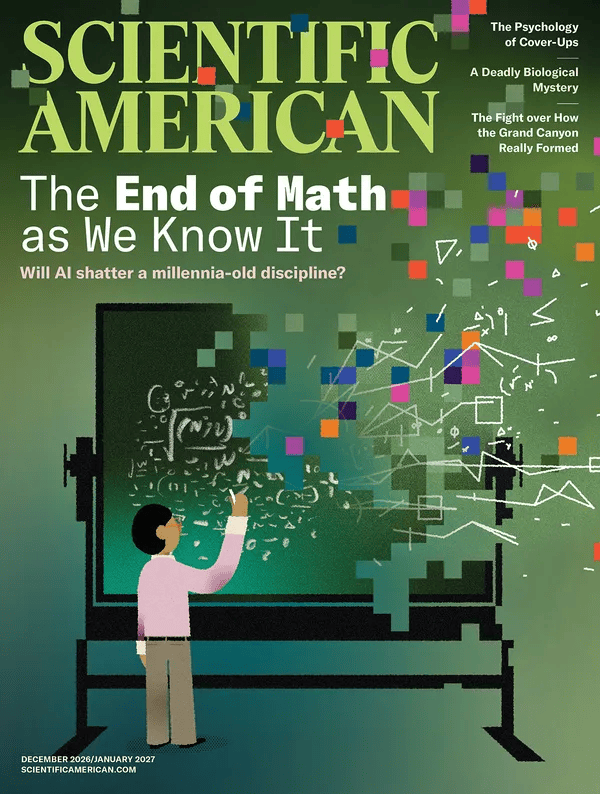
Mathematicians have begun to use the word “crisis” about the state of their field. Bryner, the magazine’s editor, takes the alarm seriously without sharing the despair: mathematics will come through, she argues, but only if it is willing to change how it works.
Cosmos & Space
2. The Universe’s Broken Symmetry
By Anne-Katherine Burns · Cosmology · November 16
Physicists have found hints that some of the rules we treat as permanent did not yet hold in the moments after the big bang. In the universe’s first seconds, a symmetry that seems fixed today may already have been breaking.
3. Voyager 1 Reaches a Light-Day
By Christopher K. Walker · Space Exploration · November 18
Launched in 1977, Voyager 1 is now so far away that its radio signals take a full day to reach Earth, about 16 billion miles. Walker calls the probe humanity’s best-known interstellar message in a bottle, and argues it is unlikely to be the last one we send.
4. SpaceX’s Orbital AI, and the Air Below
By Jacklin Kwan · Space Exploration · November 18
SpaceX wants to move AI computing into orbit on as many as a million satellites. Kwan asks what a constellation on that scale would do to Earth’s atmosphere, and warns that the pollution could be severe.
The Planet
By Quentin Septer · El Niño · November 16
The strongest El Niño on record is bringing drought and fire to the rainforest. Researchers fear the Amazon may be nearing a point of no return, beyond which the damage could become permanent.
6. The Riddle of the Grand Canyon
By Stephanie Pappas · Geology · November 17
Six million years in the making, and geologists still disagree about how the Grand Canyon was carved. Pappas reports that the canyon is at last beginning to give up some of its secrets.
Health & Energy
7. Hormones and the Menopausal Mind
By Allison Parshall · Alzheimer’s Disease · November 16
Hormone therapy may help women think more clearly after menopause. How much it helps, Parshall reports, depends on two things: a woman’s genes and the kind of hormone therapy her doctor prescribes.
8. A Quiet Revolution for Nuclear Power
By Stephanie Pappas · Nuclear Energy · November 18
The Bipartisan American Affordability and Jobs Act, the permitting bill the Senate voted to advance on November 9, is mostly sold as a way to speed up transmission lines and renewables. Pappas explains why, if Congress passes it, it could also transform nuclear power.
Puzzles & Wonders
By Lyndie Chiou · Mathematics · November 18
A deceptively simple problem set on the 64 squares of a chessboard still has mathematicians puzzled after 120 years. Chiou explains why it keeps its hold on them.
10. Can Fungi Think?
Podcast · Ecology · November 18
An episode that travels into the fungal world and asks how organisms with no brains at all might change what we mean by intelligence, and by life itself.
The Threads
Old questions, still open. A canyon six million years old, a chessboard puzzle at 120 and the universe’s first seconds all resist a final answer. The lead essay asks who will keep working on such questions. (1, 2, 6, 9)
What counts as a mind. The lead essay defends the human mathematician, the podcast asks whether a brainless organism can think, and the hormone study tracks how thinking changes after menopause. (1, 7, 10)
Points of no return. A rainforest near its tipping point, an atmosphere asked to absorb a million satellites and a symmetry that broke at the start of time: each is a story about changes that cannot be undone. (2, 4, 5)
Building at scale. Faster permits for reactors and data centres in orbit show how much AI and energy now shape the physical world. (4, 8)
Before You Close the Issue
If the universe itself once played by other rules, what makes us sure we know the rules now?
Drawn from Scientific American online, November 16–18, 2026. Visit the homepage at scientificamerican.com.
— The Editors, Intellicurious —

