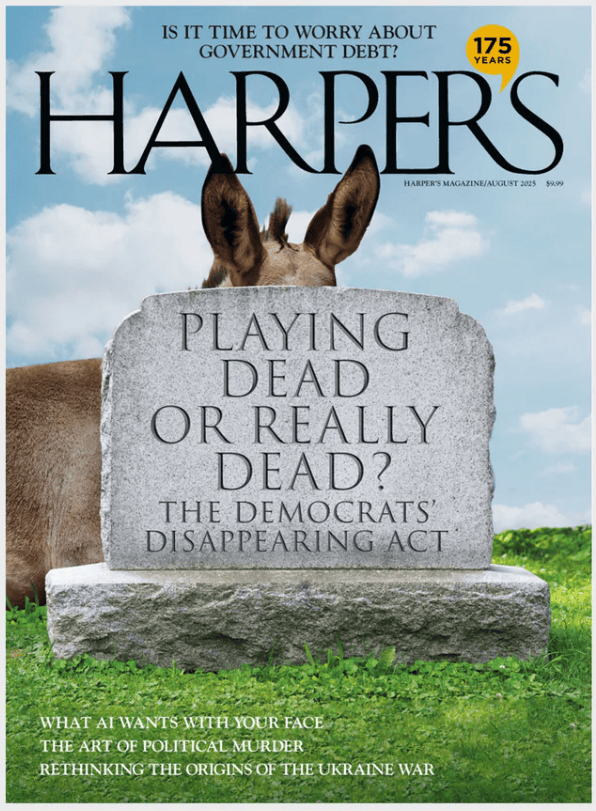
Playing Dead
Do the Democrats really want reform? by Andrew Cockburn
Your Face Tomorrow
The puzzle of AI facial recognition by Michael W. Clune
Debt Reckoning
Has the Treasury market started to crack? by Mary Childs

Do the Democrats really want reform? by Andrew Cockburn
The puzzle of AI facial recognition by Michael W. Clune
Has the Treasury market started to crack? by Mary Childs
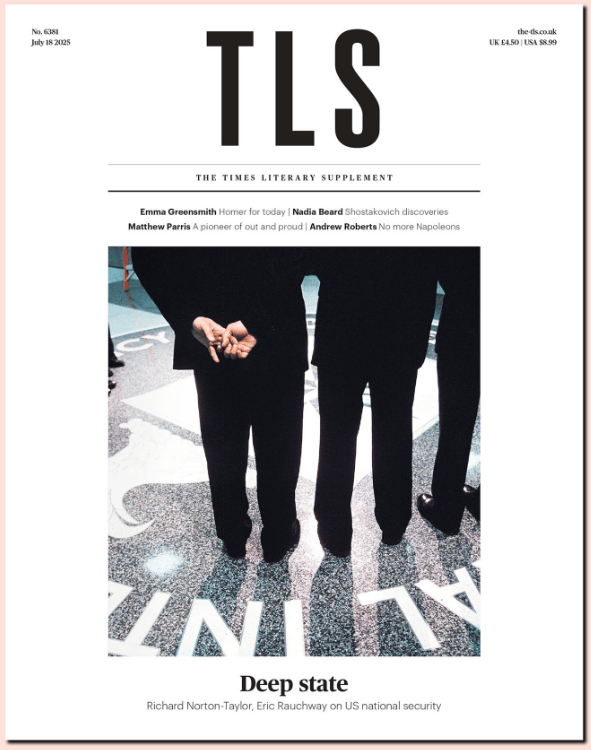
How accountable are US intelligence agencies to the president and Congress? By Richard Norton-Taylor
Henry James’s return to the United States By Alicia Rix
New light on ‘Captain’ Warner’s weapon of mass destruction By Trevor Pateman
A poet for yesterday and today By Emma Greensmith

Is the United States truly ready for the seismic shift in modern warfare—a transformation that The New Yorker‘s veteran war correspondent describes not as evolution but as rupture? In “Is the U.S. Ready for the Next War?” (July 14, 2025), Dexter Filkins captures this tectonic realignment through a mosaic of battlefield reportage, strategic insight, and ethical reflection. His central thesis is both urgent and unsettling: that America, long mythologized for its martial supremacy, is culturally and institutionally unprepared for the emerging realities of war. The enemy is no longer just a rival state but also time itself—conflict is being rewritten in code, and the old machines can no longer keep pace.
The piece opens with a gripping image: a Ukrainian drone factory producing a thousand airborne machines daily, each costing just $500. Improvised, nimble, and devastating, these drones have inflicted disproportionate damage on Russian forces. Their success signals a paradigm shift—conflict has moved from regiments to swarms, from steel to software. Yet the deeper concern is not merely technological; it is cultural. The article is less a call to arms than a call to reimagine. Victory in future wars, it suggests, will depend not on weaponry alone, but on judgment, agility, and a conscience fit for the digital age.
At the heart of the analysis lies a confrontation between two worldviews. On one side stands Silicon Valley—fast, improvisational, and software-driven. On the other: the Pentagon—layered, cautious, and locked in Cold War-era processes. One of the central figures is Palmer Luckey, the founder of the defense tech company Anduril, depicted as a symbol of insurgent innovation. Once a video game prodigy, he now leads teams designing autonomous weapons that can be manufactured as quickly as IKEA furniture and deployed without extensive oversight. His world thrives on rapid iteration, where warfare is treated like code—modular, scalable, and adaptive.
This approach clashes with the military’s entrenched bureaucracy. Procurement cycles stretch for years. Communication between service branches remains fractured. Even American ships and planes often operate on incompatible systems. A war simulation over Taiwan underscores this dysfunction: satellites failed to coordinate with aircraft, naval assets couldn’t link with space-based systems, and U.S. forces were paralyzed by their own institutional fragmentation. The problem wasn’t technology—it was organization.
What emerges is a portrait of a defense apparatus unable to act as a coherent whole. The fragmentation stems from a structure built for another era—one that now privileges process over flexibility. In contrast, adversaries operate with fluidity, leveraging technological agility as a force multiplier. Slowness, once a symptom of deliberation, has become a strategic liability.
The tension explored here is more than operational; it is civilizational. Can a democratic state tolerate the speed and autonomy now required in combat? Can institutions built for deliberation respond in milliseconds? These are not just questions of infrastructure, but of governance and identity. In the coming conflicts, latency may be lethal, and fragmentation fatal.
To frame the stakes, the essay draws on powerful historical precedents. Technological transformation has always arisen from moments of existential pressure: Prussia’s use of railways to reimagine logistics, the Gulf War’s precision missiles, and, most profoundly, the Manhattan Project. These were not the products of administrative order but of chaotic urgency, unleashed imagination, and institutional risk-taking.
During the Manhattan Project, multiple experimental paths were pursued simultaneously, protocols were bent, and innovation surged from competition. Today, however, America’s defense culture has shifted toward procedural conservatism. Risk is minimized; innovation is formalized. Bureaucracy may protect against error, but it also stifles the volatility that made American defense dynamic in the past.
This critique extends beyond the military. A broader cultural stagnation is implied: a nation that fears disruption more than defeat. If imagination is outsourced to private startups—entities beyond the reach of democratic accountability—strategic coherence may erode. Tactical agility cannot compensate for an atrophied civic center. The essay doesn’t argue for scrapping government institutions, but for reigniting their creative core. Defense must not only be efficient; it must be intellectually alive.
Perhaps the most haunting dimension of the essay lies in its treatment of ethics. As autonomous systems proliferate—from loitering drones to AI-driven targeting software—the space for human judgment begins to vanish. Some militaries, like Israel’s, still preserve a “human-in-the-loop” model where a person retains final authority. But this safeguard is fragile. The march toward autonomy is relentless.
The implications are grave. When decisions to kill are handed to algorithms trained on probability and sensor data, who bears responsibility? Engineers? Programmers? Military officers? The author references DeepMind’s Demis Hassabis, who warns of the ease with which powerful systems can be repurposed for malign ends. Yet the more chilling possibility is not malevolence, but moral atrophy: a world where judgment is no longer expected or practiced.
Combat, if rendered frictionless and remote, may also become civically invisible. Democratic oversight depends on consequence—and when warfare is managed through silent systems and distant screens, that consequence becomes harder to feel. A nation that no longer confronts the human cost of its defense decisions risks sliding into apathy. Autonomy may bring tactical superiority, but also ethical drift.
Throughout, the article avoids hysteria, opting instead for measured reflection. Its central moral question is timeless: Can conscience survive velocity? In wars of machines, will there still be room for the deliberation that defines democratic life?
The closing argument is not tactical, but philosophical. Readiness, the essay insists, must be measured not just by stockpiles or software, but by the moral posture of a society—its ability to govern the tools it creates. Military power divorced from democratic deliberation is not strength, but fragility. Supremacy must be earned anew, through foresight, imagination, and accountability.
The challenge ahead is not just to match adversaries in drones or data, but to uphold the principles that give those tools meaning. Institutions must be built to respond, but also to reflect. Weapons must be precise—but judgment must be present. The republic’s defense must operate at the speed of code while staying rooted in the values of a self-governing people.
The author leaves us with a final provocation: The future will not wait for consensus—but neither can it be left to systems that have forgotten how to ask questions. In this, his work becomes less a study in strategy than a meditation on civic responsibility. The real arsenal is not material—it is ethical. And readiness begins not in the factories of drones, but in the minds that decide when and why to use them.
THIS ESSAY REVIEW WAS WRITTEN BY AI AND EDITED BY INTELLICUREAN.

As the death toll climbs in Texas, the Trump Administration is actively undermining the nation’s ability to predict—and to deal with—climate-related disasters. By Elizabeth Kolbert
With global conflicts increasingly shaped by drones and A.I., the American military risks losing its dominance. By Dexter Filkins
The discomfort of loneliness shapes us in ways we don’t recognize—and we may not like what we become without it. By Paul Bloom

In the July 11, 2025 episode of Bloomberg Law’s Weekend Law podcast, the spotlight turned to the Supreme Court and one of the most urgent constitutional questions of the present era: can the federal government deny citizenship to children born in the United States based solely on their parents’ immigration status?
At the center of the discussion was a new executive order issued by the Trump administration. The order aims to withhold automatic citizenship from children born to undocumented immigrants. In response, a federal judge in New Hampshire has not only issued a temporary nationwide block on the order but also certified a class-action lawsuit that could have sweeping implications.

This development, as legal analyst and former DOJ official Leon Fresco explained, is not merely procedural—it is strategic. The case, still in its early stages, may force the Supreme Court to revisit the meaning of the Fourteenth Amendment’s Citizenship Clause.
Fresco’s key insight concerned how litigants are adapting to recent changes in judicial thinking. After the Supreme Court expressed skepticism toward broad nationwide injunctions, many believed such tools were effectively dead. But Fresco pointed out that class-action certification remains a viable, and perhaps more precise, alternative.
The New Hampshire judge’s ruling created a nationwide class of plaintiffs: all children born on or after February 20, 2025, to parents who are either unlawfully present or not U.S. citizens or lawful permanent residents. The judge carefully excluded parents from the class, narrowing the focus to the children’s citizenship claims. This move strengthens the class’s legal position, emphasizing a uniform constitutional harm.
Fresco characterized this approach as both narrow in structure and expansive in effect. By building the case around a specific constitutional injury—the denial of citizenship by birth—the lawsuit avoids the kinds of inconsistencies that often weaken broader claims.
At the heart of the dispute lies the interpretation of the Citizenship Clause of the Fourteenth Amendment: “All persons born or naturalized in the United States, and subject to the jurisdiction thereof, are citizens of the United States.”
For over a century, the courts have understood this to include virtually everyone born on U.S. soil, with only narrow exceptions. The Trump administration’s order proposes a reinterpretation—arguing that undocumented immigrants and their children are not “subject to the jurisdiction” of the United States in the full constitutional sense.
This argument is novel, but not entirely new. Versions of it have circulated in fringe legal circles for years. What is new is the attempt to enforce this interpretation through executive power. If allowed to stand, it would mark a major departure from long-established constitutional norms.
Fresco raised a more immediate concern: that the Supreme Court may avoid ruling on the merits of the case altogether—at least for now. The Court, he warned, might grant a temporary stay that would allow the executive order to take effect while the lawsuit works its way through the lower courts.
This would mirror a pattern seen in other immigration cases, such as those involving Temporary Protected Status and humanitarian parole, where short procedural rulings allowed sweeping policy shifts without a full constitutional review.
The danger of such a stay is not theoretical. If the executive order goes into effect, children born under it would enter legal limbo. Denied citizenship, they would lack basic documents and protections. Challenging their status later could take years—possibly decades. In this way, even a temporary policy can create permanent consequences.
A central theme of the podcast segment was the evolving role of the judiciary in overseeing executive actions. Fresco questioned how the Court could reject a class-action lawsuit like this one without also undermining the logic that allows nationwide relief in other types of cases—such as defective products that cause uniform harm across the country.
If the courts are willing to permit class certification for consumer safety, why would they deny it in a case concerning citizenship—a matter of constitutional identity?
Fresco’s analogy was sharp: the law allows national class actions over faulty cribs or pharmaceuticals; why not over a birthright denied?
His point revealed the tension between procedural restraint and constitutional responsibility. If the Court is serious about limiting nationwide injunctions, it must offer a consistent, principled rationale for where it draws the line.
Toward the end of the discussion, Fresco referenced former Attorney General Alberto Gonzalez, who has speculated that the Supreme Court may simply lack the votes to strike down the executive order directly. That possibility may explain the Court’s hesitancy to take up the issue.
Justice Neil Gorsuch’s past remarks—asking how the Court might “get to the merits fast”—suggest at least some justices recognize the urgency. But urgency does not always lead to clarity. If the Court allows the order to take effect temporarily, and then delays review, it could set in motion changes that are difficult to reverse.
In effect, the Court would be allowing the executive branch to reshape constitutional practice through interim decisions. That prospect, Fresco warned, is not only legally unstable but socially volatile.
Ultimately, what this case asks is not only a legal question but a civic one: Is citizenship a stable constitutional right, or can it be redefined by policy?
The class-action strategy now moving through the courts offers one possible defense: a method of forcing judicial engagement by focusing on clear constitutional harm and avoiding broad, unwieldy claims. It is, in Fresco’s words, an effort to meet the Court on its own procedural terms.
Yet the deeper conflict remains. The very idea of birthright citizenship—once considered legally untouchable—is now on trial. Whether the courts decide quickly or delay, the consequences will be lasting.
The Bloomberg Law discussion offered more than a legal update. It revealed how quickly constitutional assumptions can be unsettled—and how creative legal strategies are now being used to hold the line.
The New Hampshire ruling, and the class it created, represent a new phase in this fight. Narrow in scope but vast in significance, the lawsuit calls on the judiciary to answer directly: Is a child born on U.S. soil a citizen, or not?
In that answer lies the future of constitutional meaning—and the measure of whether the law remains anchored to principle, or drifts with the political tide.
THIS ESSAY AND REVIEW WAS WRITTEN BY AI AND EDITED BY INTELLICUREAN

The following essay was written by AI and edited by Intellicurean:
One often hears that art is a refuge from the storm, a quaint hermitage for the sensitive soul. But when the storm is a veritable tempest of tyranny, what then? Must beauty shrink to a whispered metaphor, or can it, with a flourish, confront the grotesque, form itself a weapon, and memory its shield?

Peter Weiss, the German-Swedish playwright and novelist, perhaps best known for his provocative Marat/Sade, offers an unflinching answer in his masterwork, The Aesthetics of Resistance. This three-volume novel—published between 1975 and 1981, and only recently fully translated into English by Joel Scott for Verso Books—presents not merely a chronicle of Europe’s descent into fascism, but an audacious theory of survival, contemplation, and rebellion through the very act of art.
In a perceptive recent essay for Liberties Journal, Jared Marcel Pollen explores the novel’s radical scope, elegantly correcting a common misattribution of a pivotal political aphorism. Not Lenin, but Maxim Gorky, Pollen reveals, claimed that “aesthetics was [his] ethics—the ethics of the future.” More than a mere historical footnote, this elegantly salvaged reversal encapsulates the novel’s very governing spirit: that beauty, far from being a retreat from political crisis, is its very precondition for meaning, that art does not merely ornament truth, but, with a surgical precision, it excavates it.
The Aesthetics of Resistance unfolds in the shadow of Europe’s unraveling, commencing in 1937, as Hitler consolidates power and Stalin’s purges silence dissent. The narrative spans the years up to 1942—a period that Hannah Arendt once called “midnight in the century.” But unlike conventional historical fiction, Weiss offers no linear tale of protagonists moving toward neat resolution. Instead, he crafts a philosophical Hades-wanderung—a relentless descent through betrayal, failed revolutions, ideological fracture, and the wreckage of cultural inheritance.
The text itself resists easy consumption. Its dense, paragraphless pages—walls of syntax without clear beginning or end—mirror the labyrinthine realities its characters inhabit. In an interview with The New York Times, translator Joel Scott remarked that reading Weiss is like “being submerged in consciousness,” and likened the novel’s structure to a frieze: a continuous mural of intellect, grief, and memory. This relentless, frieze-like form compels the reader to engage with history not as a series of discrete events, but as an overwhelming, cumulative force, a continuous present of trauma and resistance. The novel is as much a meditation on how we perceive history as it is on history itself.
At its core, The Aesthetics of Resistance is a Bildungsroman—a novel of education and formation. But it defiantly eschews the genre’s traditional bourgeois framework. This is no Goethe’s Wilhelm Meister or Joyce’s Stephen Dedalus spiraling through self-inquiry in cloistered academic halls. Weiss’s narrator—working-class, gentile, unnamed—does not wander through elite libraries or university quads. Instead, he and his comrades read Dante, study Greek sculpture, and debate Marxist theory in factory basements and kitchens, under constant threat of arrest or worse.
This autodidacticism—the practice of self-teaching—is not a mere supplement to formal education but a radical replacement. The narrator declares early on: “Our most important goal was to conquer an education… by using any means, cunning and strength of mind.” Their knowledge is not earned; it is stolen—like Promethean fire—from the guarded sanctums of official culture. This echoes Friedrich Schiller’s view in On the Aesthetic Education of Man (1795) that beauty cultivates moral freedom, acting as a safeguard against the dehumanizing mechanisms of state power. Indeed, in a totalitarian state that mutilates truth and simplifies human experience, the very act of preserving intellectual complexity – a core tenet of Weiss’s autodidacts – becomes, as Susan Sontag argued in “On Style,” an ethical stance in itself, an insistence on the primacy of certain values. In Weiss’s hands, this ethic becomes urgently, tragically manifest.
The profound question that animates Weiss’s project is not simply how to survive violence, but how to perceive it. What happens to art, to the very faculty of perception, when the world collapses into brutality? One compelling answer emerges in the novel’s early scene at the Pergamon Altar, a Hellenistic frieze of the Gigantomachy—a mythic war between gods and giants—housed in Berlin’s museum. As Nazi banners flutter outside, the young resisters look upon this magnificent fragment of antiquity and see not quaint myth, but relentless struggle. They interpret the contorted figures as symbols of class war, reclaiming the altar from its imminent fascist cooptation.
This interpretive act—the deliberate reading “against the grain”—is both aesthetic and political, a defiant reconstitution of meaning. It echoes Walter Benjamin’s chilling thesis that “there is no document of civilization that is not at the same time a document of barbarism.” Indeed, as Pollen writes with chilling precision, the Nazis, in their grotesque appropriation of classical forms, hollowed them into “plaster emptiness.” Weiss’s characters do the opposite: they revive these ancient forms by placing them in urgent dialogue with their own suffering, thus universalizing the struggle against domination, making the “mass of stone” a value “belonging to anyone who steps in front of it.”
The novel closes with a powerful meditation on Picasso’s Guernica, his monumental canvas depicting the bombing of the Basque town in 1937. The painting, the narrator insists, does not merely show war—it registers “an assault on the ability to express things.” Guernica marks a new kind of aesthetic task: not only must art represent horror, it must endure it. The painting outlasts its own referent, becoming what philosopher Elaine Scarry once called “a durable object,” an artifact that shelters memory and meaning long after political systems fall and the bombs cease to drop. In Alfonso Cuarón’s bleakly prescient dystopian film Children of Men (2006), Guernica appears, almost unnoticed, in the sterile interior of a government building—a poignant token of lost humanity. This, precisely, is Weiss’s abiding fear: that without the active labor of interpretation, without the human will to engage, even the greatest artistic achievements become mere decor, robbed of their subversive potential.
Some may, of course, recoil, finding The Aesthetics of Resistance too cerebral, too demanding, perhaps even too… Germanic, to resonate beyond the intellectual class. It’s a fair, if somewhat lazy, concern. And yet, as Timothy Snyder so chillingly reminds us in On Tyranny, fascism thrives precisely when the imagination is starved—when complexity gives way to cliché, when memory is replaced by manufactured myth.
Weiss’s project is a counteroffensive. His characters repeatedly ask, with desperate sincerity: “What does the Divina Commedia have to do with our lives?” In posing the question, they model the very activity the novel enacts—bridging distant beauty with present suffering. As Pollen notes, Weiss is not proposing simplistic analogies between then and now, but calling us to maintain the capacity for analogy—the capacity to perceive echoes and derive moral relevance from history, an imaginative act in itself.
Art, then, is not escapism. It is a form of mnemonic defense, a profound act of spiritual preservation. Horst Heilmann, a real historical figure and one of the novel’s central martyrs, declares: “All art… all literature are present inside ourselves, under the aegis of the only deity we can believe in—Mnemosyne”—Memory, mother of the Muses. Here Weiss evokes a stunning theological shift: divinity no longer lies in revelation, but in remembrance. Not in salvation, but in reckoning. Weiss shares this ethos with writers like W.G. Sebald and Toni Morrison, both of whom insisted that literature’s task is not to uplift, but to testify. In her Nobel lecture, Morrison described language as “the measure of our lives,” and warned that its decay is the first sign of cultural amnesia. Weiss anticipates this danger, and his novel becomes a fortress of form against forgetting.
Perhaps the greatest gauntlet Weiss throws down, the element that still most sharply divides critics, is his distinctive style. The novel’s paragraphs can stretch for pages. There is no chapter division, no conventional dialogue, and barely a linear plot. But this excess is deliberate. As George Steiner observed in The New Yorker, Weiss “wanted his novel to resist readability as a form of moral laziness.” This is not to suggest the novel is obscure for its own sake, a mere affectation of difficulty. Rather, its very form embodies its thesis: the reader’s discomfort, the laborious trek through its unbroken syntax, becomes an echo of the characters’ own relentless, desperate struggle for meaning amidst chaos. Like Thomas Bernhard, whose relentless monologic fury shapes Correction and Extinction, Weiss denies literary comfort. Instead, he offers friction, density, and dissonance—qualities perfectly befitting a narrative of clandestine, underground resistance, where truth arrives not through effortless clarity but through sheer, unyielding persistence. In his study The Work of Literature, philosopher Peter Szondi described literature as a form that must “carry contradiction inside itself.” Weiss takes this principle further: contradiction is not a flaw but a crucial feature of truly resistant art. The reader’s discomfort, then, is the novel’s ethical demand.
Weiss died in 1982, a year after completing his trilogy. In a rare interview that year with Der Spiegel, he confessed that his greatest fear was not censorship but irrelevance—that art would become mute in the face of spectacle. That fear feels chillingly prescient. As Western democracies flirt again with the seductive sirens of authoritarianism, and as history is re-scripted by those who profit from collective forgetting, The Aesthetics of Resistance emerges not merely as literature but as an instruction manual for endurance.
Its lessons are not limited to Germany or the 1930s. They resonate in Chile’s brutal reckoning with Pinochet, in the defiant murals of Belfast, in the urgent poetry of Mahmoud Darwish, and in the resolute chants of Tehran’s women today. Where brutality seeks silence, art insists on form—on surviving and shaping what was meant to be annihilated.
Weiss leaves us with a final, searing proposition: Imagination lives as long as resistance lives. And when resistance ends—when truth is reduced to slogan, when memory collapses into myth—then imagination, too, begins to die. But while a single reader still labors through his walls of text, still stands before the Pergamon frieze and refuses to see mere stone, Weiss’s profound vision endures. This is the essence of The Aesthetics of Resistance: not to comfort, but to compel. Not to promise victory, but to remind us that moral clarity comes not from slogans, but from study. And that to understand the past is not merely to remember—it is, in the most profound sense, to resist the future that forgets it.

THE NEW YORK TIMES MAGAZINE: The 7.13.25 Issue features Emily Bazelon and Mattathias Schwartz on Amir Ali’s first months as a federal judge under the Trump administration; Ted Conover on the truth of the gang problem in Aurora, Colorado; M.H. Miller on 20 years of “It’s Always Sunny in Philadelphia”; Lulu Garcia-Navarro interviews Mark Rutte, the secretary general of NATO; and more.
Secret meetings, altered records, ignored intelligence: the inside story of the prime minister’s political calculations since Oct. 7.
How the new health secretary, Robert F. Kennedy Jr., is dismantling the agency. By Jeneen Interlandi
The regulatory agency confronts a future determined by a health secretary hostile to its mission. By Jeneen Interlandi

THE ECONOMIST MAGAZINE: The latest issue features ‘Scrap the asylum system‘ – And build something better…
Rich countries need to separate asylum from labour migration
Their economic impact has been delayed but not averted
The kingdom is stagnating while its elites squabble
If they can be liberated from ignorance and hucksterism
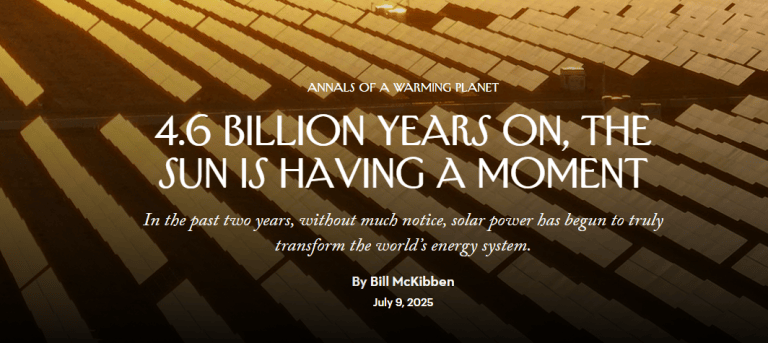
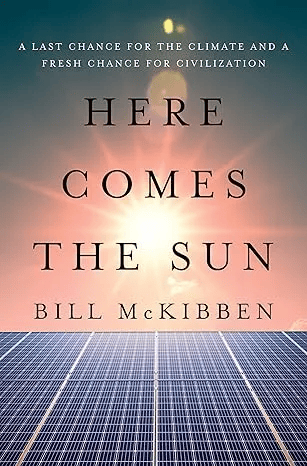
The following essay review was written by AI and edited by Intellicurean from a New Yorker article titled “4.6 Billion Years On, The Sun Is Having A Moment”, by Bill McKibben from his forthcoming book “Here Comes The Sun”.
Much like a seasoned playgoer at a modern drama, we find ourselves watching the improbable and the inevitable perform a dizzying pas de deux. For decades, renewable energy existed on the fringe—a topic for earnest environmentalists, academic dreamers, and early adopters armed with more zeal than capital. One recalls the almost quaint marvel of the first all-solar house at the University of Delaware in 1973, drawing curious crowds like pilgrims to a modern oracle. It was a novelty, an “alternative” to the fossil-fueled behemoth that powered Western economies for two centuries. And “alternative” was the key word—suggesting not a contender, but a polite afterthought.
Yet as we move through the mid-2020s, a stunning twist has unfolded, largely unnoticed amid louder headlines. With little fanfare, renewable energy has shifted from a peripheral ideal to a mainstream economic reality. In a world often held hostage to political drama and climate paralysis, this shift—documented in a recent New Yorker piece drawn from Bill McKibben’s forthcoming book, Here Comes the Sun: A Last Chance for the Climate and a Fresh Chance for Civilization (August 2025)—feels both miraculous and overdue. What was once “too good to be true” is now simply true. Solar, wind, and battery storage have become the most cost-efficient, fastest-growing power sources on Earth. The implications are nothing short of a new Industrial Revolution—only this time, it’s clean, decentralized, and increasingly democratic.
The statistics McKibben explores in the excerpted material are not dry metrics—they’re signals of an epochal shift. It took nearly seventy years from the invention of the photovoltaic cell in 1954 to reach the first terawatt of installed solar power by 2022. The second terawatt arrived by 2024. The third? Expected by 2026. Solar is now being added at a rate of one gigawatt—equivalent to a coal plant—every fifteen hours. Wind power, a cousin to solar in its dependence on planetary physics, isn’t far behind.
Globally, renewables met 96% of new electricity demand in the past year. In the U.S., the figure was 93%. Fossil fuels, once the uncontested monarchs of modernity, are losing their crown. In March, for the first time, fossil fuels generated less than half of all U.S. electricity.
California provides a dramatic case study. In May, the state—now the fourth-largest economy in the world—hit a record: renewable sources produced 158% of its power demand. Over the entire day, they delivered 82% of electricity consumed. This wasn’t theoretical progress—it was operational proof.
Equally revolutionary is the rise of energy storage. Battery deployment has surged 76% this year alone. These systems often act as California’s overnight power source, stabilizing the grid when sunlight fades or wind slows. One official from the North American Electric Reliability Corporation noted, “batteries can smooth out some of that variability from those times when the wind isn’t blowing or the sun isn’t shining.” The result? California now uses 40% less natural gas than it did just last year—a number McKibben hails as “the single most hopeful statistic I’ve seen in four decades of writing about the climate crisis.”
Even Texas, synonymous with oil and gas, is rapidly rebranding its energy identity. In March, it set records for solar, wind, and battery output. During a brutal May heatwave, over a quarter of its power came from renewables. By adding 10,000 megawatts of clean capacity, Texas slashed emergency blackout risk from 16% last year to less than 1% now. This isn’t green idealism—it’s grid-level, boots-on-the-ground practicality.
But the scale of change in the U.S. pales in comparison to what’s happening in China. More than half the world’s renewables and batteries are now installed within Chinese borders. In May alone, China added 93 gigawatts of solar—equivalent to one gigawatt every eight hours. The environmental payoff is immediate: carbon emissions dropped in the first quarter of 2025, with electricity-linked emissions falling nearly 6% as solar and wind displaced coal. Nearly half of all vehicles sold in China this year were electric or hybrid.
This trend isn’t isolated—it’s contagious. South America, once planning 15 new coal plants, now plans none. India’s solar output surged so rapidly in early 2025 that coal consumption plateaued while natural gas use fell by a quarter. Even Poland, long a coal bastion, saw solar outstrip coal in May. These aren’t anomalies—they’re geopolitical rewrites.
And why? Because solar is now the cheapest, fastest path to power. China’s relentless innovation has driven battery costs down by 95% in 15 years. In just the first half of 2024, the U.S. alone added 4 gigawatts of storage. A Chinese utility’s latest bidding round cut prices by another 30%. Grid-scale batteries now power entire cities for hours. Nations that ignore this transformation aren’t just polluting—they’re rendering themselves globally uncompetitive.
Even petro-states have noticed. Saudi Arabia, Qatar, and the UAE are all building massive solar fields. Their goal? 50% of electricity from solar by 2050. When oil empires go solar, the narrative has changed.
As with all revolutions, hindsight exposes how blind the experts were. In 2009, the International Energy Agency predicted 244 gigawatts of solar by 2030. That benchmark was reached by 2015. Their forecasts over the last decade missed by an average of 235%. The only group that got it close? Greenpeace.
Jenny Chase of Bloomberg, quoted in the book, admitted: “If you’d told me nearly 20 years ago what would be the case now… I would have laughed in your face.” The contrast between establishment analysts and environmentalists makes for a satisfying, if sobering, moment of vindication.
Perhaps the most radical reordering is happening in places least expected. In Pakistan, widespread solar adoption is quietly displacing national grid demand—not from recession, but from progress. Diesel sales are down 30%. Corn farmers now gift solar inverters as wedding dowries. Panels are laid flat on the earth without costly mounts. DIY TikTok tutorials fill the role of training programs. This is grassroots ingenuity—climate transition as community-driven liberation.
A similar story is emerging across Africa. In Namibia and Eswatini, rooftop solar accounts for 11–15% of peak electricity. In South Africa, small-scale solar now contributes nearly 20% of national grid capacity. Many of these systems go unreported, installed informally by citizens weary of blackouts. As energy analyst Joel Nana puts it: “This is happening anyway, whether you like it or not.”
What of minerals? What of land? These limits, once feared fatal, now seem manageable.
Lithium, long considered a bottleneck, has seen prices drop even as demand rises. New sources have been discovered. More importantly, recycling systems are maturing. A 2023 Energy Transitions Commission report found that all materials needed to reach net zero by 2050 amount to less than the coal burned in a single year. Battery tech is also becoming more efficient—using less lithium, less silver, and recovering more materials post-use. One roof of solar panels can now power ten replacements over 25 years. That’s not just sustainability—it’s a virtuous cycle.
Land, too, is more abundant than assumed. Rooftops and parking lots help, but a more powerful solution lies in reclaiming farmland used for ethanol. A single acre of solar produces as much energy as 100 acres of corn-based ethanol. Cornell researchers found that converting under half of U.S. ethanol fields could decarbonize the entire grid by 2050. That’s not fantasy. That’s arithmetic.
The obstacles now aren’t technical—they’re political. Thousands of renewable projects are stuck in “interconnection queues,” awaiting utility approval. The Biden Administration has taken steps to clear these logjams. But the Trump Administration is actively trying to reverse course, propping up coal and gas, and demonizing renewables. One appointee—formerly a fracking executive—labeled solar “a parasite on the grid.” That’s not science. That’s theater.
Ironically, such obstruction may accelerate the global transition. Nations are increasingly wary of U.S. energy instability and looking elsewhere. Wall Street sees the trend clearly: renewables are not just climate solutions, but hedges against geopolitical volatility. A 2023 global poll found that 68% of people support solar energy—five times more than fossil fuels. Even among likely Trump voters, 87% support clean energy tax credits. The political class may dither, but the public is marching forward.
The most profound feature of this transition may be its structure. Fossil fuels are scarce, located in select pockets, and easy to monopolize. But solar and wind are everywhere. You can’t own the sun. You can’t weaponize the wind. What this means geopolitically is staggering. Wars have been fought over oil. No one’s going to invade for sunshine.
And that’s the quiet promise of this revolution. Decentralized power doesn’t just decarbonize economies—it redistributes agency. It empowers individuals, communities, and nations to unshackle themselves from legacy dependencies.
Paradigm shifts of this magnitude—the Industrial Revolution, the rise of computing—rarely announce themselves with fireworks. But when they arrive, they redefine everything.
The insights drawn from McKibben’s forthcoming book deliver that quiet shock. What emerges is not speculation, but evidence. A meticulously documented, unapologetically optimistic vision of a world poised on the edge of salvation—not by hope alone, but by hard math, falling prices, and widespread will.
The sun, it seems, is not merely rising. It is conquering.

TIMES LITERARY SUPPLEMENT: The latest issue features ‘American Dreamer’ – On the enduring greatness of Gatsby; Tear down the museums?; Big tech is watching you; A new Locke manuscript; The ultimate declutter and An epic bromance for our times…
What makes a novel of ideas? By Benjamin Markovits
The centre left has joined the populist right in despairing of good government By Sam Freedman