
The New York Review of Books · December 17, 2026
Markets, Mystics & Moors
Two histories of capitalism, the trickster Carlos Castaneda, and the elusive Emily Brontë
The December 17 issue of The New York Review of Books is about the stories we inherit and the stories we are sold. Suzanne Schneider weighs two new histories of capitalism and asks whether we can still imagine a world beyond it. Nathaniel Rich follows the hoaxer and cult leader Carlos Castaneda through a 658-page biography that he says feels like an indoctrination of its own. Lorrie Moore goes looking for Emily Brontë, a writer who left almost no trace beyond one ferocious novel. Around them: Colm Tóibín on Douglas Stuart, France on the brink, Mexico’s killing fields, Virginia Giuffre’s memoir, Jacques-Louis David, and the art festivals of a greying Japan.
Here is the issue, with our notes on the threads that run through it.
The Cover
December 17, 2026
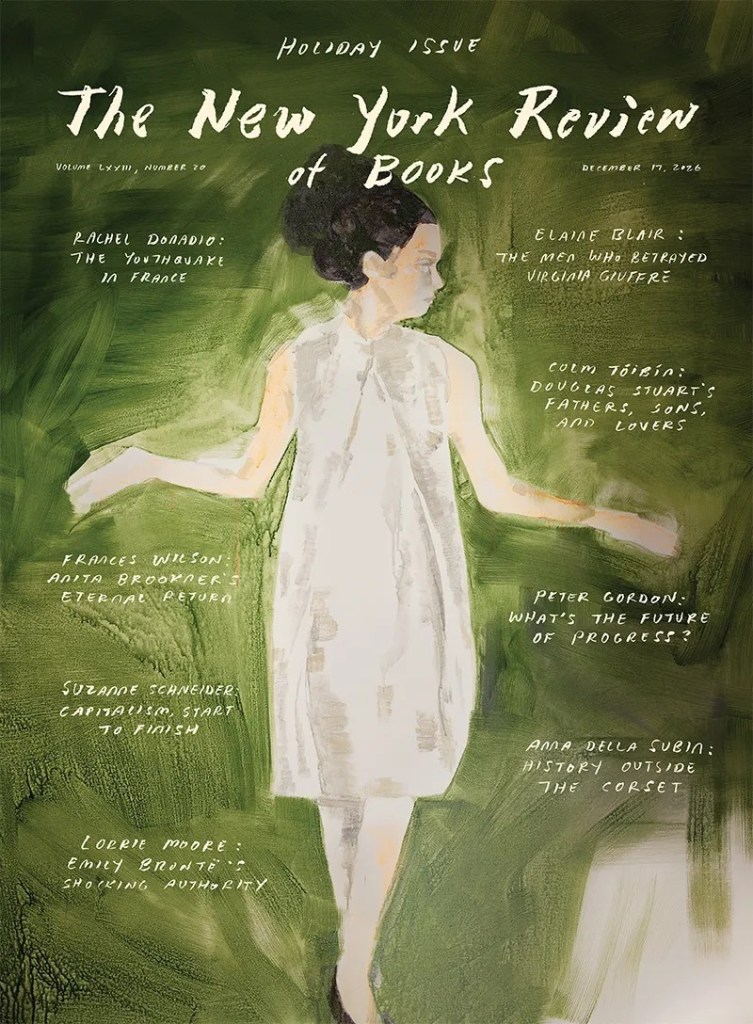
The issue’s cover features three pieces: Rachel Donadio on France in turmoil, Elaine Blair on Virginia Giuffre’s memoir, and Colm Tóibín on Douglas Stuart’s new novel, John of John.
Featured Reviews
By Suzanne Schneider · History & Economics
Schneider reviews Sven Beckert’s Capitalism: A Global History (Penguin Press, 1,325 pp., $49) and Trevor Jackson’s The Insatiable Machine: How Capitalism Conquered the World (Norton, 312 pp., $33.99). She opens with a striking fact: in 2015, as Britain cut £12 billion from welfare, the Treasury made its final payment on a loan taken out in 1835 to compensate slaveholders, a sum that had equalled 40 percent of the state’s budget.
Beckert’s millennium-long history begins in the merchant networks of the Islamic world and argues that capitalism was “born global” and made by states, through monopolies, conquest and what he calls war capitalism. Plantation islands such as Barbados were, he contends, its core rather than its periphery. Schneider admires the synthesis but finds his definition of capitalism so broad as to be clumsy, and his eleventh-century starting point arbitrary.
Jackson’s slimmer book offers a tighter definition, markets in land, labour and capital, and treats wage labour as the defining feature, with the seventeenth-century Dutch Republic as the first capitalist polity. Schneider finds that approach too rigid and is more persuaded by Beckert’s view that capitalism adapts to many labour regimes and kinds of state. Both authors agree that the state made the market, and that capitalism, being human-made, could be unmade, though neither offers much of a route out. Her closing point: with the right now souring on free trade and a president who treats politics and business as one, the old firewall between state and market looks more mythical than ever.
2. The Power of Magical Thinking
By Nathaniel Rich · Biography
Rich reviews Ru Marshall’s American Trickster: The Hidden Lives of Carlos Castaneda (OR Books, 658 pp., $30), the product of twenty years’ research. Castaneda, born César Arana in Cajamarca, Peru, in 1925, was a lifelong fabulist; Marshall notes that his given names amount to “savior trickster”. At UCLA he turned an unverifiable class paper into The Teachings of Don Juan (1968), a tale of a Yaqui sorcerer and hallucinogenic plants whose dates, details and borrowings collapse under scrutiny. The anthropology department let it through, Rich writes, out of flattery, laziness and cowardice, helped by the sociologist Harold Garfinkel, whose ethnomethodology held reality itself to be provisional.
Castaneda went on to sell millions of books, to inspire Obi-Wan Kenobi and the language of self-help, and to build a controlling, sexually exploitative cult around his “four winds” and paid Tensegrity classes, using love-bombing and isolation tactics familiar from other cults. Rich finds the biography sprawling and bewildering, a crowd of digressions about hoaxes, cults and the author’s own doubts, but timely: in an age of alternative facts, algorithmic feeds and chatbots that flatter us, Castaneda looks less like an oddity than a prophet. The man himself, Rich concludes, remains a shadow.
The review describes psychological and sexual abuse within Castaneda’s group.
By Lorrie Moore · Literature & Film
Moore reviews Deborah Lutz’s This Dark Night: Emily Brontë, a Life (Norton, 334 pp., $33.99) and Emerald Fennell’s film of Wuthering Heights. Where Elizabeth Gaskell had Charlotte Brontë’s letters, Emily left only three, so Lutz’s admirable biography must lean on educated guesses and careful hedging. What it makes vivid is the poverty and sickness of Haworth: an overcrowded churchyard fouling the water, a village life expectancy of twenty-five, children raised on porridge, and two older sisters lost to the brutal school at Cowan Bridge. Lutz also shows that Emily, with Anne, clung longest to the siblings’ imaginary kingdom of Gondal. Emily may have left a second novel, possibly destroyed by Charlotte; she died at thirty, three months after her brother Branwell, having refused all medical care.
Moore insists that Wuthering Heights is no swoony romance but a story of intergenerational cruelty and revenge, in which it is Hareton, loved and taught to read, who finally breaks the cycle; literacy, for Brontë, meant freedom. Of the films, she rates Andrea Arnold’s 2011 version the most intelligent. Fennell’s, with Jacob Elordi and Margot Robbie, has a strong close and a fine moment of grief from Elordi, but veers into lurid sexual fantasy.
Fiction & Lives
By Colm Tóibín · Fiction
Tóibín reviews Douglas Stuart’s John of John, in which a complex father-and-son drama plays out against a bleak Scottish island landscape.
By Frances Wilson · Biography
Reviewing Hermione Lee’s Anita Brookner: Art and Life, Wilson finds a strange and magnificent body of work spanning Brookner’s emotionally intense novels and her precise, careful art histories.
Arts
By Arya Roshanian · Opera
Missy Mazzoli’s opera of George Saunders’s Lincoln in the Bardo, with a libretto by Royce Vavrek, ran at the Metropolitan Opera from October 19 to November 14. Amid its chorus of voices, the grieving president becomes the emotional centre.
7. Painting to Transform the World
By Colin B. Bailey · Art
The Louvre’s recent Jacques-Louis David exhibition presented a painter whose politics and art were deeply intertwined.
By E. Tammy Kim · Japan
In rural Japan, a series of art festivals has sprung up to acknowledge, and try to confront, the country’s stark demographic future.
By Will Heinrich · Art
In Beverly Buchanan’s architecturally inspired work, at Andrew Edlin Gallery in New York until December 19, the real and the ideal do battle.
10. Punk Rocks
By Walker Mimms · Art
What are Bernhard Schobinger’s abrasive jewels trying to say? Mimms visits Going Underground at the Museum of Fine Arts, Houston, until January 3.
History & Ideas
By Anna Della Subin · History
On the historian Erin Maglaque and her new book, Presence: A Hidden History of the Female Body, which explores the sacred, the ordinary and the dissenting in the lives of early modern European women.
By Peter E. Gordon · Philosophy
The philosopher Rahel Jaeggi argues in Progress and Regression, translated by Robert Savage, that despite our disillusion with historical progress, the idea should be redefined, not abandoned.
By Brenda Wineapple · History
Nathaniel Philbrick’s The Rush: California Gold, the Civil War, and the Making of the Modern World shows how the rush to strike it rich in California reshaped the whole country.
The World
By Rachel Donadio · Politics
Five months before presidential elections in which the extreme right is widely expected to take power, France faces a debt crisis, a political crisis and a social crisis at once.
15. ‘Where Bodies Are Destroyed’
By Claudio Lomnitz · Mexico
When a collective of bereaved families found evidence of mass killings at a cartel-run ranch in Teuchitlán, they cast new light on Mexico’s networks of violence. Lomnitz reviews Sandra Romandía’s account of the Izaguirre ranch.
This review concerns mass killings.
16. Virginia’s World
By Elaine Blair · Memoir
Virginia Giuffre’s memoir, Nobody’s Girl, illuminates a network of abuse that reached far beyond Jeffrey Epstein and implicated many other, much less powerful men.
This review concerns sexual abuse.
Letters
17. Lamarck, Get Set, Go: An Exchange
Jessica Riskin, George Levine, Peter Candell, Victor I. Reus and others · Letters
Readers and Riskin debate the legacy of Jean-Baptiste Lamarck.
Poems
Poetry
Aaron Poochigian’s “The Dead Mall”, and two poems by Tamara Barnett-Herrin, “City” and “Fall”. Best read whole, in the issue.
The Threads
Invented lives. Castaneda’s fabricated self, the scanty record of Emily Brontë, and the myths that capitalism tells about its own birth: three reviews about stories that outlive the facts. (2, 3, 1)
Power and its victims. Capitalism’s violent beginnings, a cult built on control, Giuffre’s account of abuse beyond Epstein, and Mexico’s ranch of horrors. (1, 2, 16, 15)
American dreams. The Gold Rush, a grieving Lincoln and a Peruvian trickster who found fame in Los Angeles. (13, 6, 2)
Futures in doubt. Imagining life after capitalism, redefining progress, France braced for the far right, and Japan’s ageing villages turning to art. (1, 12, 14, 8)
Art and politics. David’s revolutionary canvases, Buchanan’s battles between real and ideal, and Schobinger’s punk jewels. (7, 9, 10)
Before You Close the Issue
Capitalism’s origin myths, Castaneda’s sorcerer and the Brontë legend all survived because people stopped asking questions. Which stories are we still living inside?
Drawn from The New York Review of Books, December 17, 2026. The views summarised are those of its reviewers. Visit the homepage at nybooks.com.
— The Editors, Intellicurious —

