
Science · 26 November 2026
Milk, Ice & Immunity
What’s in a mother’s milk, polar ice melting from below, and a gentler weapon against autoimmune disease
This week’s Science puts motherhood under the microscope. Its cover research uses multiomics to read the nutritional make-up of human milk from mothers in several countries, and asks how diet, health and supplements change it. The news pages, meanwhile, find warm water eating polar sea ice from below, a safer-looking way to tame autoimmune disease, China quietly importing thousands of research monkeys, and a fruit-fly brain map that has finally been given a body.
Here is the issue, with our notes on the threads that run through it.
The Cover
Cover Research · Pages 964 & 965
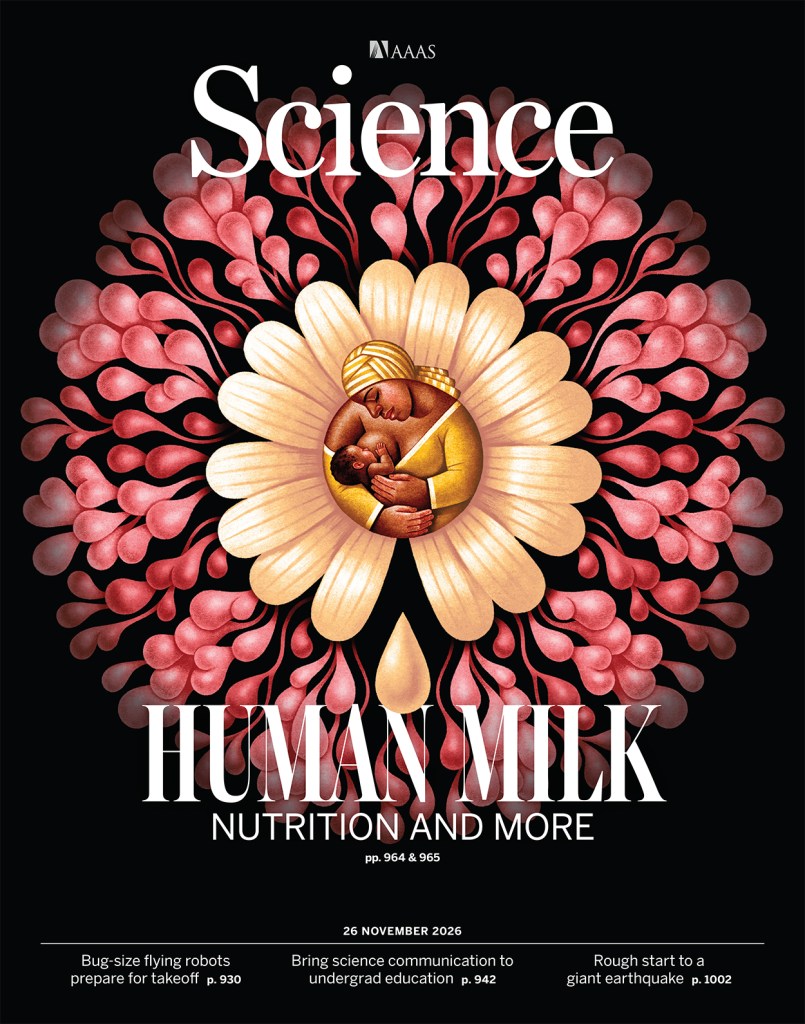
Applying cutting-edge multiomics techniques to human milk samples from mothers in several countries, researchers examined how maternal health and diet shape the milk’s nutritional content, and assessed the potential benefits of supplementing mothers with different kinds of nutrients. The work is presented on pages 964 and 965.
On the cover, Miriam Martincic’s illustration places a nursing mother and infant at the heart of a flower ringed by mammary glands, one of its petals turning into a drop of milk.
Editorial
2. Rebuilding Science’s Social Contract with the Public
By Colette Delawalla · Editorial
Delawalla’s editorial considers how to rebuild the relationship of trust between science and the public.
News in Depth
3. China Has Been Quietly Importing Thousands of Research Monkeys
By Refael Kubersky · News in Depth
The animals are coming from Cambodia, a country that has been accused of laundering wild-caught primates.
4. At Both Poles, Warm Water Is Eating Away Sea Ice from Below
By Paul Voosen · News in Depth
For decades Arctic sea ice shrank while Antarctic sea ice puzzlingly grew. Then, in 2015, ice failed to form around Antarctica over an area twice the size of Greenland, with new lows in 2022 and 2023. A run of new studies now explains why. Drawing on more than 100,000 ocean profiles from robotic Argo floats, sensor-carrying seals and ships, Theo Spira of the Alfred Wegener Institute and colleagues found that the cold layer insulating Antarctic ice from warmer water below thinned by about 2 metres a year in the decade before 2015; strong winds then broke it down, letting heat well up. Teams led by Earle Wilson at Stanford and Aditya Narayanan at the University of New South Wales reached the same conclusion by other routes.
The Arctic has been on this path longer, as warm, salty Atlantic water breaks through its own cold layer, a process called Atlantification; record-low winters in 2025 and 2026 have restored a clear downward trend. Spira sees little prospect of the Antarctic layer recovering. The losses matter well beyond polar bears and penguins: Antarctic sea ice shields glaciers from ocean heat, and Arctic ice loss can affect weather as far away as West Africa. The tale of two poles, Voosen concludes, has become one story.
5. Are T Cell Engagers the Next Big Thing in Autoimmune Disease Treatment?
By Mitch Leslie · News in Depth
Engineered CAR-T cells have produced remarkable, even drug-free, remissions in lupus and other autoimmune diseases, but deaths in trials have been sobering: Novartis halted eight trials after three participants died, and a patient in a Bristol Myers Squibb trial for multiple sclerosis died of septic pneumonia. Researchers are now turning to T cell engagers, lab-made antibodies that handcuff a patient’s ordinary T cells to the rogue B cells that drive disease. In a phase 1 trial in 12 people with lupus, one engager caused no serious side effects and quelled symptoms in some for at least a year.
More than 50 trials are under way, and drugmakers are paying billions for the technology. Engagers can be mass-produced, stored and often injected, need no chemotherapy beforehand, and can be dosed gradually. They are not risk-free, however: they can trigger dangerous cytokine surges and infections, and some patients relapse. The next frontier, researchers say, is engagers that kill only the harmful B cells and spare the rest.
6. Europe Looks Past Its Giant Telescope to Its Next Big Bet
By Daniel Clery · News in Depth
With its 39-metre Extremely Large Telescope nearly complete, the European Southern Observatory is weighing bids for its next-generation instrument.
7. Fruit Fly Brain Map Gets a Body
By Kelly Servick · News in Depth
A modelling effort aims to predict how activity in the fly’s mapped neurons drives its movements.
Feature
By Phie Jacobs · Feature
When will insect-sized flying robots be ready for takeoff? Jacobs investigates.
Commentary
9. Moving Beyond Hyperscale Ambitions for AI Infrastructure in Africa
By Chinasa T. Okolo · Expert Voices
Okolo argues that Africa’s approach to AI infrastructure should look beyond the race for giant hyperscale data centres.
The contents we received run to Expert Voices; the issue’s Perspectives, Policy Forum, Books, Research and Careers sections are in the full table of contents.
The Threads
Bodies, decoded. Multiomics reading a mother’s milk, antibodies that rewire the immune system, and a fly brain wired to a virtual body. (1, 5, 7)
Hidden depths. Warm water lurking beneath polar ice, rogue B cells hiding among healthy ones, and nutrients in milk that only new tools can measure. (4, 5, 1)
Trust and its supply chains. An editorial on science’s bargain with the public, research monkeys of uncertain origin, and a call for AI infrastructure that fits Africa’s needs. (2, 3, 9)
Big and small machines. Europe’s 39-metre telescope and its successor, and robots the size of insects. (6, 8)
Before You Close the Issue
The biggest changes in this issue happen out of sight, beneath the ice, inside the immune system, in a drop of milk. What else is shifting where we aren’t looking?
Drawn from Science, Volume 394, Issue 6827, 26 November 2026. Visit the homepage at science.org.
— The Editors, Intellicurious —

