
Science · 19 November 2026
Bees, Bits & Bow Ties
Quantum contextuality, ghost chemicals, bumble-bee minds and the return of measles
This week’s Science puts one of the strangest features of quantum theory on its cover and shows it doing real work: a game that no classical device can win every time, won on a superconducting quantum processor. Around it, the issue hunts for chemicals no one knew were there, finds clues to the origins of intelligence in the bumble bee, records a mouse’s whole developmental history in its DNA, and reports on measles, AI mathematicians and a new to-do list for American physics.
Here is the issue, with our notes on the threads that run through it.
The Cover
Quantum Contextuality: Beating the Classical Odds
Cover · 19 November 2026
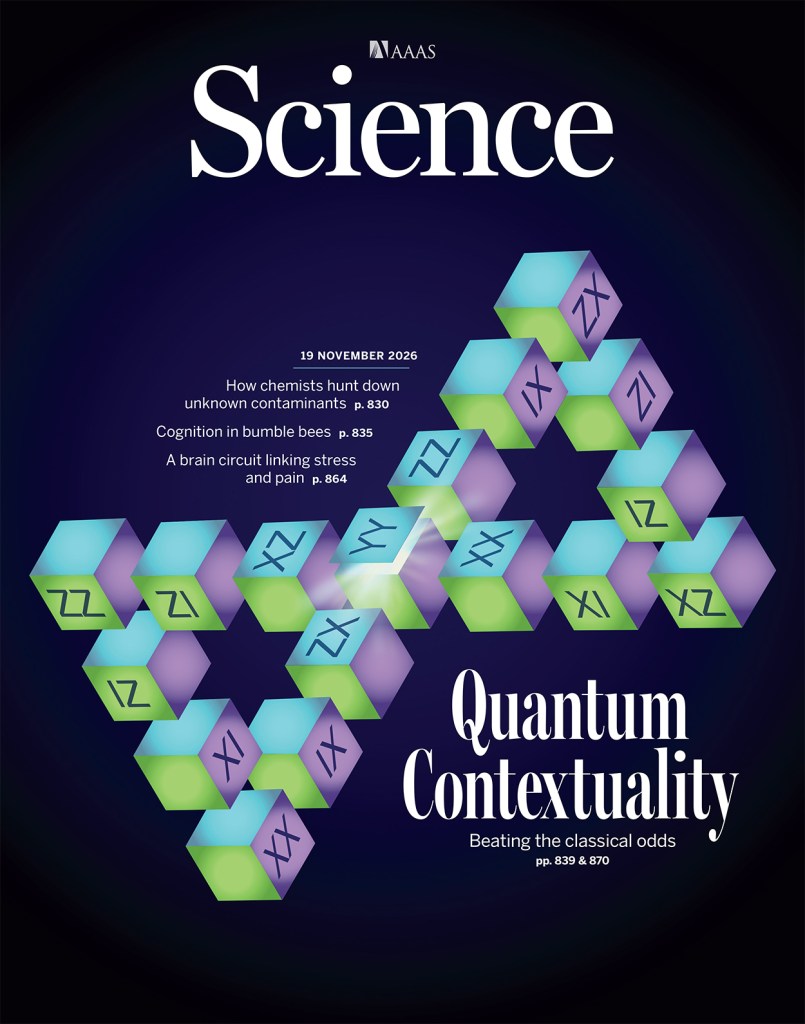
Glowing cubes in cyan, green and violet float against a deep navy field, each face stamped with a pair of letters, ZZ, XI, YY and the like, naming measurements made on pairs of qubits. Stacked together, the cubes form an impossible bow tie, a figure that cannot exist in three dimensions, with a burst of light at its crossing point. The picture stands for the issue’s cover research: by running a sequence of measurements on a superconducting quantum processor, researchers won a game that classical resources alone cannot always win.
The Cover Story
Rui Soares Barbosa · Perspective · pp. 839 & 870
In quantum theory, the result of a measurement can depend on which other measurements are made alongside it, a property called contextuality that has no counterpart in classical physics and is key to quantum algorithms. The accompanying research article turns that puzzle into a game and plays it on a superconducting processor, beating the classical limit. Barbosa argues that the paradox at the heart of quantum theory could now serve a practical purpose, as a benchmark for quantum computers.
In Depth
2. Measles Comeback in U.S. Adds to Global Resurgence
By Gretchen Vogel · In Depth
Eroding trust, shrinking funding and political strife have helped an easily preventable disease return, in America and around the world.
3. AI Rivals Take On One of Physics’ Hardest Math Problems
By Jacklin Kwan · In Depth
OpenAI and a group associated with Anthropic have both made progress on Yang-Mills theory, the mathematics behind the fundamental forces, whose existence and “mass gap” problem is one of the Clay Institute’s million-dollar Millennium Prize Problems.
4. DOE to Delay Atom Smasher and Speed AI, Quantum, and Fusion Projects
By Adrian Cho · In Depth
The Department of Energy’s first new list of priority facilities in 23 years pushes back a particle collider and moves AI, quantum and fusion projects up the queue, reflecting both fast-moving science and tighter budgets.
5. Killing More Sea Lions Won’t Help Endangered Salmon Recover, Model Suggests
By Erik Stokstad · In Depth
A surprising result, at odds with earlier studies, complicates the policy argument over culling sea lions to protect salmon.
6. Chinese Gene-Therapy Researchers Fired After Probe Into Child’s Death
By Brendan Borrell · In Depth
Dismissals and institutional sanctions have followed an investigation into a child’s death during a gene-editing trial.
Feature
By Perri Thaler · Feature · p. 830
Most testing finds only the pollutants chemists already know to look for. Thaler reports on the new tools that let them hunt down unknown contaminants, revealing a hidden world of chemical pollution.
Commentary & Perspectives
8. Making Ecological Programs Work at Scale
Yuanning Liang · Expert Voices · Free to read
An expert view on what it takes for ecological programmes to succeed when they are expanded to a large scale.
Lars Chittka & Stanley Heinze · Perspective · p. 835 · Free to read
Bumble bees, with brains smaller than a grain of rice, can learn and solve problems in ways that surprise researchers. Chittka and Heinze argue that they offer clues to the origins of intelligence itself.
10. Mammalian Development, Recorded and Decoded
Arman Adel & Nozomu Yachie · Perspective
Two genome-editing approaches have produced detailed maps of how cells descend from one another as a mouse develops before birth. One of them, the DNA Typewriter, writes a running record into the genome itself, tracing a mouse’s cell lineage from the fertilised egg to late organ formation.
Also in the Issue
11. A Brain Circuit Linking Stress and Pain
Research · p. 864
One of the issue’s cover lines: a study of the neural circuit through which stress and pain are connected.
The Threads
Making the invisible legible. Unknown chemicals revealed by new instruments, a cell’s family history written into DNA, and quantum behaviour that only shows up in the pattern of many measurements. (1, 7, 10)
Where intelligence comes from. Bees with tiny brains, AI systems taking on a millennium problem, and a circuit that ties stress to pain. (3, 9, 11)
Evidence meets policy. Measles returns where trust and funding fail, a model questions the case for culling sea lions, a government reorders its science priorities, and a death in a gene-editing trial brings sanctions. (2, 4, 5, 6)
Before You Close the Issue
If a bee’s tiny brain can hint at the origins of intelligence, and a quantum chip can win a game no classical machine can, what else are we underestimating?
Drawn from Science, 19 November 2026. Visit the homepage at science.org.
— The Editors, Intellicurious —

