
Tag Archives: Gaza

The Economist Magazine – April 6, 2024 Preview

China’s risky reboot

The Economist Magazine (April 4, 2024): The latest issue features China’s risky reboot; Trump and nuclear deterrence; Latin America’s right-wingers; Why India’s elite love Modi and more…

Xi Jinping’s misguided plan to escape economic stagnation

It will disappoint China’s people and anger the rest of the world

Central banks have spent down their credibility

That will make inflation trickier to handle in future

Beware a world without American power

Donald Trump’s threat to dump allies would risk a nuclear free-for-all

Politics: The Guardian Weekly – April 5, 2024

Image

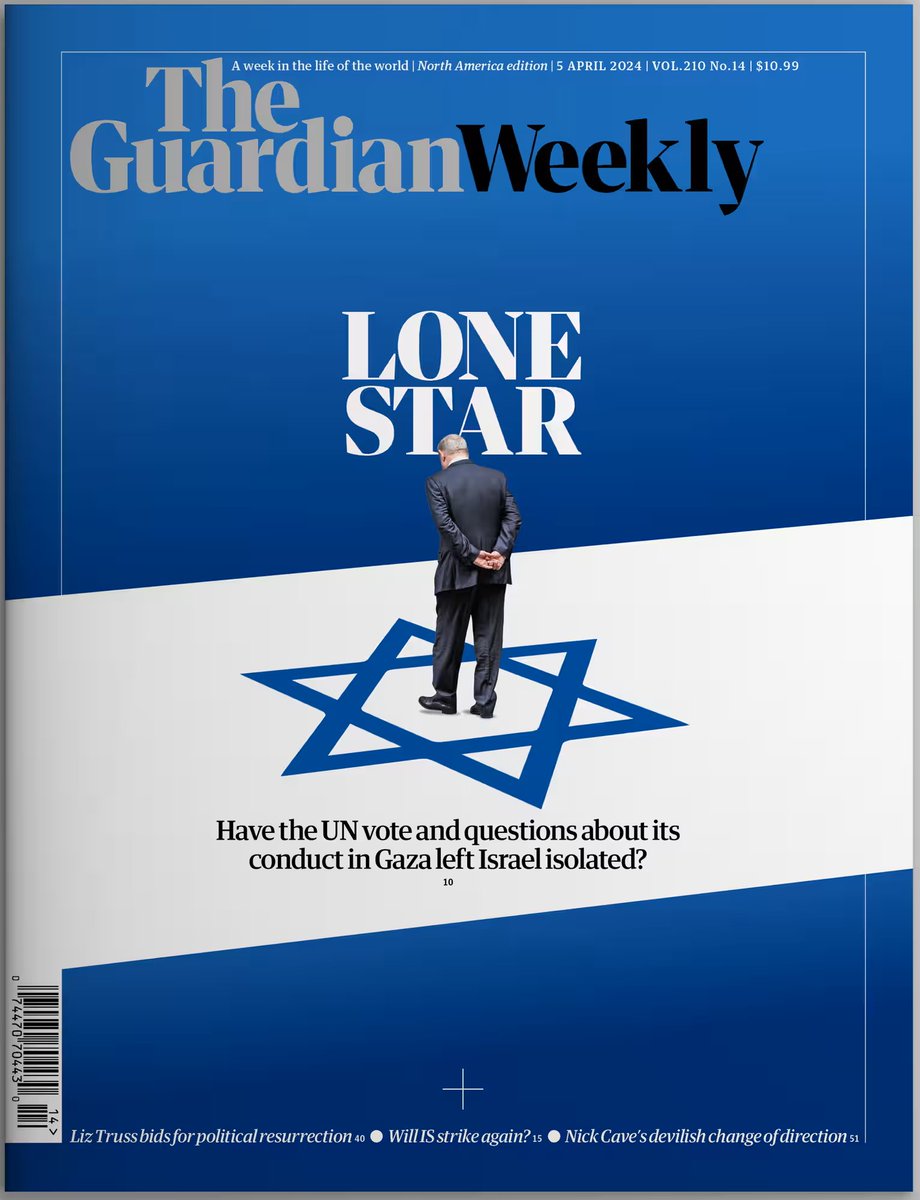
The Guardian Weekly (April 5, 2024) – The new issue features ‘Lone Star’ – Have the UN vote and questions about its conduct in Gaza left Israel isolated?; Liz Truss bids for political resurrection; Will IS strike again?; Nick Cave’s devilish change of direction…

Spotlight | IS affiliates could launch new wave of terror on the west

Islamic State has stalled in Iraq and Syria but officials believe it has been planning new attacks on the west for years, reports Jason Burke; while Angelique Chrisafis writes that France’s interior minister has met intelligence services to assess the terrorist threat to the country ahead of this summer’s Olympic Games

Environment | True cost of a city built from scratch

Nusantara is billed as a state-of-the-art capital city that will coexist with nature – but not all residents of Borneo’s Balikpapan Bay are happy, find. By Rebecca Ratcliffe and Richaldo Hariandja

Feature | 49 days later

Liz Truss trashed the economy as Britain’s shortest-serving prime minister. But she is back, launching a new conservative movement and spreading her ideology across the world. You just can’t keep a bad politician down, argues David Runciman

Culture | The devil in the details

In the past nine years, Nick Cave has lost two sons – an experience he explores in a deeply personal new ceramics project. He discusses mercy, forgiveness, making and meaning with Simon Hattenstone

Architecture | A Māori-built environment

A new wave of Indigenous architects are behind a series of stunning buildings embracing tribal identity in Aotearoa New Zealand, Oliver Wainwright discovers

Sunday Morning: Stories And News Analysis From London, Zürich & Istanbul

Monocle on Sunday, March 31, 2024: Emma Nelson, Charles Hecker and Yossi Mekelberg on the weekend’s biggest talking points.

We also speak to Monocle’s editorial director, Tyler Brûlé, in Zürich and get the latest on Turkey’s local elections with Monocle’s Istanbul correspondent, Hannah Lucinda Smith.

The Economist Magazine – March 30, 2024 Preview

The Economist Magazine (March 21, 2024): The latest issue features

The AI doctor will see you…eventually

A doctor with a computer screen head displaying a loading icon

Artificial intelligence holds huge promise in health care. But it also faces massive barriers

Better diagnoses. Personalised support for patients. Faster drug discovery. Greater efficiency. Artificial intelligence (ai) is generating excitement and hyperbole everywhere, but in the field of health care it has the potential to be transformational. In Europe analysts predict that deploying ai could save hundreds of thousands of lives each year; in America, they say, it could also save money, shaving $200bn-360bn from overall annual medical spending, now $4.5trn a year (or 17% of gdp). From smart stethoscopes and robot surgeons to the analysis of large data sets or the ability to chat to a medical ai with a human face, opportunities abound.

The triple shock facing Europe’s economy

After the energy crisis, Europe faces surging Chinese imports and the threat of Trump tariffs

Russia is gearing up for a big new push along a long front line

Ukraine must prepare

Antarctica needs a lot more attention

Melting ice sheets do more than raise sea levels

Sunday Morning: Stories And News Analysis From London, Paris And Vienna

Monocle on Sunday, March 24, 2024: Emma Nelson, Nina dos Santos and David Bodanis on the weekend’s biggest talking points.

We also speak to Monocle’s editorial France and North Africa correspondent, Mary Fitzgerald, and our Vienna correspondent, Alexei Korolyov, for the latest on the Slovakia elections.

The Economist Magazine – March 23, 2024 Preview

Image

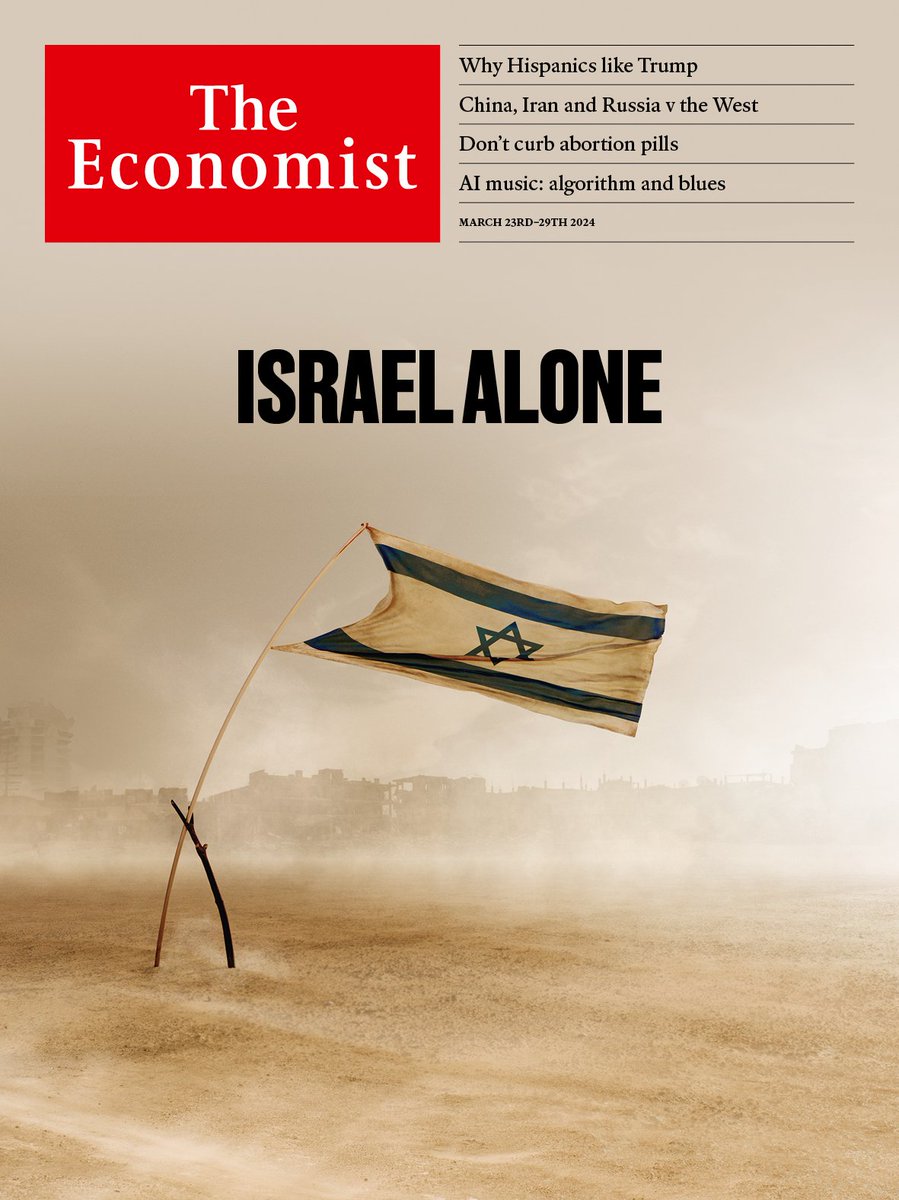
The Economist Magazine (March 21, 2024): The latest issue features ‘Israel Alone’ – At a moment of military might, Israel looks deeply; ‘How To Trade An Election’ – It is getting harder for investors to ignore politics; China, Iran and Russia versus The West – Assessing the economic threat posed by the anti-Western axis…

At a moment of military might, Israel looks deeply vulnerable

The flag of Israel being blown in a sandstorm

America should help it find a better strategy

There is still a narrow path out of the hellscape of Gaza. A temporary ceasefire and hostage release could cause a change of Israel’s government; the rump of Hamas fighters in south Gaza could be contained or fade away; and from the rubble, talks on a two-state solution could begin, underwritten by America and its Gulf allies. It is just as likely, however, that ceasefire talks will fail. That could leave Israel locked in the bleakest trajectory of its 75-year existence, featuring endless occupation, hard-right politics and isolation. Today many Israelis are in denial about this, but a political reckoning will come eventually. It will determine not only the fate of Palestinians, but also whether Israel thrives in the next 75 years.

How to trade an election

It is becoming harder for investors to ignore politics

Illustration of a ballot box falling onto a piggy bank.

Investors differ in their approach to elections. Some see politics as an edge to exploit; others as noise to block out. Even for those without a financial interest, markets offer a brutally frank perspective on the economic stakes. As elections approach in America and Britain, as well as plenty of other countries, that is especially valuable.

Sunday Morning: Stories And News From London, Lisbon And Nairobi, Kenya

Monocle on Sunday, March 17, 2024: Emma Nelson, Terry Stiastny and Stephen Dalziel on the weekend’s biggest talking points. We also speak to Monocle’s editorial director, Tyler Brûlé, in Lisbon and Naveena Kottoor, Monocle’s correspondent in Nairobi.

Sunday Morning: Stories And News From Zürich 

Monocle on Sunday, March 10, 2024: Eemeli Isoaho, Juliet Linley and Benedikt Germanier join Monocle’s editorial director, Tyler Brûlé, to discuss the weekend’s hottest topics.

We speak to Monocle’s senior foreign correspondent, Carlota Rebelo, for the latest on Portugal’s elections and Monocle’s editor in chief, Andrew Tuck, joins us from London. Plus: authors Alex Dahl and Thomas Enger join Tyler in Zürich to discuss Norwegian crime fiction.

The Economist Magazine – March 9, 2024 Preview

And they’re off. What could upend America’s election?

The Economist Magazine (March 7, 2024): The latest issue features Three big risks that might tip America’s presidential election – Third parties, the Trump trials and the candidates’ age introduce a high degree of uncertainty; Xi Jinping’s hunger for power is hurting China’s economy; How to fix the Ivy League – Its supremacy is being undermined by bad leadership…

And they’re off. What could upend America’s election?

Politics: The Guardian Weekly – March 8, 2024

Image

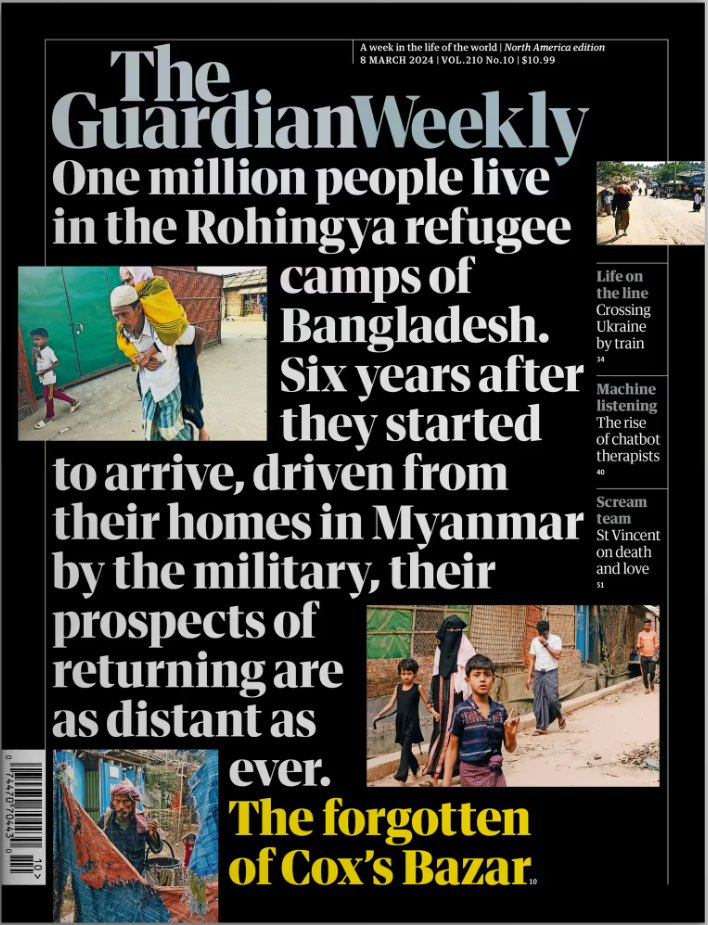
The Guardian Weekly (March 7, 2024) – The new issue features Faint hope of return for Rohingya people. Plus: a journey through Ukraine

It was August 2017 when the world really started to take note of Myanmar’s Rohingya people. Descendants of Arab Muslims who speak a different language to most other people in Myanmar, the Rohingya had up to that point lived mainly in the northern Rakhine state, coexisting uneasily alongside the majority Buddhist population.

But the Rohingya were reviled by many as illegal immigrants and treated by the then government as stateless people. In 2017, when violence broke out in the north of the state, security forces supported by Buddhist militia launched a “clearance operation” that forced more than 1 million Rohingya people to flee their homes and the country, actions that many onlookers saw as ethnic cleansing. Most Rohingya were driven into vast refugee camps in the Cox’s Bazar region of Bangladesh, where they have remained ever since.

The Guardian global development reporter Kaamil Ahmed has been covering the Rohingya crisis for almost a decade, making multiple trips to the region. For this week’s Big Story, Kaamil returned to Cox’s Bazar where, in two moving reports, he details how disease and illness are widespread in the ramshackle camps, and how the desperation to escape has resulted in rich business for people traffickers.

And, with Myanmar now controlled by a military junta and introducing a deeply unpopular conscription drive (as Rebecca Ratcliffe and Aung Naing Soe report), the prospect of any Rohingya people being able to return home to Rakhine state remains as distant as it did in 2017.