
Times Literary Supplement · November 27, 2026
Plots, Princesses & Prints
A history of the British novel found wanting, McGahern’s Ireland, Diana’s brother and Hokusai’s Fuji
This week’s Times Literary Supplement opens with a reviewer who wanted to love a book and could not: Daniel Karlin on Philip Hensher’s new history of the British novel. Around it, Eimear McBride weighs the first authorised life of John McGahern, Frances Wilson reads Charles Spencer’s sharp-edged memoir of his sister Diana, and Boyd Tonkin follows Hokusai’s Fuji to south London. Beyond them lie Roman dogs, the Jews of Venice, a medieval rape trial, novels about composers, and a narcissist bound for Mars.
Here is the issue, with our notes on the threads that run through it.
The Cover
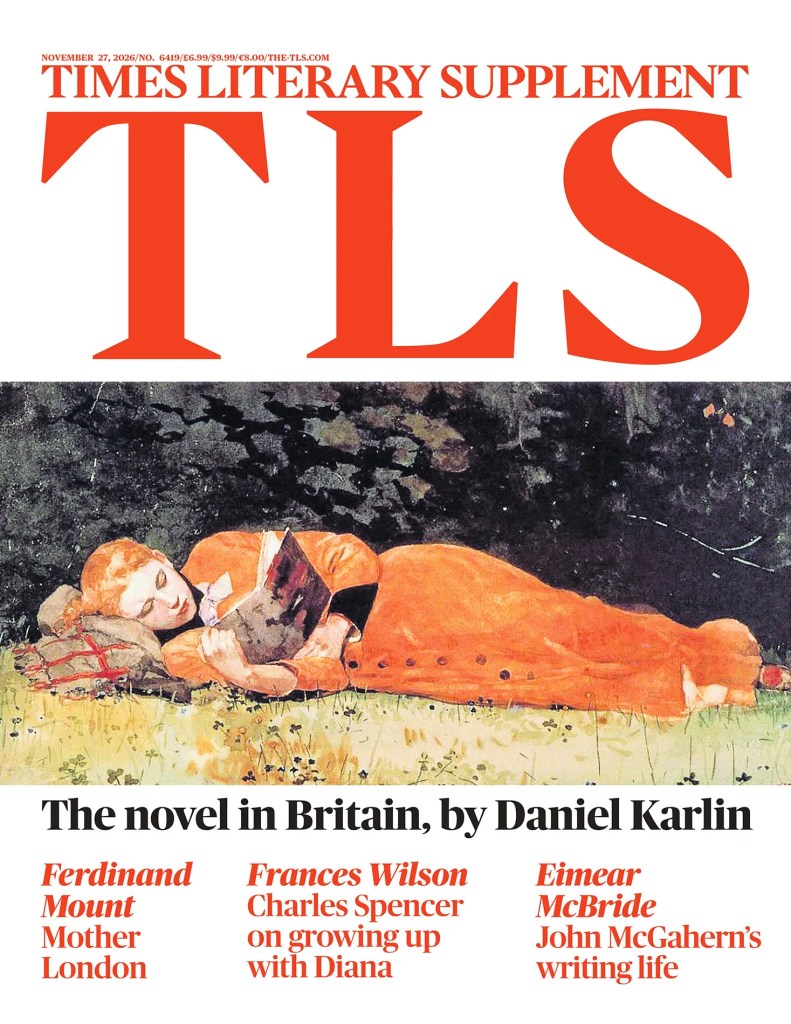
Cover · November 27, 2026
The cover sets the lead review’s headline over a detail from Private Conversation (1899), one of the hushed, faintly conspiratorial domestic interiors of the Swiss-born painter Félix Vallotton. It is an apt image for an issue so preoccupied with what people say to one another in private, and what novels, memoirs and diaries later make of it.
Lead Reviews
1. The Plot Against the Novel: British Fiction’s Quest for Freedom
By Daniel Karlin · British Literature
Karlin reviews Philip Hensher’s A History of the Novel in Britain (Pelican, 704pp, £25) and finds, to his regret, that he cannot recommend it: its one real virtue is swamped by its defects, and he thinks it the wrong book for Hensher to have written. That virtue is love. Hensher is an amateur in the old, honourable sense, reading widely and unashamedly for pleasure, from Defoe to Zadie Smith, and he can illuminate a book in a single phrase, as when he calls Samuel Selvon’s The Lonely Londoners not a comic novel but one “into which laughter enters”.
Karlin enjoys Hensher’s championing of favourites such as Thackeray, Trollope, Arnold Bennett, Ivy Compton-Burnett, Nancy Mitford and Elizabeth Taylor, and his prizing of the novel’s energy, inventiveness and irresponsibility. Hensher distrusts fiction that has designs on its reader, especially the high-minded kind. For Karlin, though, these pleasures cannot rescue a book whose many defects, he argues, overwhelm them.
2. Embracing Contradiction: John McGahern and High Irish Style
By Eimear McBride · Biography
Twenty years after John McGahern’s death, McBride notes, his pale imitators are still multiplying, which makes Frank Shovlin’s John McGahern: A Writing Life (Faber, 496pp, £25), the first biography authorised by his estate, a timely reminder of what made the original so arresting. She sketches the fraught, dreary Ireland of the mid-century: civil-war scars unhealed, a near-theocracy in the ascendant, schools run on corporal punishment, and the Irish language deployed to keep foreign influence out.
McGahern himself credited British institutions, Penguin, the BBC and the Sunday papers among them, with giving the Irish their windows on the world. Shovlin even lists the ingredients of a “McGahernesque” novel, from the mother who dies young and the brutish father to the struggle with a religious vocation and the vividly observed countryside. McBride is struck by how such an Irish writer kept a lifelong fondness for England, and by an independence of mind that showed everywhere.
3. Althorp and After: An Astringent Memoir of Diana, Princess of Wales
By Frances Wilson · Biography
Charles Spencer’s Swan Song: Diana, My Sister (Michael Joseph, 384pp, £28) is, in Wilson’s judgement, meandering, barbed and bitter. Its most vivid pages are childhood anecdotes Spencer left out of his Westminster Abbey eulogy: the young Diana dispatching a thrashing conger eel with a penknife on a lobster-potting trip in Scotland; by his account, hooking a leg around their stepmother Raine and shoving her down the stairs at Althorp, and pushing her brother off a sea wall into the gorse below.
The Spencers, Wilson concludes, are a cruel tribe. She traces the damage back to the parents’ 1967 separation, when Frances Shand Kydd’s own mother gave evidence against her and the four children stayed with a father Wilson calls emotionally inadequate, and to a series of nannies, one of them violent.
4. Feasting on Blue: Hokusai’s Late-Career Flowering
By Boyd Tonkin · Visual Arts
At Dulwich Picture Gallery until January 17, the Iuchi Collection has lent its complete set of early impressions of Hokusai’s Thirty-Six Views of Mount Fuji, which in fact run to 46 prints, ten of them a supplement with a style of their own. The show includes two variant impressions of the Great Wave, an image Tonkin says now rivals the Mona Lisa as the world’s most reproduced and parodied artwork, and which since 2024 has appeared on the Bank of Japan’s 1,000-yen note.
Look at the work going on in these prints, Tonkin urges, and your attention shifts: the men beneath the clawing wave are crewing fast barges that carried fish to market, so a late-Edo supply chain becomes a drama of life and death. The series was late-life labour. Born poor in 1760, Hokusai had in the 1820s suffered a stroke, financial ruin and the death of his wife, and he signed these views with a name meaning “one again”.
Arts
By Rowland Bagnall · Visual Arts
Texture, vision and beauty in photography’s earliest experiments.
By Duncan Wheeler · Film
A new Spanish film that weaves together different timespans and narratives.
7. Antiheroes, Always in Retreat
By Rod Mengham · Visual Arts
Georg Baselitz’s figures of what the review calls a “destroyed society”.
History
By Katherine Harvey · Medieval History
Harvey reviews a study that investigates a medieval rape case.
By David Laven · History
Laven on a history of the Jews of Venice.
11. Die Like a Dog
By Catherine Steel · Ancient History
Steel examines the ritual killing of dogs in Roman Britain.
By Ferdinand Mount · Modern History
Mount follows London’s rise in the years after the fall of the Bastille.
Fiction
By Amanda Craig · Fiction
Craig reviews the long-awaited sequel to The Time Traveler’s Wife.
15. Finite Resources
By Esme Lloyd · Fiction
A novel about a narcissist preparing to leave for Mars.
By Peter Kemp · Fiction
A novel about the bond between Ralph Vaughan Williams and his teacher Maurice Ravel.
17. Shared Terrain
By Dinah Birch · Fiction
A new trilogy about the Irish composer John Field and the musician Adelaide Percheron.
19. On Her Own Terms
By Russell Williams · Fiction
A study of an uncompromising nature photographer.
Criticism & Letters
By Thomas Keymer · Literary Criticism
Keymer on Charles Lamb’s masterpiece, the essays of Elia.
21. Critical Spirit
By Sofia Cumming · Literary Criticism
Cumming on an eclectic twentieth-century thinker.
By David E. Wellbery · European Literature
Wellbery on the vocation of a German poet.
23. From the Frying Pan into the Mire
By Karen Leeder · European Literature
Leeder reviews the diaries of the singer-songwriter known as East Germany’s Bob Dylan, a member of the awkward squad.
By Kathryn Sutherland · British Literature
Sutherland on women novelists and the power of the periodical.
25. In Miniature
By Michèle Roberts · Literary Criticism
Roberts on a gathering of nineteenth-century short stories from around the world.
Books About Books
27. Sloane’s Range
By Melanie Bigold · Bibliography
Bigold on Hans Sloane’s collections, the bedrock of the British Library.
Poems
Poetry
The issue carries two new poems: Chris Orsman’s “Visiting Captain Scott, January 1998” and Fedir Rudyi’s “One day”. They are best read whole, in the issue.
The Threads
Family secrets. Charles Spencer’s bitter memoir of Diana, the first authorised life of McGahern, with its dying mother and brutish father, and a set of East German diaries all turn private life into public record. (3, 2, 23)
The novel’s long story. Hensher’s history, the women novelists who learned to disarm their reviewers, Lamb’s essays and a world of nineteenth-century short stories map the forms by which British readers have been entertained. (1, 24, 20, 25)
Music on the page. Vaughan Williams and Ravel, John Field and Adelaide Percheron, and a grieving London DJ: three novels set fiction to music. (16, 17, 18)
Ways of seeing. Hokusai’s Fuji, photography’s first experiments, Baselitz’s retreating antiheroes and an uncompromising nature photographer ask what an image can hold. (4, 5, 7, 19)
Hidden histories. A medieval woman’s testimony, the Jews of Venice, Roman Britain’s sacrificed dogs and Sloane’s collections recover the margins of the record. (8, 9, 11, 27)
Before You Close the Issue
Hensher loves novels that have no designs on their readers. Can any book, a history, a biography or a sister’s memoir, ever be so innocent?
Drawn from the Times Literary Supplement, November 27, 2026. The views summarised are those of its reviewers. Visit the homepage at the-tls.com.
— The Editors, Intellicurious —

