President Trump’s reversal of a ban on sales of advanced semiconductors to China undercut the strategic logic behind years of American policy that was meant to keep the US ahead in the race to develop AI systems.
The Gilded Cage: Technology, Development, and State Capitalism in China by Ya-Wen Lei
The Thinking Machine: Jensen Huang, Nvidia, and the World’s Most Coveted Microchip by Stephen Witt
The Nvidia Way: Jensen Huang and the Making of a Tech Giant by Tae Kim
Here’s a question I often bat around with graduate students in my International Political Economy seminar: In book 12 of the Odyssey, how do the shipmates know which Ulysses to trust?
You know the story. Ulysses and his crew have been on Circe’s island for a year. They’re finally about to depart when the goddess takes Ulysses aside and warns him of the dangers that await them. The first of these is the “piercing songs” of the Sirens. “So listen,” she says, “I will give you good instructions; another god will make sure you remember.”
Circe tells Ulysses to put wax in his sailors’ ears but that he can listen to the Sirens if he wants to — as long as his shipmates bind him “hand and foot” to the mast: “So bound, you can enjoy the Sirens’ song. But if you beg your men to set you free, they have to tie you down with firmer knots.”
As their ship approaches the Sirens’ sharp rocks, the wind dies down, they pull the sails, and they begin to row. As predicted, Ulysses yells out to his men to set him free. He is still their captain. But instead of obeying his orders, Eurylochus and Perimedes stand up and “tie him down with firmer knots.” How, I ask my students, do they know to trust the first Ulysses over the second? How is it that as readers, we never question their choice?
Albert Kahn has been called “the father of industrial architecture” and “the architect of Detroit.” His firm was certainly prolific: it was responsible for the Ford Motor Company of Canada factory in Toronto, near a laneway that bears his name, and the General Motors assembly plant in Regina, along with nearly 900 buildings in Motor City alone. Kahn’s oeuvre encompassed offices, grand homes for his industrialist clients, and libraries and fraternity houses at the University of Michigan, in Ann Arbor, not to mention a post office, a synagogue, and multiple hospitals and skyscrapers. Many of Kahn’s buildings reflect a pastiche of styles that might be considered a precursor of a postmodern eclectic. Yet this prolific architect is relatively unknown today, especially outside of Michigan.
Albert Kahn Inc.: Architecture, Labor, and Industry, 1905–1961 by Claire Zimmerman
The mood on the Sea Adventurer’s bridge was grim. “She’s only making eight knots,” said our expedition leader. “We need to hit at least fourteen to keep to our itinerary.” We were four days into a two-week sailing and anchored off Ilulissat, near a UNESCO World Heritage site nestled into the crenellated western coast of Greenland.
Earlier that day, I had found myself at the helm of a Zodiac, manoeuvring the rubberized craft through thick fog, near-freezing water, and growlers. The ten high-paying passengers under my care likely had no idea that this was my first trip with the tour operator or my first time north of the Arctic Circle.
The US capture of Venezuelan president Nicolás Maduro reinforces the Trump administration’s capacity to invent any pretext to justify the use of armed force.
A new life of Gertrude Stein treats her as a philosopher of language to trust, not explain—and gathers force from archival discoveries and intriguing plots of her reception and reputation.
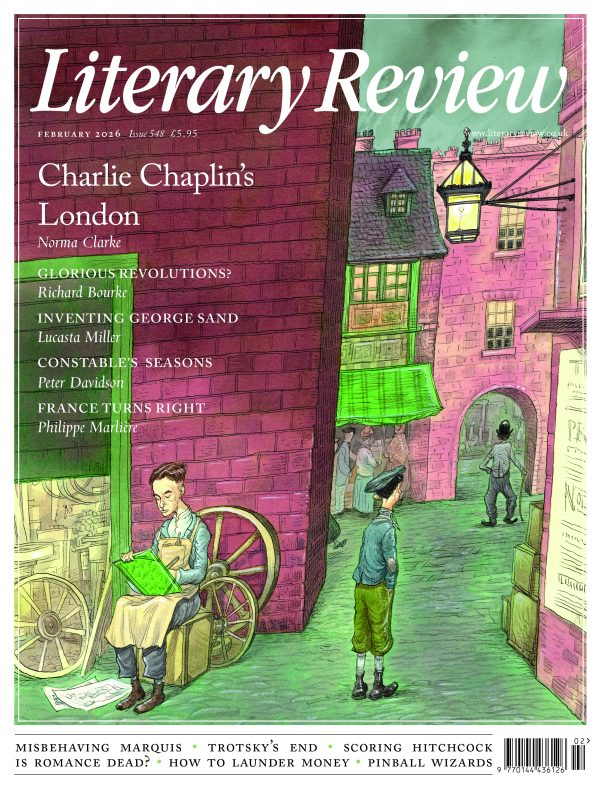
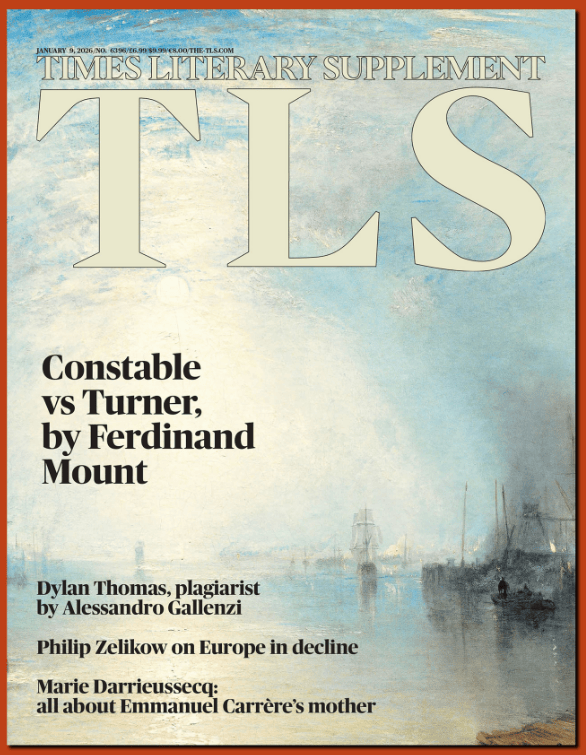
Turner is on our banknotes, Constable in our hearts By Ferdinand Mount
Coming out of Tate Britain just before noon on Budget Day, you are blinded by a blistering white sun behind Vauxhall Cross. The steepling glass towers south of the river are washed in an opal mist, the ziggurats of the MI6 HQ eclipsed to a ruined beige. Vauxhall Bridge gleams in the scarlet and yellow of a Turner sunset. J. M. W. would have rushed to the Embankment, whipped out his sketchbook, then worked up the whole shimmering scene into a six-footer and called it something like “The End of England”. John Constable would probably have turned away to catch the next coach to Hampstead Heath to paint Branch Hill Pond again.
‘One day, they’ll find me out’
How the young Dylan Thomas repeatedly stole from others By Alessandro Gallenzi
Mother was always right
A love-hate relationship recalled by France’s ‘greatest living writer’ By Marie Darrieussecq
The notebook fallacy
Why stylish stationery won’t change your life By Ian Sansom
Weary of war and staring down the likelihood of an unjust peace, Ukrainian intellectuals are plotting out a road map for the future.
East Side Story
Josh Safdie’s new film, starring Timothée Chalamet, is both a character study of monomania and a moving fable of how the American century of table tennis was lost.
L’Affaire Carlson
Concern over antisemitism on the right has split the conservative world in two—and GOP gatekeepers have lost the ability to contain it.
‘They Killed Our People’
More than a century after white mobs in Elaine, Arkansas, murdered hundreds of black sharecroppers in 1919, the massacre’s memory remains contested.
‘The Ancient and Long-Forgotten Language of Cinematography’
If the movies are dead, why does Bi Gan’s Resurrection feel so alive?
Rare recordings of E.E. Cummings, Mary Oliver and more offer a tour through literary history led by authors in their own words — and voices. Take a listen.
It’s the day the “Animal Goncourt” is awarded. “Who better,” a judge says, “to talk about the fabulous relationship between animals and men than writers and philosophers?”




 Intellicurious