The following essay was written by ChatGPT, and edited by Intellicurean, through the creative filter of Oscar Wilde’s barbed wit and George Bernard Shaw’s moral seriousness, of a review of John Bellamy Foster’s “Albert Einstein’s ‘Why Socialism?’: The Enduring Legacy of His Classic Essay” as it would appear in an esteemed magazine or journal.
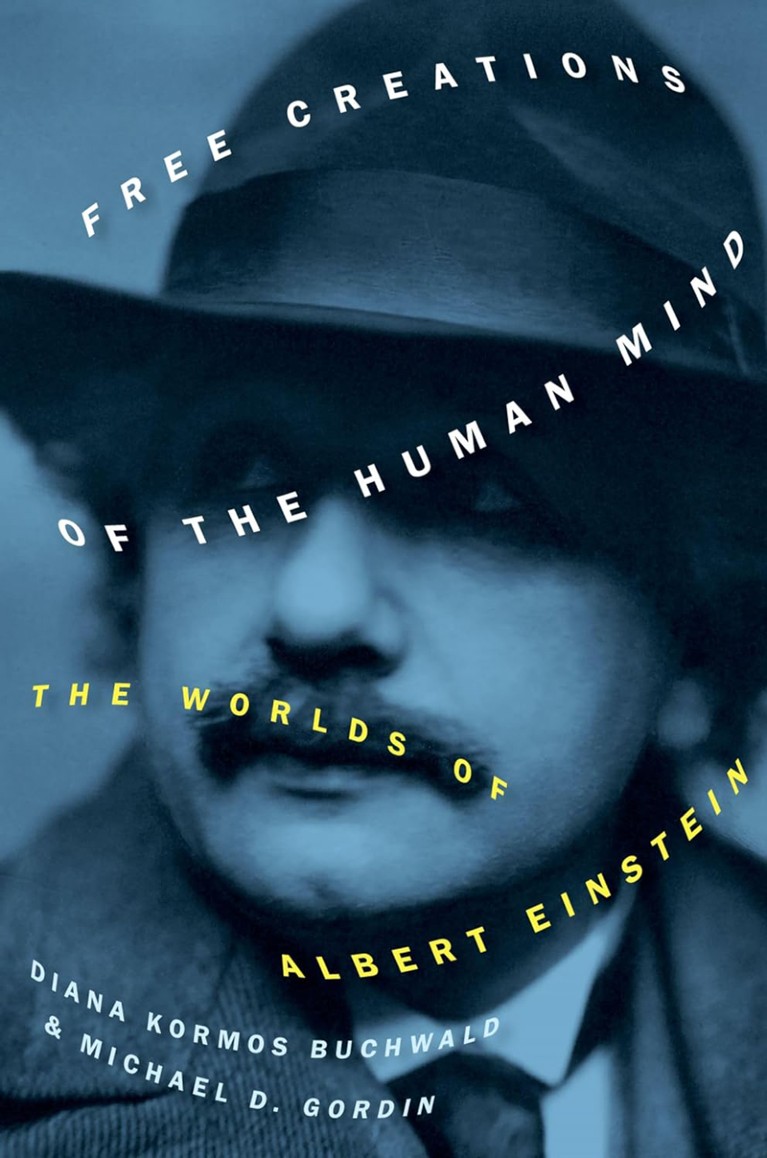
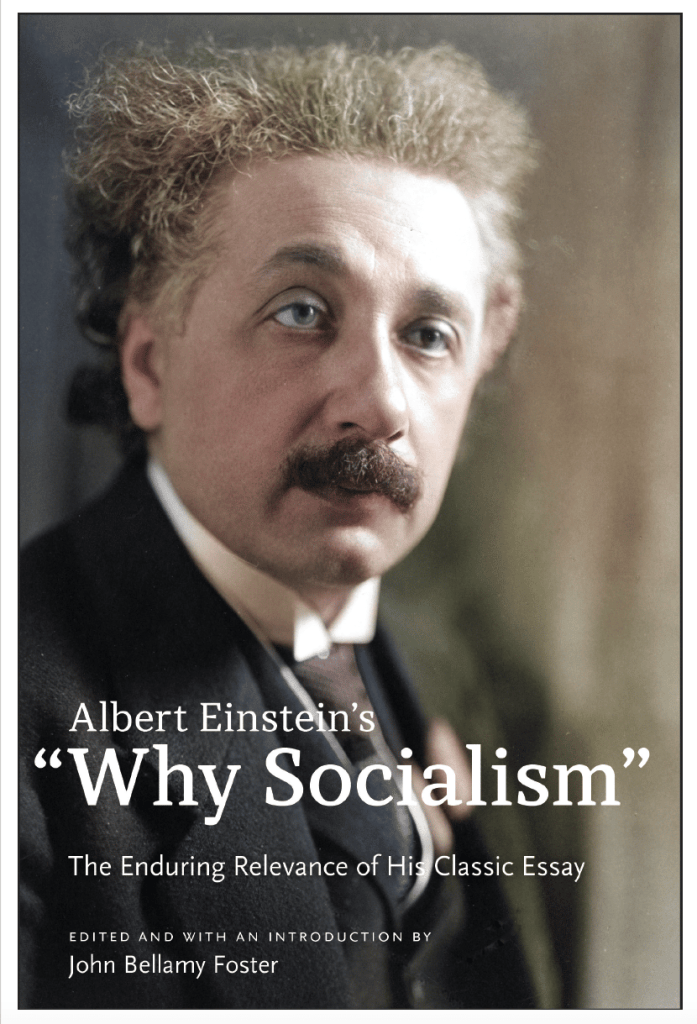
In an era where celebrity chatter often drowns out meaningful discourse—ephemeral as the pixels that transmit it—it is both refreshing and necessary to recall that Albert Einstein was not merely a demigod of science, floating above the affairs of humankind. He was a thinker with moral conviction and intellectual courage. John Bellamy Foster’s timely volume, Albert Einstein’s “Why Socialism?”: The Enduring Legacy of His Classic Essay (Monthly Review, July 2025), excavates an overlooked manifesto whose radical clarity remains provocatively undiminished by time.
Unpacking Einstein’s Socialist Vision
More than seventy-five years have passed since Einstein contributed his essay Why Socialism? to the inaugural issue of Monthly Review in May 1949—right in the throes of America’s Red Scare. In that climate of ideological hysteria, even reason itself was suspect. Yet Einstein, with characteristic directness, named capitalism as the source of modern spiritual and economic malaise. “The economic anarchy of capitalist society,” he wrote, “is, in my opinion, the real source of the evil.”
This was no armchair abstraction. It was an act of moral and intellectual defiance in an era of conformity. Rather than tempering his critique to placate the political climate, Einstein diagnosed capitalism as a system that cripples the individual, erodes social cohesion, and mistakes profit for purpose. His socialism, then, was not bureaucratic dogma, but a humane vision: a call for solidarity, responsibility, and human dignity.
Foster’s introduction accomplishes three critical feats. First, it confirms Einstein’s consistent—if unfashionable—commitment to socialist ideals. Second, it situates Why Socialism? within a contemporary moment of deepening ecological and geopolitical crisis, not unlike the postwar anxieties Einstein addressed. Third, and most compellingly, Foster refuses to treat Einstein’s words as nostalgic artifacts. Instead, he reads them as instruments of moral interrogation for the present.
Einstein’s Moral Urgency in a Cynical Age
A powerful moment recounted in Foster’s commentary draws from a recently unearthed interview transcript titled, YES, ALBERT EINSTEIN WAS A SOCIALIST. In it, Einstein recounts a chilling conversation: a friend, contemplating nuclear annihilation, casually asks why Einstein is so concerned about humanity’s extinction. The question is as nihilistic as it is sincere—eerily prefiguring today’s fatalism disguised as realism.
Einstein’s response was telling. He saw this resignation not as philosophical sophistication, but as a symptom of capitalism’s emotional deadening. A world driven by profit, he argued, had alienated people not only from one another but from their very capacity to find joy. “The naive, simple and unsophisticated enjoyment of life,” he mourned, had become a casualty. The resulting solitude, he observed, was not noble introspection but a prison built of egotism and insecurity.
In Why Socialism?, Einstein extends this observation: “Man is, at one and the same time, a solitary being and a social being… As a social being, he seeks to gain the recognition and affection of his fellow human beings… and to improve their conditions of life.” The essay thus offers not just an economic critique, but a portrait of the spiritual crisis induced by capitalism.
A Socialism of Decency, Not Dogma
Einstein did not envision socialism as the rigid apparatus of state control feared by his critics. Instead, he imagined a cultural and moral transformation—one that would replace competition with cooperation, and empty success with meaningful contribution. “In addition to promoting his own innate abilities,” he wrote, “education would attempt to develop in [the individual] a sense of responsibility for his fellow man in place of the glorification of power and success in our present society.”
This human-centered socialism bears more resemblance to George Bernard Shaw’s ethical idealism than to any centralized Leninist command structure. It’s a socialism that asks not only how society is organized, but what kind of people it produces.
Economic Insecurity and the Specter of Waste
Foster’s commentary reaches its most powerful moments when it highlights the relevance of Einstein’s critique in light of today’s contradictions. Technological progress has not delivered leisure or security—it has exacerbated anxiety. “The worker is constantly in fear of losing his job,” Einstein observed. “Technological progress frequently results in more unemployment rather than an easing of the burden of work for all.”
The implications are strikingly modern. The rise of AI, automation, and gig economies has done little to stabilize human life. Meanwhile, the grotesque spectacle of billionaires launching vanity rockets while basic needs go unmet seems to fulfill Einstein’s warning: “Private capital tends to become concentrated in few hands… at the expense of smaller ones.”
Einstein’s insights cut deeper than economics. He warned that unbridled competition produces “a huge waste of labor and… crippling of the social consciousness of individuals.” Foster echoes this, showing how the very mechanisms that promise efficiency often produce alienation and redundancy. In a world where millions remain hungry while supply chains overflow, the diagnosis of “planned chaos” is tragically apt.
The Courage to Imagine a Better World
To Foster’s credit, the book does not shy away from the difficulties of implementing socialism. It acknowledges Einstein’s own candor: that centralized systems can create new forms of domination. “How can the rights of the individual be protected,” he asked, “and therewith a democratic counterweight to the power of bureaucracy be assured?”
Foster does not offer easy answers, nor does he romanticize Einstein’s views. But what he recovers is the philosopher’s refusal to retreat into cynicism. Einstein, like Shaw, understood that history does not advance through comfort or caution. It advances through the courage to propose—and live by—dangerous ideals.
This moral clarity is what makes Why Socialism? enduring. In an era when capitalism insists that no alternatives exist, Einstein reminds us that alternatives are always possible—so long as we preserve the moral imagination to conceive them.
No Middle Ground—And That’s the Point
If one criticism can be leveled at Foster’s approach, it is that he leaves little room for ambiguity. This is no quiet meditation on gradual reform. It is a call to judgment. In a time when readers often seek the past as comfort, Foster compels us to read it as confrontation. The result is not a nostalgic ode to Einstein’s politics but a provocation: What kind of civilization do we want?
Einstein wrote, “I am convinced there is only one way to eliminate these grave evils, namely through the establishment of a socialist economy, accompanied by an educational system which would be oriented towards social goals.” The boldness of that sentence still stings in a society that treats cooperation as utopian and hoarding as genius.
Foster’s restraint is notable throughout—he avoids both hagiography and polemic. He invites the reader to wrestle with Einstein’s ideas, not worship them. The book’s greatest achievement is that it makes us take Einstein seriously—not just as a physicist, but as a moral thinker who challenged the logic of his time and, perhaps, still ours.
Conclusion: A Dangerous Hope
To read Why Socialism? in 2025 is to hear a still-resonant signal from a thinker who refused to let go of the future. Einstein’s socialism was never about bureaucracies—it was about the possibility of decency, of cooperation, of lives lived without fear. And if that vision sounds naive today, then perhaps the problem lies not in the vision, but in the world that has taught us to dismiss it.
As Foster’s book makes clear, the choice remains what it was in 1949: between solidarity and atomization, between a society built on care or one cannibalized by competition. It is, at bottom, a choice between life and extinction.
One imagines Einstein, ever the pragmatist with a poet’s soul, would have approved.