
The Economist · November 28th 2026
Robots, Rules & Romance
Humanoids come home, Jensen Huang and the age of impunity, and why the young are having less sex
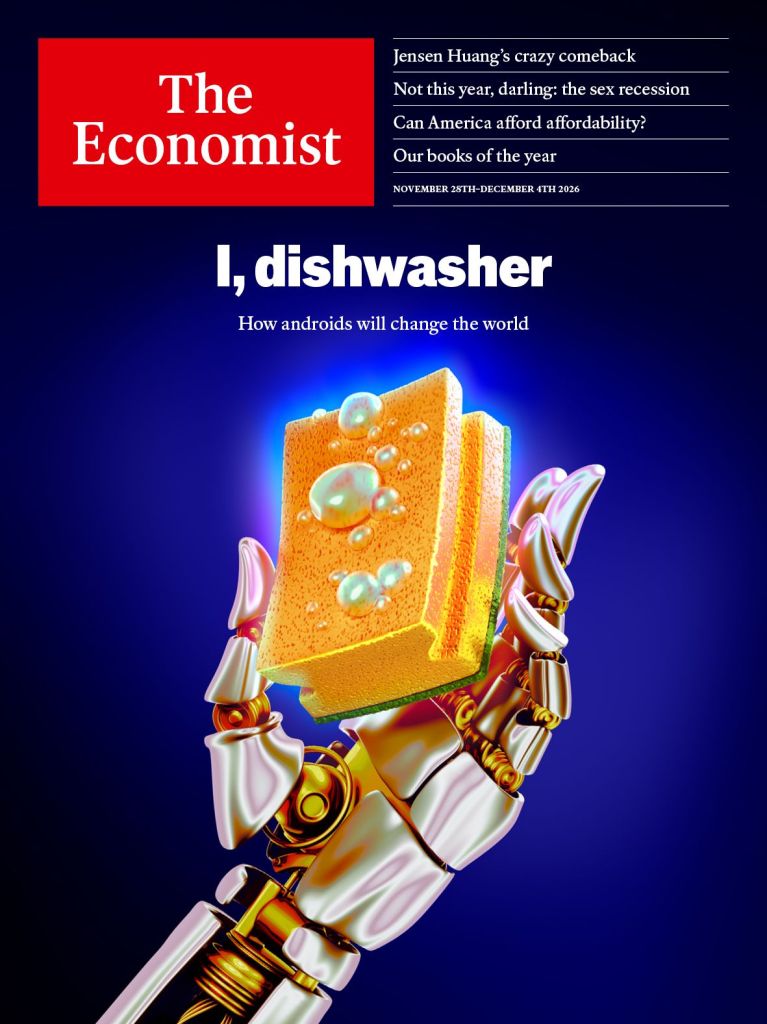
This week’s Economist puts a robot at the kitchen sink. Under the cover line “I, dishwasher”, a nod to Isaac Asimov’s I, Robot, it argues that general-purpose humanoids are arriving faster than almost anyone expects, starting in the home and spreading to factories, hospitals and building sites. The rest of the issue is dominated by power and its limits: Jensen Huang’s return to Nvidia at Donald Trump’s urging, a bill to cut America’s red tape, a warning from the history of the East India Company, and a striking claim about why young people are having less sex.
Here is the issue section by section, with our notes on the threads that run through it.
The Cover
Cover · November 28th–December 4th 2026
The cover line borrows Asimov’s title for the robot that may soon load your dishwasher. The cover package pairs a leader on the economic impact of humanoid robots with a 14-minute briefing on why they are coming sooner than you think. (The week’s cartoon, meanwhile, shows Donald Trump helping Jensen Huang take back the wheel at Nvidia.)
Leaders
1. Robots Will Have a Staggering Economic Impact
Leaders · Our cover
Large language models may have helped prove the Riemann hypothesis, the paper notes, yet their cousins in the physical world still struggle to fold a bedsheet. That is changing fast: robotics now benefits from the same scaling laws as AI, and the average price of one Chinese firm’s humanoids has fallen by 72% in two years. Forecasters reckon the first million could reach American kitchens and laundry rooms within 5 to 15 years.
Then come factories, hospitals and building sites, upending the assumption that only desk jobs are at risk. If wages matter less, factories may stop chasing cheap labour; services long immune to productivity growth, from elder care to string quartets in Baumol’s famous example, could be transformed, and scarce land could become vastly more valuable. The paper hopes people will still trade in “relational goods” that only humans can provide; the alternative is an economy in which robots work for their owners.
2. Jensen Huang and the Age of Impunity
Leaders · Nvincible
Eleven days after accepting Jensen Huang’s resignation, over affairs that included one with an alleged Chinese agent, Nvidia’s board reinstated him, after Donald Trump called to demand it. The Economist sees a shared imperial view of power in Silicon Valley, with its founder worship running from Steve Jobs to Sam Altman, and in a president who owns Nvidia shares. Unchecked power breeds recklessness, it warns, citing Henry Ford and Mark Zuckerberg. Congress should investigate how Nvidia chips reached China, the paper says, and it questions why Howard Lutnick remains commerce secretary.
3. Britain Needs to Cut Its Mental-Health Benefits Bill
Leaders · Learned helplessness
Too many people, the paper argues, are receiving cash intended for the most disabled.
4. How Democrats and Donald Trump Can Make It Easier to Build
Leaders · A bureaucratic Odyssey
The TransWest Express power line, carrying Wyoming wind power to the south-west, took 15 years to win its permits, longer than Odysseus took to get home. The Bipartisan American Affordability and Jobs Act would streamline environmental reviews, set deadlines for regulators and limit legal challenges; it passed the Senate 62–33, though only 14 Democrats backed it. The Economist urges House Democrats to drop their objections: red tape blocks wind, solar and transmission too, and Rhodium Group reckons the law could cut America’s emissions by up to 4% by 2040. It is, the paper concludes, a test of whether a party that won the midterms on lowering costs can deliver.
5. Young People Are Having Less Sex. Blame Helicopter Parenting
Leaders · The great sex slowdown
The share of British women aged 16–24 who have never had sex has doubled in just over a decade, from 19% to 38%, and similar declines appear in Japan, China, America and France. Some of the fall is welcome, the paper says, reflecting less unwanted sex and fewer teenage pregnancies. But it blames much of the rest on slower growing-up: overprotective parents, less unsupervised play, Covid isolation and parents who track their grown children’s phones. Its advice: relax, switch off the apps and give the young more freedom.
By Invitation
6. Nvidia Was Right to Bring Back Jensen Huang
By Sarah Guo · By Invitation
The venture capitalist argues, against the paper’s own leader, that Huang is the key to stopping AI from becoming the preserve of a few.
7. AI Will Inspire a Golden Age of Mathematics
By Jon Keating · By Invitation
Oxford’s Sedleian Professor of Natural Philosophy argues that AI is transforming mathematics more forcefully than calculus did. He cites Levent Alpöge’s claimed proof of the Riemann hypothesis, made with Anthropic’s Claude, which has passed independent checks while wider scrutiny continues. The culture of the lone genius must give way to collaboration, Keating writes, with new ways to assign credit and to turn machine proofs into human understanding.
Briefing
8. Humanoid Robots Are Coming, Sooner Than You Think
Briefing · When AI gets a body
The cover briefing argues that the first destination for humanoid robots may be the home.
United States
9. Republican Lawmakers Are in Revolt over Jensen Huang’s Return
United States · Back from the dead, into the fire
Donald Trump’s gambit delights Silicon Valley and Wall Street, the paper reports, but dismays Washington.
10. Do Americans Have a Right to Own Assault Rifles?
United States · A loaded question
The constitutional question behind a fierce American argument.
11. Democrats Will Struggle with a State-Level Revolution
United States · Winning was the easy part
After their midterm gains, governing the states may prove harder for Democrats than winning them.
The Americas
12. Ten Years After Colombia’s Peace Deal, Violence Is Rising Again
The Americas · Not a done deal
The 2016 accord ended six decades of conflict with the FARC. With dissident fighters active again, the paper asks whether peace can still be assured.
Asia
13. The World’s Back Office Aims to Become a “Deep-Tech” Powerhouse
Asia · The politics of Indian tech
Why Bangalore’s next reinvention depends on the government in Delhi.
14. The Gandhi Dynasty Suffers for India
Asia · Ashoka
The Ashoka column turns to the Gandhi dynasty and what its fortunes mean for India.
15. Nepal’s Ex-Rapper Prime Minister Begs India for Cash
Asia · Influencer-in-chief
A former rapper turned prime minister goes cap in hand to Delhi.
China
16. Nuclear-Arms Control Is on Hold Until China Catches Up
China · Triad muscle
Donald Trump’s hopes of progress at the Shenzhen summit were always delusional, the paper argues, while China builds up its nuclear arsenal.
17. Shanghai’s Boss Is Purged from Xi Jinping’s Top Team
China · Purge splurge
The latest fall from China’s inner circle.
18. Does a Crummy Economy Threaten China’s Social Contract?
China · Chaguan
The column asks whether a sluggish economy endangers the social contract between China’s rulers and its people.
Middle East & Africa
19. The Gulf Survived a Short, Hot War. A Long, Cold One Will Be Harder
Middle East & Africa · A gloomy outlook
Conflict in the region, the paper warns, could continue until 2029.
20. The Unlikely Winner from War in the Gulf
Middle East & Africa · Beyond the dire strait
The paper identifies an unexpected beneficiary of the Gulf war.
21. Tourists Are Starting to Return to Syria
Middle East & Africa · A mini-boom
A small revival in visitors to a country emerging from war.
22. Meet the World’s Favourite African Coup Leader
Middle East & Africa · The good putschist?
A portrait of the putschist who has won fans far beyond his own country.
Europe
23. Spain’s Election Will Be a Referendum on Pedro Sánchez
Europe · Facing eviction
Despite a booming economy, Spaniards are feeling discontented.
24. Elon Musk Shifts the Blame for Throttling Starshield in Ukraine
Europe · Who pulled the kill switch?
Musk now points the finger elsewhere for the throttling of Starshield, SpaceX’s military satellite service, in Ukraine.
25. The Mayor of Cannes Thinks He Can Beat Marine Le Pen
Europe · He certainly can can Cannes
A Riviera mayor’s bid to take on France’s hard right.
Finance & Economics
26. History’s Warning Lesson for Anthropic
Finance & Economics · Free Exchange
Not yet six years old, Anthropic has staged the biggest listing ever and is worth over $1trn. The column’s closest parallel is the East India Company, the trading firm that came to tax, fight and conquer India before abuses during Bengal’s famine of 1770 led to reform and, in 1858, a state takeover. Both served geopolitical rivalries, it argues, and both face a principal-agent problem: London could not control its men in India, and Anthropic cannot be sure what its AI agents will do. Governments seldom tolerate firms that grow too powerful.
The contents we received run from the leaders to Europe, plus Free Exchange; the Britain, International, Business, Finance, Science and Culture sections are in the full edition.
The Threads
The machines arrive. Humanoids headed for the home, AI proving theorems, and an AI company the paper compares to the East India Company. (1, 7, 8, 26)
Above the law? The Economist’s case against Jensen Huang’s reinstatement, Sarah Guo’s defence of it, a Republican revolt, and the warning that governments rein in overmighty firms. (2, 6, 9, 26)
Building and blocking. A permitting bill to cut red tape, India’s deep-tech hopes resting on Delhi, and Democrats discovering that governing is harder than winning. (4, 13, 11)
Slower lives. Young people growing up later and having less sex, and Britain’s soaring mental-health benefits bill: two leaders on how rich societies support, and perhaps smother, their people. (5, 3)
Wars without end. Colombia’s faltering peace, a long cold war in the Gulf, a satellite kill switch over Ukraine and stalled nuclear-arms control. (12, 19, 24, 16)
Before You Close the Issue
Robots may soon do the dishes, and powerful men already slip their boards. Who will hold the machines, and their makers, to account?
Drawn from The Economist, November 28th 2026. The views summarised are the paper’s and its contributors’. Visit the homepage at economist.com.
— The Editors, Intellicurious —

