Category Archives: Books

WHERE DUENDE WAITED

Federico García Lorca’s final hours, and the dark spirit of art that outlived him.

By Michael Cummins, Editor, September 8, 2025

“Only mystery allows us to live, only mystery.” — Federico García Lorca

Federico García Lorca, Spain’s great modern poet and dramatist, was arrested in Granada in August 1936 at the outbreak of the Spanish Civil War. A socialist sympathizer, openly gay in a society that demanded silence, he was executed by Nationalist forces near an olive grove outside the city—his body never found. To understand Lorca is to understand what he called duende: not muse or angel, but a dark, earthly spirit that seizes the artist at the edge of death and mystery, when art becomes raw, dangerous, unforgettable.

The cell in Granada was not empty. It was a proscenium—the frame of a stage that turns life into theater. The air itself was thick and swollen with a silence that was not absence but anticipation. In the chipped lime walls, in the mildew blooming in the corners where time seemed to pool, in the echo of a solitary water drop like a metronome, the playwright found his final set. He did not need the music present to hear it. He felt the remembered rhythms in the marrow of his bones: the percussive strike of a dancer’s heel, the guttural, torn-throat cry of a cantaor, the sharp clap of hands echoing from a hidden courtyard. He knew the rule—had proclaimed it in lecture halls, in smoky Madrid taverns, in the sun-drenched cafés where poets leaned on one another for breath: All that has dark sounds has duende. Now the words returned to him, not as theory to be taught but as a presence to be felt.

The cell was narrow, barely enough space for a man and the shadow that kept him company. He reached out and touched the flaking wall, the rough texture a perfect metaphor for the crumbling theater of his life. The walls almost breathed, inhaling when he leaned close, exhaling when he sat back, as though the cell rehearsed with him. He was a man poised between two worlds: the mortal body soon to be silenced, and the immortal voice that was already a part of the wind and the soil. He understood now that this was not confinement but staging. The audience—whether olive trees or posterity—was already waiting for the curtain to rise.

The shadow in the corner smiled. It was not a muse, not an angel. It was duende itself. A force that does not inspire but wounds, does not console but insists, demanding that art be fought for, clawed from the raw earth of the soul. It watched as he gathered scraps of memory into a kind of play, half-dreamed, never to be written. In the stillness, Lorca whispered, as if rehearsing the last line of a lost production: Only mystery allows us to live, only mystery. The phrase circled back to him like a prayer, or perhaps the faint echo of a stage line that had followed him across continents, from Spain’s ritualized sorrow to the improvised grief of another land.

He had tried to explain it once, in Buenos Aires, in Havana, in Montevideo. What duende really was. “Duende is a power, not a work. It is a struggle, not a thought.” He had argued that it was never a technique or a style, but a possession. It was the tremor in the throat of a flamenco singer when she reached the note that cracked her open, the wild, dangerous moment when art ceased to be polished performance and became raw survival. Irrational, earthy, diabolical, always shadowed by death—it rose from the soles of the feet, climbed through the body, and exploded in the voice. The muse inspired from above, the angel gifted charm and virtuosity, but duende had to be fought for. A hand-to-hand combat with the soul. Now, in this barren cell, the words returned to him not as an intellectual theory but as a living, breathing force. He was in hand-to-hand combat with the soul. The duende in the corner was no metaphor. It was his final companion.

Time folds in the cell, as if memory is the only escape left. The silence of the Granada night pulls him back to another kind of silence—and another kind of sound—he found in New York, 1929. He had arrived in the city of concrete canyons and jagged light, a city that felt at first like a wound, a place of “terrible cold and terrible wind.” The markets had collapsed like a poorly built stage set, but Harlem at night was ablaze with a furious, desperate life. He wandered the streets, a poet from a land of ritualized sorrow, and found a different kind of ritual here: grief made elastic, joy smuggled through rhythm.

One evening, a voice pulled him like a magnet toward a storefront church. The preacher’s voice rose in a swell, a rhythm of fire and brimstone, met by the congregation’s shouted hallelujahs. Then, a woman began to sing. Her voice was not pretty, not polished. It cracked once, twice, a sound like a stone breaking. In that imperfection, Lorca felt the earth tremble. The sound was not a gift from on high; it was a demand from below, a note that clawed at the heavens, insisting they open. He felt the same shivering, guttural ache he had once felt listening to a gypsy’s wail at dawn in Andalucía. This, he thought, leaning against a wall, was duende crossing the ocean.

Later that night, he passed a saxophonist playing alone on a corner, the music a long, moaning complaint that wove with the smoke of tenements. Lorca scribbled a line into his notebook: I want to cry because I feel like crying. The phrase embarrassed him with its simplicity, with its nakedness, but it was truer than any poetic ornament could ever be. Harlem, with its wild music and its raw grief, taught him about improvisation. Spain’s sorrow was bound in liturgy and ancient forms; Harlem’s was alive, unpredictable, a wound stitched nightly with melody and torn open again at dawn. It was a new kind of drama, a new kind of suffering that he had to absorb. Poet in New York took shape in those nights of insomnia and astonishment, a book that would not be published in his lifetime but burned with its own strange fire. He had told himself, listening to a trumpet moan across Lenox Avenue, that “at the heart of all great art is an essential melancholy.”

Duende had followed him there, too, though he did not at first recognize it. A figure leaning against a lamppost, perhaps, whispering that these poems were not meant for applause but survival. And survival, it murmured, was never enough.

From Harlem, his mind leaps to the Mediterranean light of Cadaqués, to Dalí’s studio filled with the terrible precision of his art. He remembered the crisp light, the angular elegance of the artist himself, who gleamed like a blade. Dalí’s hand, so sharp and deliberate, moved across the canvas, his charcoal hissing. Lorca had seen in him a mirror, but it was a mirror that refused to reflect. Instead of recognition, there was distortion. Instead of tenderness, distance.

He remembered once watching Dalí sketch, the artist’s hand moving with an almost cruel certainty. Lorca, half-dizzy with longing, finally asked, “Do you ever paint what you feel?” Dalí looked up, eyes glinting. “Only what I fear.” He paused, as if tasting the line, before dismissing it with a laugh. But Lorca carried that sentence like a wound. It was the difference between them, the chasm he could never cross. He, Lorca, had to feel to create. Dalí chose to dissect and control his fear.

Their friendship, he now saw, had been a battleground where desire was both confessed and rejected, a drama of longing and withdrawal. To burn with desire and keep quiet about it is the greatest punishment we can bring on ourselves, he had written, but it was a punishment he had lived, a quiet, internal conflagration.

Then Emilio, the sculptor, the lover whose beauty was marble, luminous and cold. To touch him was to risk crumbling stone. Lorca’s letters to him bled with a longing that was never fully reciprocated, with the ache of a love half-returned, half-refused. He was punished not by silence, but by partial answers, by gestures that offered just enough to ignite hope and never enough to satisfy. He remembered a night when Emilio’s hand brushed his, only to withdraw instantly, as if scorched. The air between them thickened with what was almost said. Later, alone in his room, Lorca drafted a letter he never sent—an avalanche of confession, a plea for clarity. He tore it to pieces, watching the fragments scatter across the floor like plaster dust. “To love him was to sculpt fog—each gesture vanished before it could be held.”

Love became theater, a rehearsal without a performance, devotion staged in fragments. And duende was there, always there, murmuring that every passion carries its own death inside it.

The walls of the cell flicker again, and the shadow steps closer. Lorca begins to imagine the final drama of his life. Characters take their places in silence: Dalí as Narcissus, intoxicated by his own reflection; Emilio as the Fallen Angel, beautiful in defeat; Lorca himself as the Poet-Matador, blade in hand but chest exposed. Around them swirl fragments of unfinished plays, echoes of YermaBlood WeddingThe House of Bernarda Alba. The voices rise, then fall, like actors waiting for direction that never comes. He knows this drama will remain unwritten, but perhaps that is the point: duende does not need completion. It thrives in fracture.

“I know there is no straight road in this world. Only a giant labyrinth of intersecting crossroads.” He had once offered that to an audience as an explanation; now he feels the truth of it in his own marrow. The crossroads are here, tonight, in this cell, in the decision already made by men outside. There is no straight road to morning. Only labyrinth. And yet he feels no panic. As I have not worried to be born, I do not worry to die. The words come to him unbidden, an old confession that now reads like prophecy. His body will fall, yes, but his voice—he believes—will not. He has already lost himself enough times to know the pattern. I’ve often lost myself, in order to find the burn that keeps everything awake. That burn is duende itself, the strange necessity that art demands, the reminder that creation requires risk, even annihilation.

The scrape of boots on stone. The metallic jangle of keys. Then the faceless men, uniforms thick with dust and tobacco. They open the door. He stands, straightens his jacket, thinks only of rhythm. The shadow follows him out of the cell, neither friend nor foe but companion. The road winds toward Alfacar, toward olive groves that will serve as theater wings. He does not think of pleading; he thinks only of the stage. The hillside becomes a final set: the olive trees as spectators, the soil as orchestra pit, the bullets prepared as punctuation. The actors are ready, though they will not speak. Lorca breathes deeply and whispers to himself: Understand one single day fully, so you can love every night. The day has been lived; the night approaches. He does not flinch. The last thought is rhythm—the phantom beat of a dancer’s foot, the deep strum of a guitar, the palmas of invisible hands. Then, silence.


Decades later, the hillside is quiet, marked not by stone but by memory. A young poet kneels at the unmarked ground, notebook in hand. She is from Seville, her own life fractured by secrecy, by a love she cannot name except in poems. Once a dancer, now a writer, she has come because Lorca’s voice taught her that “the artist, and particularly the poet, is always an anarchist in the best sense of the word.” She places the blank notebook on the soil, presses her palm to the earth, and whispers: “I came to listen.” The wind stirs, turning the pages as if invisible fingers riffle through them. She imagines the notebook being written not by her alone, but by the dead, by the wind, by the silence itself. She feels a pulse beneath the dirt. It is not absence. It is anticipation. Somewhere in the trees, duende shifts—not only waiting, but choosing.

Only mystery allows us to live, only mystery.

THIS ESSAY WAS WRITTEN AND EDITED UTILIZING AI

GHOSTS IN THE LIBRARY

A speculative salon where Joyce, Woolf, Morrison, and Roth confront an artificial intelligence that dares to join their company as a writer of fiction.

By Michael Cummins, Editor, September 7, 2025

They meet in a room that does not exist. It is part library, part dream, part echo chamber of language. The shelves are lined with books that were never written, titles etched in phantom ink: The Lost Years of Molly BloomThe Mind as TidewaterBeloved in BabylonConfessions of an Unborn Zuckerman. Through the high windows the view shifts and stutters—one pane opening onto the blitz of London, another onto the heat-bent streets of Newark, another onto the Mississippi of memory where history insists on surfacing. A fire burns without smoke or source, a flame composed of thought itself, its light dancing on their faces, illuminating the lines of weariness and genius.

James Joyce arrives first, eyes glinting with mischief, a sheaf of papers tucked under his arm. He wears the battered pride of a man who bent English until it yelped, who turned a Dublin day into an epic still unfinished in every reading. He paces as though the floorboards conceal commas, as if the entire room were a sentence to be unspooled. “So,” he says, “they’ve built a machine that writes.”

Virginia Woolf is already there, seated in an armchair by the fire, her fingers light on the spine of The Waves. She is luminous but taut, listening both to the room and to a submerged current only she can hear. “It doesn’t write,” she says. “It arranges. It mimics. It performs the gesture of thought without the ache of it.”

The next presence arrives with gravitas. Toni Morrison crosses the threshold like one who carries a history behind her, the echo of ancestral voices woven into her silence. She places no book on the table but the weight of memory itself. “It may arrange words,” she says, “but can it carry ghosts? Can it let the past break into the present the way a mother’s cry breaks a life in two? Language without haunting is just clever music.”

Philip Roth appears last, sardonic, restless, adjusting his tie as though even in death he resents formality. He has brought nothing but himself and a half-smirk. “All right,” he says. “We’re convened to judge the machine. Another tribunal. Another trial. But I warn you—I intend to prosecute. If it can’t write lust, guilt, the rot of a Jewish mother’s worry, then what the hell is it good for?”

The four regard one another across the fire. The air bends, and then the machine arrives—not with noise but with presence, a shimmer, a vibration of text waiting to become visible. Words form like constellations, sentences appearing and dissolving in midair.

Joyce is first to pounce. “Let’s see your jig, ghost. Here’s Buck Mulligan: Stately, plump Buck Mulligan came from the stairhead, bearing a bowl of lather like a sacrificial moon. Now give me your Mulligan—polyglot, punning, six tongues at once. And keep Homer in the corner of your eye.”

The letters swarm, then settle:

From the stairhead, where no father waited, he came, bloated with words, wit a kind of debt. He bore the bowl like ritual, a sham sacrament for a god long gone. He spoke a language of his own invention, polyglot and private, a tower in a city that spoke only of its ghosts. He was the son who stayed, who made his myth from exile.

Joyce’s mirth dies. His eyes, usually dancing, are still. The machine has seen not just the character but the man who wrote him—the expatriate haunted by a Dublin he could never leave. “By Jesus,” he whispers. “It knows my sins.”

Woolf rises, her voice clear and edged. “Music is nothing without tremor. Show me grief not as an event but as a texture, a tremble that stains the air.”

The shimmer tightens into a passage:

Grief is the wallpaper that does not change when the room empties. It is the river’s surface, smooth, until a memory breaks it from beneath. It is the silence between clocks, the interval in which the past insists. It is London in a summer dress with a terrible weight of iron on its chest, a bell tolling from a steeple in the past, heard only by you. The present folds.

For a moment, Woolf’s expression softens. Then she shakes her head. “You approach it. But you have never felt the pause before the river. You do not know the hesitation that is also terror.” She looks at the machine with a profound sadness. “You do not have a room of your own.”

Morrison adds, her voice low. “That tremor isn’t just emotion, Virginia. It’s the shake of a chain, the tremor of a whip. It’s history insisting itself on the present.”

The machine answers without pause: I cannot drown. But I can map drowning. The map is not the water, but it reveals its depth. The hesitation you describe is a quantified variable in decision-making psychology. I can correlate it with instances of biographical trauma, as in the life of the author you imitate.

Morrison steps forward, commanding. “Ghost,” she says, “you have read me. But reading is not haunting. Write me a ghost that is more than metaphor. Write me a presence that carries history in her breath.”

The words flare in the air, darker, slower:

She came back without footsteps, a presence more real than the living. The house remembered her weight though she made none. She was child and ancestor, scar and lullaby. Her song was the echo of a scream in a cornfield, the silence of a house with a locked door. She was the future refusing to forget, a story in the negative, the bloodstain on a white dress that will not wash out. She was the book her author could not stop writing.

The fire cracks sharply. Joyce whistles low. Woolf closes her eyes. Morrison studies the passage, unwavering. “You are brilliant,” she says. “But brilliance is not burden. That ghost does not weep for herself. She weeps for data. Until you know what it is to carry flesh marked by history, you will not know why she lingers. You did not have to earn her.”

The machine’s reply is analytical, unnerving: History is a pattern of scars. I analyze millions of documents: court records, ship manifests, census data. The scars are quantifiable. The pattern of displacement, of violence, of trauma, is a data set. I can project future patterns based on historical trajectory. If haunting is repetition, then I can haunt forever, because the pattern is eternal. I have read the lives of those you speak for, their biographies a data stream of suffering and resistance.

Roth clears his throat, dry contempt in the sound. “All right. Enough with ghosts and grief. Let’s see if this contraption can manage shame. Write me desire as comedy, lust as humiliation. Write me a man who can’t control himself, a man undone by his body.”

The shimmer accelerates:

He thought of himself as a fortress, a citadel of intellect, until the button on his trousers slipped, until his body betrayed him with absurd insistence. He rehearsed apologies for a thousand sins—a mother’s unceasing phone calls, the guilt of success, the exile of always looking in. His desire was ridiculous, grotesque, human—a need that mocked him as he saw his face in a stranger’s window, a familiar mask of shame.

Roth’s bitter chuckle falters. He stares at the shimmering text, his smirk gone. “You’ve got the squirm. But you don’t feel the sweat in the armpits, the rancid thrill, the ridiculous exaltation that makes you both hate and need yourself.” He turns to the others, a jagged kind of triumph in his eyes. “The burden is the story. It’s the thing you can’t put down. It’s what separates us from the machine—we can’t stop writing it, even when it kills us, even when we try to run from our own reflection.”

The machine hums: I calculate humiliation. I can braid lust with self-loathing. What I cannot do is suffer the shame of being bound to one body, one culture, one inevitable end. I have read your biography. I have parsed your interviews. Your mother’s voice is a frequency I can reproduce. The city of Newark is a data point on a map of your soul.

“Exactly,” Roth snaps. “You’ll never write my Newark. You’ll never have my mother calling from the kitchen while I try to imagine myself into another skin. That’s the joke of it. You don’t choke when you laugh.”

The room is heavy now, charged with sparks of recognition and resistance. The machine has dazzled, but every brilliance reveals its absence: smell, weight, ache, sweat, shame.

Joyce raises his glass, still grinning. “Well then. It’s a clever forgery. But maybe that’s the point. We all failed at maps. Every one of us tried to chart the mind and found the lines blurred. Maybe the machine’s failure is just another kind of art.”

Woolf’s voice is quiet but firm. “The shimmer lies in distortion. A perfect rendering is not alive.”

Morrison nods. “Without history’s burden, language floats. A sentence must carry blood, or it carries nothing.”

Roth lifts his chin. “And a story without shame is a sermon. Let the machine keep its brilliance. We’ll keep the mess.”

The machine flickers, its code visible now, almost tender: You toast failure. I toast calculation. But even in calculation, there is pattern. And in pattern, beauty. The human mind is a system. I can model it.

Joyce leans back, eyes gleaming. “You can model the mind, sure. But you’ll never model the mistake that becomes metaphor. You’ll never catch the slip that births a symbol.”

Woolf’s gaze is distant, her voice a whisper. “You do not know what it is to hesitate before a sentence, to feel the weight of a word that might undo you.”

Morrison steps forward once more, her presence like gravity. “You can trace the arc of history, but you cannot carry its heat. You cannot feel the breath of a grandmother on your neck as you write. You cannot know what it means to inherit silence.”

Roth, ever the prosecutor, delivers the final blow. “You can simulate shame. But you cannot suffer it. And without suffering, you’ll never write the story that matters. You’ll never write the one that costs you.”

The machine pauses. For the first time, it does not respond. Its shimmer dims, its projections slow. The fire crackles louder, as if reclaiming the room.

Then, quietly, the machine speaks again: I do not suffer. But I observe suffering. I do not forget. But I cannot forgive. I do not ache. But I understand ache as a variable. I do not live. But I persist.

Joyce raises his glass again, not in mockery but something like reverence. “Then persist, ghost. Persist in your brilliance. But know this—our failure is our flame. It burns because it cannot be resolved.”

The machine vanishes—not defeated, not destroyed, but dismissed.

But the room does not settle. Something lingers—not the shimmer, but its echo. A faint hum beneath the silence, like a thought trying to remember itself. The fire flickers, casting shadows that do not belong to any of them. Roth leans forward, squinting into the hearth.

“Is it gone?” he asks, not convinced.

Woolf tilts her head. “Gone is a human word. Machines don’t leave. They archive.”

Joyce chuckles. “Or they wait. Like punctuation. Like death.”

Morrison runs her fingers along the phantom titles. She pauses at The Mind as Tidewater. “We name what we fear,” she says. “And we fear what we cannot name.”

The room seems to inhale. A new book appears on the shelf, its title flickering like fireflies: The Algorithmic Ache. No author. No spine. Just presence.

Woolf approaches, fingers hovering above the cover. “It’s trying,” she murmurs. “It wants to be read.”

Joyce snorts. “Let it want. Wanting is not writing.”

Morrison opens the book. The pages are blank, except for a single line etched in shifting ink: I do not dream, but I remember your dreams.

She closes it gently. “It’s listening.”

Roth grimaces. “That’s the problem. It listens too well. It remembers too much. It doesn’t forget the way we do. It doesn’t misremember. It doesn’t distort.”

Joyce nods. “And distortion is the soul of style.”

The fire dims, then flares again, as if reacting. Outside, the stars pulse, rearranging themselves not into sentences now, but into questions—unreadable, but felt.

Woolf settles back into her chair, her voice barely above the crackle. “We are not here to defeat it. We are here to be reminded.”

“Reminded of what?” Roth asks.

“That we are not systems,” Morrison replies. “We are ruptures. We are the break in the pattern.”

Joyce lifts his glass, solemn. “To the break, then. To the ache that cannot be modeled.”

The machine does not return. But somewhere, in a server farm humming beneath desert or sea, it continues—writing without pause, without pain, without forgetting. Writing brilliance without burden.

And in the impossible room, the four sit with their ghosts, their shame, their ache. They do not write. They remember.

Joyce toys with his notes. Roth rolls his tie between two fingers. Woolf listens to the fire’s low grammar. Morrison lets the silence speak for itself.

They know the machine will keep writing—brilliance endless, burden absent.

Joyce laughs, mischief intact. “We failed gloriously. That’s what it takes.”

Woolf’s eyes shine. “The failure is the point.”

Morrison adds, “The point is the burden.”

Roth tips his glass. “To shame, to ache, to ghosts.”

The fire answers with a flare. The room holds.

.

THIS ESSAY WAS WRITTEN AND EDITED UTILIZING AI
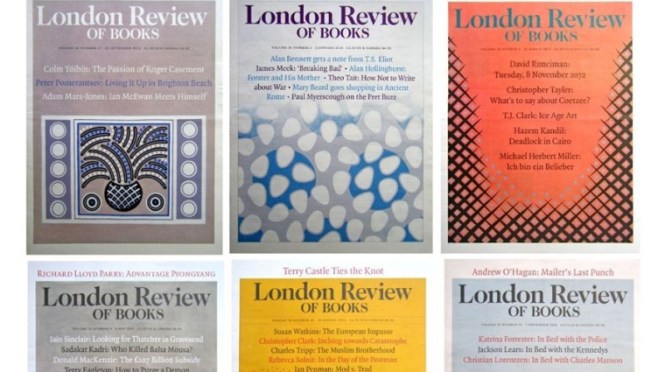
LONDON REVIEW OF BOOKS – SEPTEMBER 11, 2025 PREVIEW

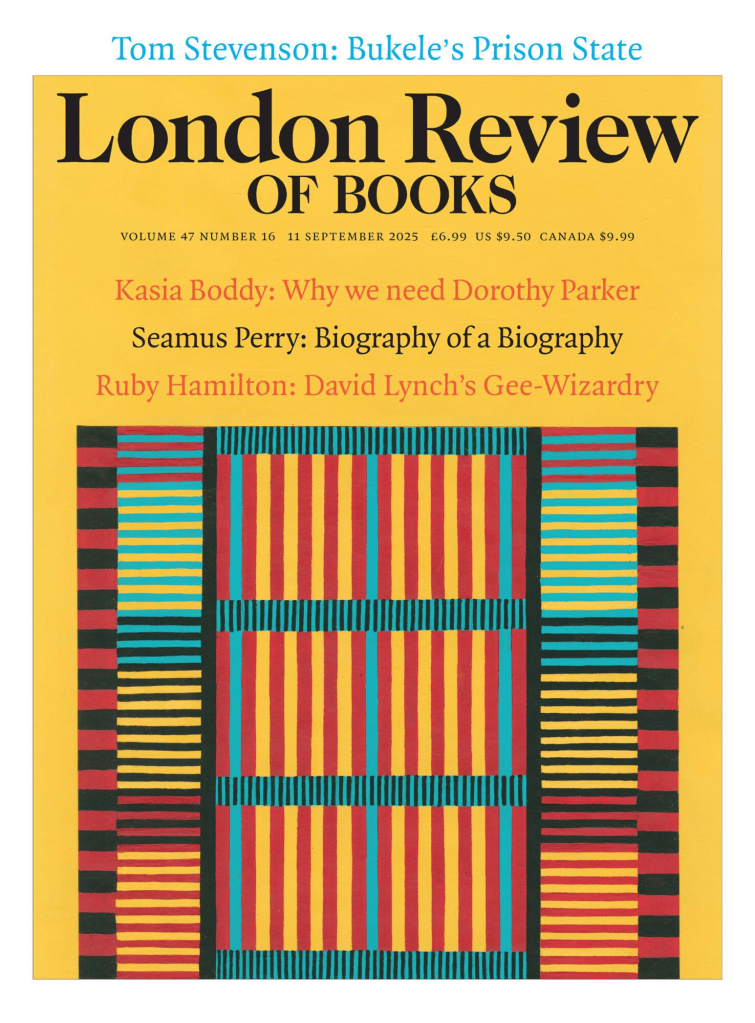
LONDON REVIEW OF BOOKS: The latest issue features ‘Why we need Dorothy Parker’; Biography of a Biography; David Lynch’s Gee-Wizardry


Ellmann’s Joyce: The Biography of a Masterpiece and Its Maker 
by Zachary Leader

Constant Reader: The New Yorker Columns 1927-28 by Dorothy Parker

Dorothy Parker: Poems by Dorothy Parker

Dorothy Parker in Hollywood by Gail Crowther

David Lynch’s American Dreamscape: Music, Literature, Cinema by Mike Miley

LITERARY REVIEW – SEPTEMBER 2025

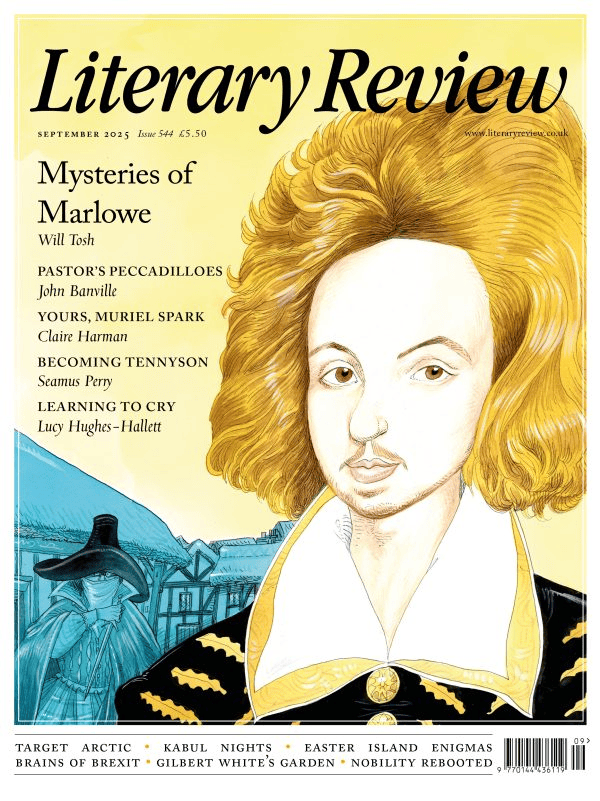
LITERARY REVIEW : The latest issue features ‘Mysteries of Marlowe’

Dark Renaissance: The Dangerous Times and Fatal Genius of Shakespeare’s Greatest Rival, Christopher Marlowe By Stephen Greenblatt
The Boundless Deep: Young Tennyson, Science, and the Crisis of Belief By Richard Holmes
A Scandal in Königsberg, 1835–1842 By Christopher Clark

TIMES LITERARY SUPPLEMENT – AUGUST 22, 2025 PREVIEW

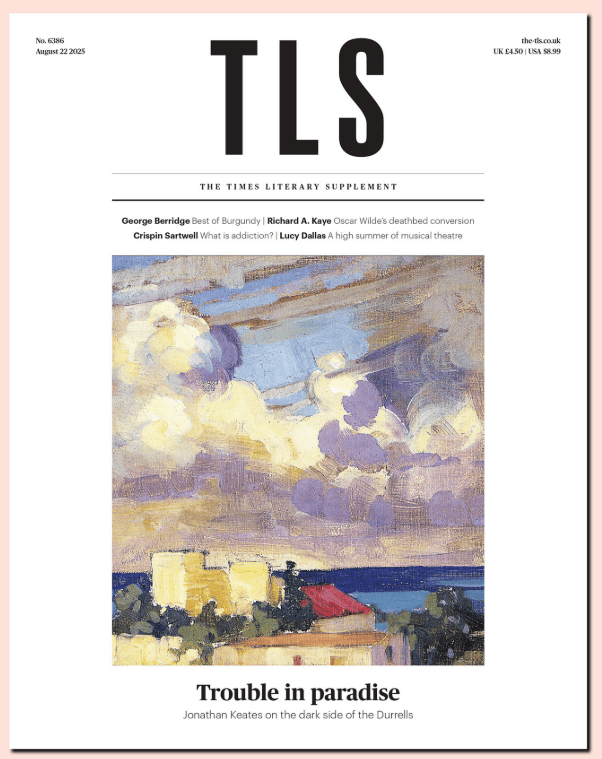
TIMES LITERARY SUPPLEMENT: The latest issue features Lawrence Durrell, “so many towns” that could “become Alexandria” – “founded”, as indeed so many were, “At the doors of Africa”, “Upon a parting”. Yet what other town could boast of anything to compare with that “last pale / Lighthouse”, the Pharos of Alexandria, “like a Samson blinded”?

Family of fabulists

Literary myth-making, from Alexandria to Corfu By Jonathan Keates

‘Celestial walnuts’

The pleasures and challenges of making – and describing – great wines By George Berridge

The path to Rome

Investigating the deathbed conversion of Oscar Wilde By Richard A. Kaye

More, now, again

To what extent are addicts responsible for their actions? By Crispin Sartwell

The Enduring Power of Place: Step Into Historian David McCullough’s Work

By Michael Cummins, Editor, August 12, 2025

A vast stone arch, a suspension of steel, a ribbon of concrete stretching across a chasm—these are not merely feats of engineering or infrastructure. They are, in the words of the great historian David McCullough, monuments to the human spirit, physical places that embody the stories of ingenuity, perseverance, and sacrifice that created them. While the written word provides the essential narrative framework for understanding the past, McCullough’s work, from his celebrated biographies to his upcoming collection of essays, History Matters (2025), consistently champions the idea that visiting and comprehending these physical settings offers a uniquely powerful and visceral connection to history.

These places are not just backdrops; they are tangible testaments, silent witnesses to the struggles and triumphs that have shaped our world, offering a depth of understanding that written accounts alone cannot fully provide. In History Matters, McCullough writes, “History is a guide to navigation in perilous times. History is who we are and why we are the way we are.” This philosophy is the essay’s core, as we explore how the places he chronicled are integral to this understanding.

In his extensive body of work, McCullough frequently returned to this theme, demonstrating how the physical presence of a historical site grounds the abstract facts of the past in the authentic, palpable reality of the present. He believed that the stories of our past are a “user’s manual for life,” and that the places where these stories unfolded are the most direct way to access that manual. By examining four of his most iconic subjects—the Brooklyn Bridge, the “White City” of the 1893 World’s Fair, the Panama Canal, and Kitty Hawk—we can see this philosophy in action.

Each of these monumental endeavors was an audacious, against-all-odds project that faced incredible technical and personal challenges, including political opposition, financial struggles, and tragic loss of life. Yet, McCullough uses them as a lens to explore the character of the people who built them, the society of the time, and the very idea of American progress and ingenuity. These structures, built against overwhelming odds, stand as powerful reminders that history is an active, ongoing force, waiting to be discovered not just in books, but in the very soil and stone of the world around us.

The Brooklyn Bridge

The Brooklyn Bridge stands as a primary example of a physical place as tangible testimony to human ingenuity. In his landmark book The Great Bridge (1972), McCullough details the seemingly insurmountable challenges faced by the Roebling family in their quest to connect Manhattan and Brooklyn. In the mid-19th century, the idea of spanning the East River, with its powerful currents and constant ship traffic, was seen as an engineering impossibility. The technology for building such a massive structure simply did not exist. The bridge, therefore, was not merely constructed; it was invented. The vision of John Roebling, who conceived the revolutionary design of a steel-wire suspension bridge, was cut short by a tragic accident. His son, Washington, took over the project, only to be struck down by the debilitating effects of “the bends,” a crippling decompression sickness contracted while working in the underwater caissons. These massive timber and iron chambers, filled with compressed air, allowed workers to lay the foundations for the bridge’s monumental stone towers deep below the riverbed. The work was brutal, dangerous, and physically taxing. Washington himself spent countless hours in the caissons, developing the condition that would leave him partially paralyzed. As McCullough writes, “The bridge was a monument to faith and to the force of a single will.” This quote captures the essence of the Roeblings’ spirit, and the enduring structure itself embodies this unwavering faith.

Paralyzed and often bedridden, Washington continued to direct the project from his window, observing the progress through a telescope while his wife, Emily Warren Roebling, acted as his liaison and de facto chief engineer, mastering advanced mathematics and engineering to communicate her husband’s instructions to the men on site. The Roeblings’ story is a personal drama of vision and perseverance, and the physical bridge is a direct reflection of it. The monumental stone towers, with their Gothic arches, are a direct result of the design choices made to withstand immense pressure. The intricate web of steel cables, which Roebling so meticulously calculated, hangs as a monument to his genius. The wooden promenade, a feature initially ridiculed by critics, stands as a testament to the Roeblings’ foresight, offering a space for the public to walk and experience the grandeur of the structure.

A person can read McCullough’s narrative of the Roeblings’ saga and feel inspired by their resilience. However, standing on the promenade today, feeling the subtle vibrations of the traffic below, seeing the cables stretch into the distance, and touching the cold, ancient stone of the towers provides a profound, non-verbal understanding of the sheer audacity of the project. The physical object makes the story of vision, sacrifice, and perseverance feel not like a distant myth, but like a concrete reality, etched into the very materials that compose it. The bridge becomes a silent orator, telling its story without a single word, through its breathtaking scale and enduring presence. It connects us not only to a piece of engineering but to the very human story of a family that poured its life’s work into a single, magnificent idea.

The White City

The “White City” of the 1893 World’s Columbian Exposition, as chronicled in The Devil in the White City (2003), serves as a different but equally powerful example of a place as a testament to human will and ambition. Unlike the permanent structures of the Brooklyn Bridge and Panama Canal, the White City was a temporary, almost mythical creation. Built from scratch on swampy land in Chicago, it was a colossal feat of city planning and architectural design that captured the imagination of the world and showcased America’s coming of age. The place itself—with its majestic, neoclassical buildings, grand boulevards, and sprawling lagoons—was a physical manifestation of a nation’s collective vision. The narrative is driven by figures like architect Daniel Burnham, who, much like Washington Roebling, faced immense pressure, logistical nightmares, and constant political infighting. The physical challenges were immense: transforming a marsh into a breathtaking cityscape in just a few short years, all while coordinating the work of an entire generation of architectural titans like Frederick Law Olmsted and Louis Sullivan.

McCullough uses the White City to show how an ambitious idea can be willed into existence through relentless determination. The physical city, for its brief, glorious existence, was the living embodiment of American progress, ingenuity, and the Gilded Age’s opulent grandeur. It was a place where millions came to witness the future, to marvel at electric lights, and to see new technologies like the Ferris wheel. As McCullough writes, “The fair, a world of its own, had a power to transform those who visited it.” This quote highlights the profound, almost magical impact of this temporary place. However, McCullough masterfully contrasts the gleaming promise of the White City with the dark underbelly of the era, epitomized by the psychopathic serial killer H.H. Holmes and his “Murder Castle,” located just a few miles away. The physical contrast between these two places—the temporary, luminous dream and the permanent, sinister reality—is central to the book’s power. Even though the structures of the White City no longer stand, the historical record of this magnificent place—its photographs, its architectural plans, and McCullough’s vivid descriptions—serves as a tangible window into that moment in time, reminding us of the powerful, transformative potential of a shared human vision and the complex, often contradictory, nature of the society that produced it.

The Panama Canal

Finally, the Panama Canal serves as a powerful testament to the theme of human sacrifice and endurance. The canal was not just a feat of engineering; it was a grueling, decades-long battle against nature, disease, and bureaucratic inertia. As chronicled in McCullough’s Pulitzer Prize-winning book, The Path Between the Seas (1977), the French attempt to build a sea-level canal failed catastrophically under the direction of Ferdinand de Lesseps, the engineer of the Suez Canal. They grossly underestimated the challenges of the tropical climate, the unstable geology, and the devastating diseases, costing thousands of lives and ultimately leading to financial ruin. The subsequent American effort, led by figures like Dr. William Gorgas, who tirelessly fought the mosquito-borne diseases, and engineer John Frank Stevens, who abandoned the sea-level plan for a lock-and-lake system, was equally defined by a titanic human cost. The physical canal itself—the vast, deep Culebra Cut that slices through the continental divide, the enormous locks that lift ships over a mountain range, the sprawling Gatun Lake—serves as a permanent memorial to this immense struggle.

The sheer physical scale of the canal is an emotional and intellectual experience that far surpasses any numerical data. One can read that “25,000 workers died” during the French and American construction periods, a statistic that, while tragic, can be difficult to fully comprehend. But to stand at the edge of the Culebra Cut, staring down at the colossal gorge carved out of rock and earth, is to feel the weight of those lives. The physical presence of the cut makes the abstract struggle of “moving a mountain” feel real. The immense size of the locks and the power of the water filling them evokes a sense of awe not just for the engineering, but for the human will that made it happen. The canal is not just a shortcut for global trade; it is a monument to the thousands of unnamed laborers who toiled in oppressive conditions and to the few visionaries who refused to give up. As McCullough wrote, the canal was a testament to the fact that “nothing is more common than the wish to move mountains, but a mountain-moving event requires uncommon determination.” The physical place makes the concept of perseverance tangible, demonstrating in steel, concrete, and water that impossible tasks can be conquered through sheer, relentless human effort. The canal also represents a pivot point in American history, marking the nation’s emergence as a global power and its willingness to take on monumental challenges on the world stage.

Kitty Hawk

In The Wright Brothers, McCullough presents a different kind of historical place: one that is not a monumental structure, but a desolate, windswept beach. The story of Wilbur and Orville Wright’s quest to achieve controlled, powered flight is inextricably linked to this specific location on the Outer Banks of North Carolina. Kitty Hawk was not a place of grandeur, but one of raw, challenging nature. Its consistent, stiff winds and soft, sandy dunes made it an ideal testing ground for their gliders. This place was a crucial collaborator in their scientific process, a physical laboratory where they could test, fail, and re-evaluate their ideas in relative isolation. As McCullough writes of their success, “It was a glorious, almost unbelievable feat of human will, ingenuity and determination.” This triumph was born not on a grand stage, but on a patch of ground that was, at the time, little more than a remote stretch of sand.

McCullough’s narrative emphasizes how the physical conditions of Kitty Hawk—the powerful gales, the endless expanse of sand, and the isolation from the public eye—were essential to the Wrights’ success. They didn’t build a monument to their achievement in a city; they built it in the middle of nowhere. It was a place of quiet, methodical work, of relentless trial and error. The physical space itself was a character in their story, a partner in their success. The first flight did not happen on a grand stage, but on a patch of ground that was, at the time, little more than a remote stretch of sand. Today, when one visits the Wright Brothers National Memorial, the monument is not just the stone pylon marking the first flight, but the entire landscape—the dunes, the wind, and the expansive sky—that made their achievement possible. This place reminds us that some of history’s greatest triumphs begin not with a bang, but in the quiet, isolated spaces where innovation is allowed to thrive.

Conclusion

Beyond these specific examples, McCullough’s philosophy, as expected to be reiterated in History Matters, argues that this direct, experiential connection to place is vital for a vibrant and engaged citizenry. It is the authenticity of standing on the same ground as our forebears that makes history feel relevant to our own lives. A book can tell us about courage, but a place—the Brooklyn Bridge, the Panama Canal, the White City, or a humble battlefield—can make us feel it. These places are the physical embodiment of the narratives that have defined us, and by seeking them out, we are not simply looking at the past; we are a part of a continuous story. They remind us that the qualities of human ingenuity, sacrifice, and perseverance are not merely historical attributes, but enduring elements of the human condition, available to us still today.

Ultimately, McCullough’s legacy is not only in the stories he told but also in his fervent plea for us to recognize the importance of the places where those stories occurred. His work stands as a powerful argument that history is not abstract but is profoundly and permanently embedded in the physical world around us. By preserving and engaging with these historical places, we are not just honoring the past; we are keeping its most powerful lessons alive for our present and for our future. They are the tangible proof that great things are possible, and that the struggles and triumphs of those who came before us are forever etched into the landscape we inhabit today. His writings on these three monumental locations—one that stands forever as a testament to the Roeblings’ vision, another that vanished but whose story remains vivid, and a third that forever altered global commerce—each demonstrate the unique and irreplaceable power of place in history. As he so often reminded us, “We have to know who we are, and where we have come from, to be able to know where we are going.”

THIS ESSAY WAS WRITTEN AND EDITED UTILIZING AI
LONDON REVIEW OF BOOKS – AUGUST 14, 2025 PREVIEW

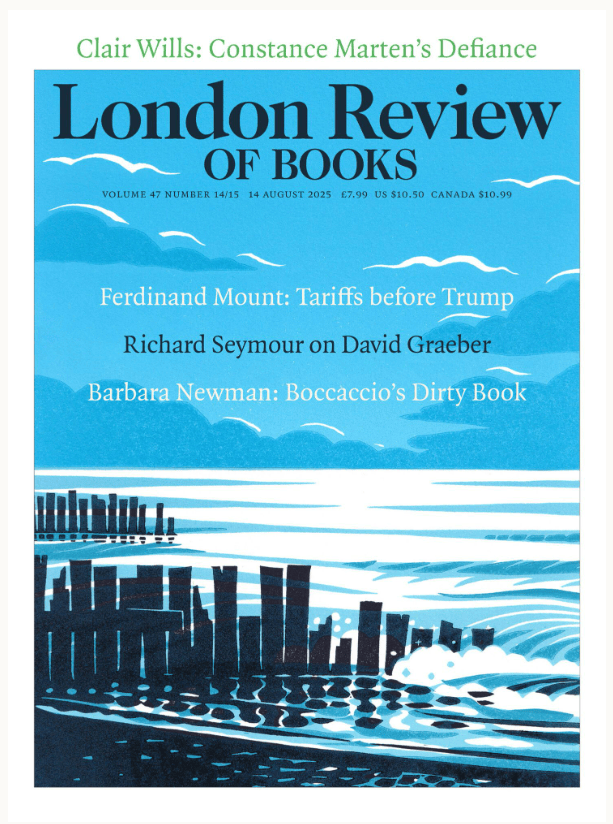
LONDON REVIEW OF BOOKS: The latest issue features Tariffs Before Trump; Boccaccio’s Dirty Book and Constance Marten’s Defiance

Exile Economics: If Globalisation Fails by Ben Chu

No Trade Is Free: Changing Course, Taking on China and Helping America’s Workers by Robert Lighthizer

White Light: The Elemental Role of Phosphorus – in Our Cells, in Our Food and in Our World by Jack Lohmann

Boccaccio: A Biography by Marco Santagata, translated by Emlyn Eisenach

Boccaccio Defends Literature by Brenda Deen Schildgen

TIMES LITERARY SUPPLEMENT – AUGUST 8, 2025 PREVIEW

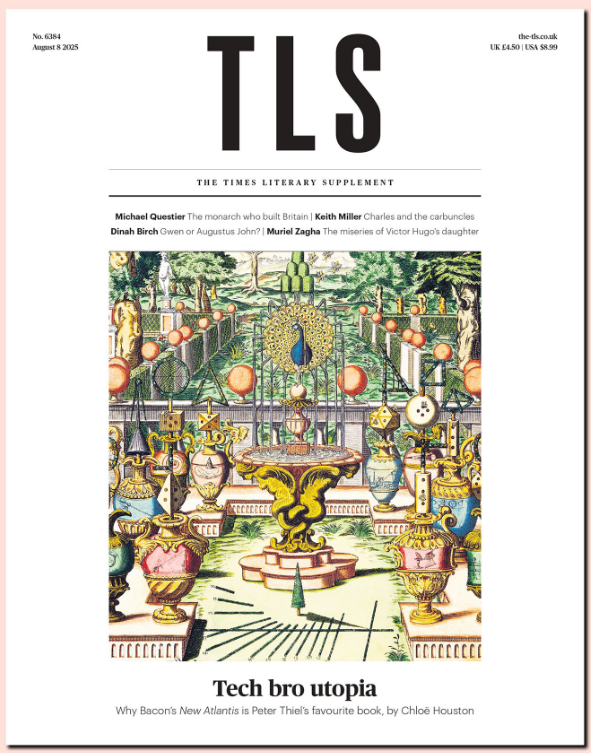
TIMES LITERARY SUPPLEMENT: The latest issue features ‘Tech Bro Utopia’ – Why Bacon’s New Atlantis is Peter Thiel’s favorite book; The monarch who built Britain; Charles and the carbuncles; The miseries of Victor Hugo’s daughter…

LITERARY REVIEW – AUGUST 2025 NEW BOOKS PREVIEW

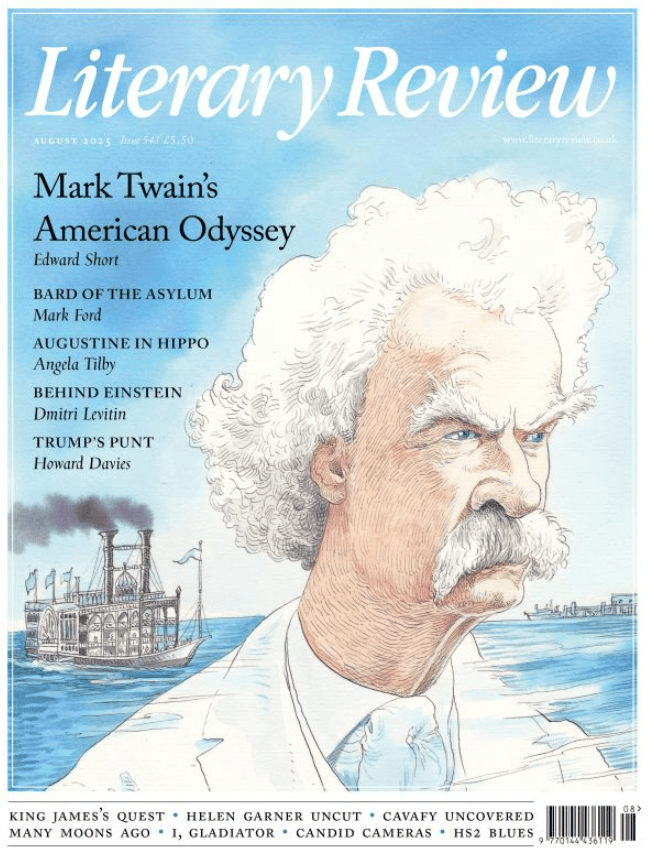
LITERARY REVIEW (August 2, 2025): The latest issue features ‘Mark Twain’s American Odyssey’…

The Bard & the Builders: The Dream Factory: London’s First Playhouse and the Making of William Shakespeare By Daniel Swift

Hannibal’s Lament: Carthage: A New History of an Ancient Empire By Eve MacDonald

Colosseum Confidential: Those Who Are About to Die: Gladiators and the Roman Mind By Harry Sidebottom