Enhanced charge density wave coherence in a light-quenched, high-temperature superconductor
The deubiquitinase USP8 targets ESCRT-III to promote incomplete cell division
All topological bands of all nonmagnetic stoichiometric materials

Nature Magazine, May 19, 2022 – At industrial scales, chemical reactions are typically driven by applying continuous heat to the reactants. In this week’s issue, Liangbing Hu and his colleagues show that pulsed heating and quenching can enhance synthetic performance while also saving energy.
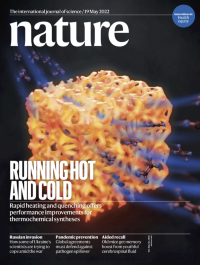
The researchers use a programmable electric current to switch between high and low temperatures very quickly — typically 0.02 seconds on, 1.08 seconds off. Rapidly quenching the reaction gives high selectivity, maintains catalyst stability and reduces energy usage. The cover image illustrates the heater in action for the pyrolysis of methane — the model reaction the team tested. Methane molecules travel through the pores of the high-temperature heater and are selectively converted into useful products.
COVER STORIES
Dark matter makes up most of the matter in the Universe, and is thought to be needed for galaxies to form. But four years ago, astronomers made a perplexing, and controversial discovery: two galaxies seemingly devoid of dark matter.
This week the team suggests that a cosmic collision may explain how these, and a string of other dark-matter-free galaxies, could have formed.
Research article: van Dokkum et al
News and Views: Giant collision created galaxies devoid of dark matter
How fossil fuel burning has caused levels of helium to rise, and a high-efficiency, hybrid solar-energy system.
Research Highlight: Helium levels in the atmosphere are ballooning
Research Highlight: Flower power: ‘Sunflower’ system churns out useful energy
We hear the stories of scientists whose lives have been affected by Russia’s invasion of Ukraine, including researchers who have become refugees, soldiers and activists in the face of a horrifying conflict.
Nature Feature: How three Ukrainian scientists are surviving Russia’s brutal war
Last week, a team of researchers released an image of Sagittarius A*, the supermassive blackhole at the centre of our galaxy. We hear how they took the image and what it is revealing about these enormous objects.
Nature News: Black hole at the centre of our Galaxy imaged for the first time
A survey of cell types across tissues as part of the Human Cell Atlas, mapped with single-cell transcriptomics in three papers in this issue, lays the foundation for understanding how cellular composition and gene expression vary across the human body in health, and for understanding how genes act in disease.
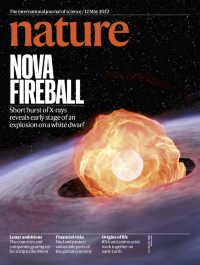
Nova explosions occur when a runaway thermonuclear reaction is triggered in a white dwarf that is accreting hydrogen from a companion star. The massive amount of energy released ultimately creates the bright light source that can be seen with a naked eye as a nova. But some of the energy has been predicted to be lost during the initial stages of the reaction as a flash of intense luminosity — a fireball phase — detectable as low-energy X-rays. In this week’s issue, Ole König and his colleagues present observations that corroborate this prediction. Using scans taken by the instrument eROSITA, the researchers identified a short, bright X-ray flash from the nova YZ Reticuli a few hours before it became visible in the optical spectrum. The cover shows an artist’s impression of the nova in the fireball phase.
Research efforts to learn more about diseases of the human eye have been hampered as these organs degrade rapidly after death, and animal eyes are quite different to those from humans.
To address this, a team have developed a new method to revive retinas taken from donors shortly after their death. They hope this will provide tissue for new studies looking into the workings of the human eye and nervous system.
Research article: Abbas et al.
A technique that simplifies chocolate making yields fragrant flavours, and 3D imaging reveals some of the largest-known Native American cave art.
Research Highlight: How to make a fruitier, more floral chocolate
Research Highlight: Cramped chamber hides some of North America’s biggest cave art
How did the earliest biochemical process evolve from Earth’s primordial soup? One popular theory is that life began in an ‘RNA world’ from which proteins and DNA evolved. However, this week a new paper suggests that a world composed of RNA alone is unlikely, and that life is more likely to have begun with molecules that were part RNA and part protein.
Research article: Müller et al.
News and Views: A possible path towards encoded protein synthesis on ancient Earth
We discuss some highlights from the Nature Briefing. This time, the ‘polarised sunglasses’ that helped astronomers identify an ultra-bright pulsar, and how a chemical in sunscreen becomes toxic to coral.
Nature: A ‘galaxy’ is unmasked as a pulsar — the brightest outside the Milky Way
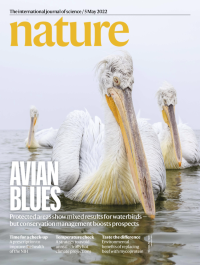
Conservation efforts for waterbirds, such as the Dalmatian pelicans (Pelecanus crispus) pictured on the cover, have centred on creating protected areas to maintain suitable habitats. But it has been unclear to what extent protected areas affect species’ population levels. In this week’s issue, Hannah Wauchope and her colleagues present an analysis that suggests protected areas have a mixed impact on waterbird populations. The researchers examined 1,506 protected areas to assess how they affected 27,055 waterbird populations across the globe. By assessing population levels before and after the implementation of protection, and comparing this change between protected and unprotected areas, the researchers identified the mixed impact, but also saw a strong indication that areas that were managed for waterbirds or their habitats were more likely to benefit populations. As a result, the team suggests that conservation strategies will require not only an increase in the number of protected areas, but active management of those areas to have the best chance of success.
Download PDF – Sites compete to mark global changes of the 1950s and define new geological age
Download PDF – Agency wants to retool its surveys and decennial census to improve efficiency and generate better data
Download PDF – Critics challenge data underpinning “resolution immunology,” triggering university probes
Download PDF – As prosecutors evaluate complaints from animal rights groups, labs try to reduce surplus
Download PDF – Atmospheric analog to ocean’s acoustic channel could be used to monitor eruptions and bombs
How a move to microbial protein could affect emissions. It’s well understood that the production of meat has large impacts on the environment.
This week, a team show that replacing 20% of future meat consumption with protein derived from microbes could reduce associated emissions and halve deforestation rates.
Research article: Humpenöder et al
News and Views: Mycoprotein produced in cell culture has environmental benefits over beef
How saltwater crocodiles’ penchant for pigs is driving population recovery in Australia, and solving the mystery of some eighteenth-century porcelain’s iridescent lustre.
Research Highlight: Pork dinners fuel huge crocodiles’ return from near-extinction
Research Highlight: The nanoparticles that give a famed antique porcelain its dazzle
Female Aedes aegypti mosquitoes strongly prefer human odours to those of animals, but how they distinguish between them is not well understood. Now, researchers have shown that human odours strongly activate a specific area in the brains of these insects, a finding that could have important implications for mosquito-control strategies.
Research article: Zhao et al.
We discuss some highlights from the Nature Briefing. This time, how climate change could affect virus transmission between mammals, and how the link between a dog’s breed and its temperament may not be as close as previously thought.
Nature: Climate change will force new animal encounters — and boost viral outbreaks
 Intellicurious