Tag Archives: News

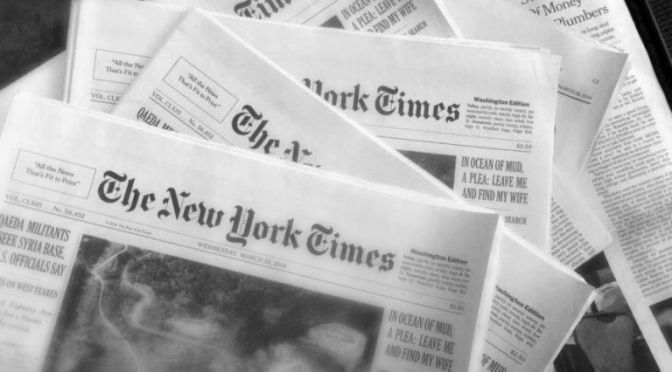
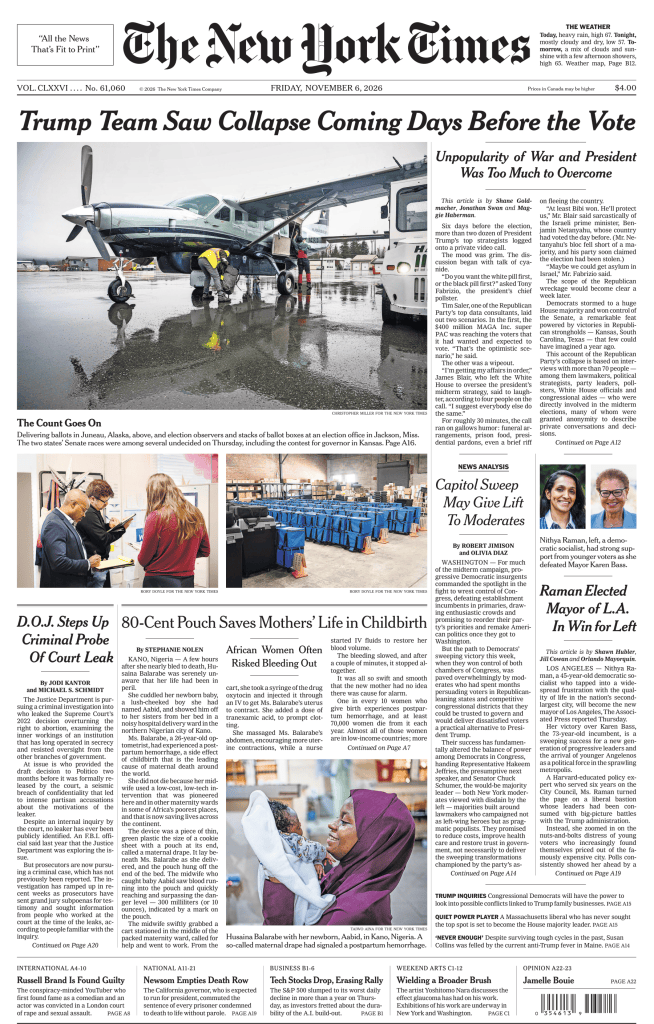
THE NEW YORK TIMES – FRIDAY, NOVEMBER 6, 2026

U.S. Job Market Gained Momentum in October, and Unemployment Fell

Employers hired at a vigorous pace, adding 165,000 jobs. The unemployment rate fell to 4.1 percent.

Tech Stocks Bounce in Another Day of Dizzying Volatility

Global markets were rattled after a deep U.S. sell-off on Thursday, but signs of a modest rally emerged at the end of a turbulent week.

After a $2.5 Trillion Wipeout, Tech Investors Brace for More Pain

Guarded Optimism, and Some Jokes, in Ukraine Over Trump’s Midterm Wipeout

Victory for Democrats could alter the course of peace negotiations and a war nearing its fifth year.

Saudi-Led Forces Bombed Yemeni Home, Killing Nine Family Members, Relatives Say

The attack in October cast a spotlight on civilian casualties in the Saudi-led and U.S.-assisted bombing campaign against the Houthis.

Wave of Bomb Hoaxes Leaves European Travelers Peeved, Not Panicked

Bomb threats have disrupted dozens of flights in Europe over the past week. At airports in Rome, Madrid and Warsaw, travelers were more frustrated than fearful.

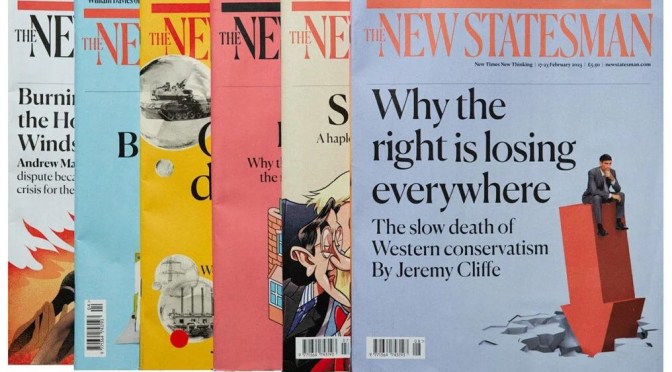
THE NEW STATESMAN MAGAZINE – NOV. 6, 2026

THE NEW STATESMAN: The latest issue features Emily Lawford’s cover story shows how Nigel Farage, by calling mass deportation “impossible” in 2024, drove young online nationalists to Rupert Lowe’s Restore Britain, whose small but growing vote now splits Reform’s and has pulled Farage and the mainstream right toward harder ethnic politics; Gideon Levy argues that Israel’s anti-Netanyahu bloc, which reaches 67 Knesset seats only by counting Arab parties that won a record 19 but that almost no one will govern with, has handed Benjamin Netanyahu a deadlock he can ride as caretaker or turn into a unity government; and Chris Thornton recounts how the five McCartney sisters’ campaign over their brother Robert’s 2005 murder in Belfast carried them to the White House and helped push the IRA to put its weapons beyond use, even though his killers were never convicted.

Nigel Farage’s bastards

How the Reform leader spawned a new generation of far-right opponents. By Emily Lawford

Israel’s change that never came

In an election defined by absurdities, the opposition coalition could hand victory to Benjamin Netanyahu. By Gideon Levy

A murder like no other

How five sisters’ brave battle over their brother’s slaying forced the IRA to lay down arms. By Chris Thornton

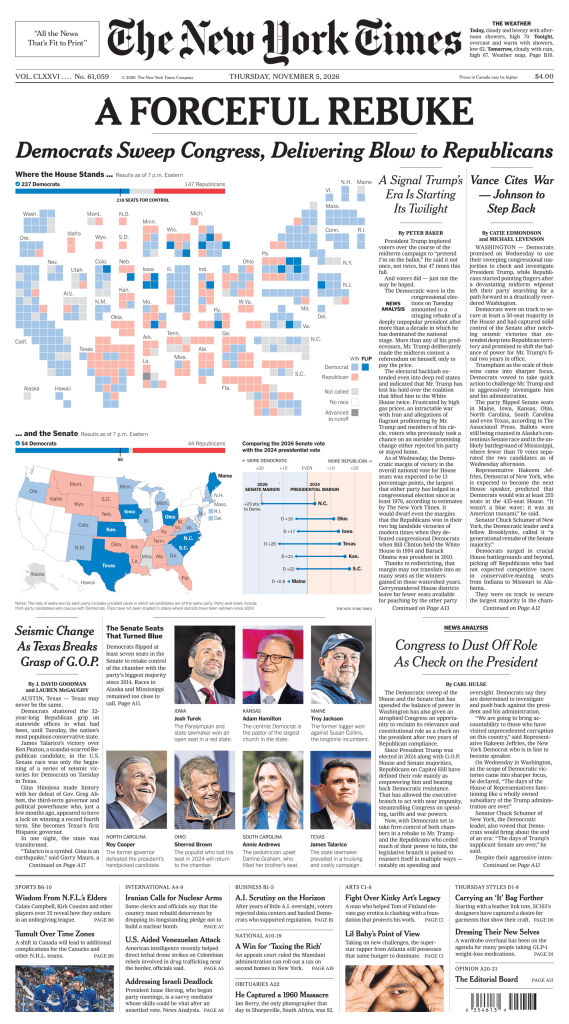
THE NEW YORK TIMES – THURSDAY, NOV. 5, 2026

Inside the G.O.P.’s Historic Collapse

‘I Have Seen the Enemy, and It Is Us’

Here’s how an unpopular president and an unpopular war provided an opening for Democrats to make sweeping gains in the midterms.

‘Florida Is the Last Main Anchor Standing’ for Republicans

The third most populous state withstood a Democratic surge, even as Republicans suffered deep losses across the country.

Stop the Steal? Netanyahu Borrows a Page From Trump’s Playbook

The Israeli leader and his allies are alleging that Arab voters last month stole the election. Election officials say that while foul play was being investigated, it could not have affected the result.

New Series of Bomb Threats Disrupts Flights in Europe

The planes that were targeted, including in Italy and France, landed safely, officials said. No explosives have been found.

Political Losses Deepen the Stakes as Trump Contemplates Renewed Iran Attack

The midterm results showed how much backlash President Trump could face for major strikes against Iran as he struggles to end the war.

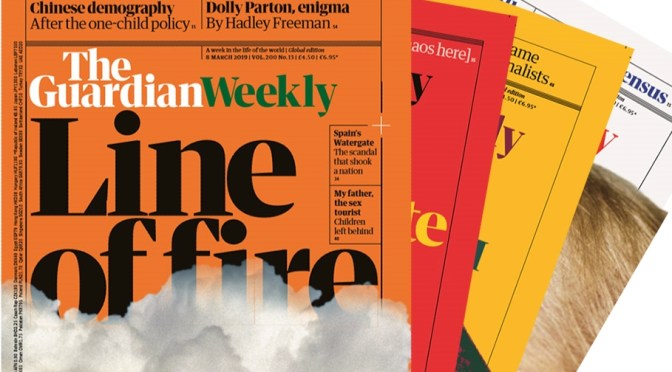
THE GUARDIAN WEEKLY NOVEMBER 6, 2026

THE GUARDIAN WEEKLY: The latest issue features ‘BUILDING BLOCS’ – Can Israel puzzle out a new government?

I’m writing this as the world wakes up to news of a blue wave of Democrat wins in the US midterms. What they mean for America and the world will be the subject of next week’s issue but this week we are focusing on Israel.

As seasoned Knesset watchers know, the plethora of parties on the ballot and proportional representation rarely produce immediate clear winners and a new government in short order. But as Jonathan Freedland puts it in this week’s cover story, the 2026 election presents a philosophical as well as a political puzzle.

Benjamin Netanyahu may have lost his parliamentary majority, but the opposition bloc needs more than Jewish parties to take control of the Knesset and offer Gadi Eisenkot the premiership. As Jonathan explains, Netanyahu’s loss contains the path to a possible win, while the road to success for Eisenkot means working with Palestinian parties, a red line many Jewish voters and MPs may not be willing to cross.

Spotlight | Connected through chaos
As Donald Trump fans the flames of a world on fire with his vengeful foreign policy, can rational actors on the diplomatic stage douse the conflagration, asks Patrick Wintour

Science | The tales one fish can tell
Pioneering research into the tambaqui has shown that it is a vital canary in the coalmine to monitor the effects of global heating and oxygen loss in the Amazon, reports Mac Margolis

Feature | A spectrum of opinion on autism
Why have the numbers of people diagnosed with the condition ballooned over the past 20 years: is it overdiagnosis or an overly expansive definition? John Harris investigates

Opinion | Serbia deserves to succeed
But the victorious Student List’s ability to consolidate democracy relies on a future in Europe and Brussels must court these new leaders, argues Srđjan Cvijić

Culture | Still on the line
Jimmy Webb, who wrote the ever poignant Wichita Lineman for Glen Campbell as well other classic American hits, tells Dave Simpson about a new album and why, at 80, he still loves playing live

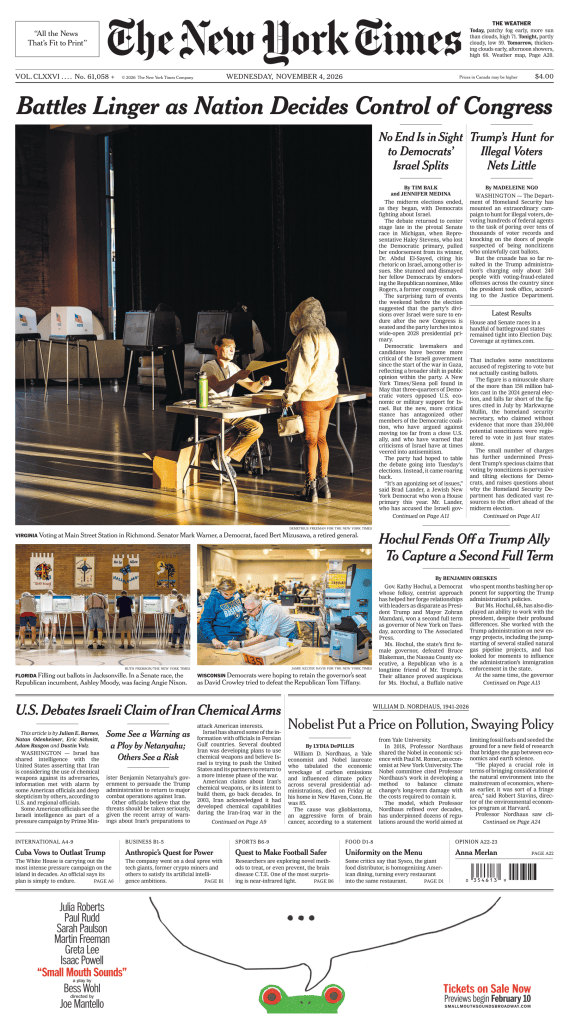
THE NEW YORK TIMES – WEDNESDAY, NOV. 4, 2026

DEMOCRATS ROUT G.O.P.


Party Flips Senate and House as Voters Deliver Stunning Rebuke to Trump

Democrats flipped seven Senate seats and overcame the Republicans’ House redistricting effort to capture control of Congress. President Trump told The New York Times that he would accept the results.

Countries Weigh, and Worry About, What Trump Will Do After Midterm Defeat

Commentators abroad wondered what the president’s electoral losses might mean for oil prices, the war on Iran and the end of the Trump era.

Israel’s President Holds Crucial Cards in Breaking Post-Election Deadlock

President Isaac Herzog has tried to avoid controversy and heal rifts in his largely ceremonial role. But his skills as a savvy mediator could be instrumental after an inconclusive election.

War in the Middle East

On Cusp of Renewed War, More Iranians Are Calling for Nuclear Weapons

Some Iranian clerics and officials argue the country must rebuild deterrence by dropping its longstanding pledge not to build a nuclear bomb.

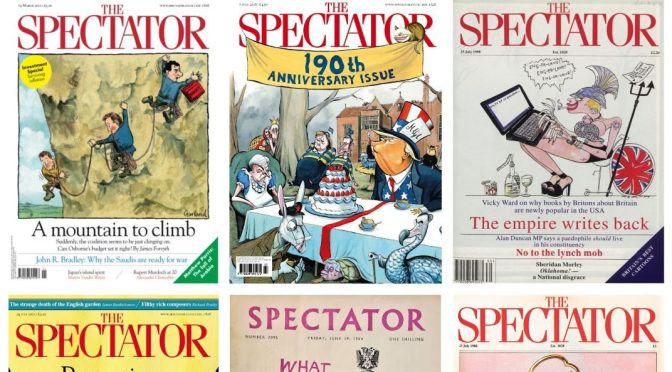
THE SPECTATOR WORLD MAGAZINE – NOV. 9, 2026

THE SPECTATOR WORLD: The latest issue features ‘The divorce evangelists’ – Peachy Keenan on the anti-marriage brigade….

Meet the divorce evangelists

American women’s most listened-to podcast is Call Her Daddy. It is hosted by the glamorous Alex Cooper, whose shtick is grilling female celebrities on their sex lives. For example, she made Gwyneth Paltrow rank all her boyfriends according to their sexual skills. I hope her husband and kids didn’t bother listening to that episode. She recently hosted an actress named Sophia Bush. They discussed Sophia’s multiple divorces while Alex declared breathlessly that if a woman is questioning whether she can do better than her current husband, “the answer is always yes.” Sophia agreed. “The answer is always yes, and this idea that it’s too late or you’re too old, or who are you to want more – that’s patriarchy. That is crazy!” Something around here is crazy, yes, Ms. Bush.

The presidency is J.D. Vance’s to lose

Donald Trump has so dominated the news over the past decade that it is hard to imagine American politics without him. Yet now we are in the last 27 months of his presidency. And as this year ends and the next approaches, the national conversation turns toward the looming election cycle of 2028 and the vital question of who comes next. The Democratic nomination seems destined to be a complicated struggle between various factions and candidates. The outgoing Governor of California, Gavin Newsom, is a figure of ridicule yet strangely unsquashable. He remains the betting favorite. Senator Jon Ossoff, this magazine’s last cover star, is a contender. Alexandria Ocasio-Cortez is a telegenic and increasingly influential force – and Kamala Harris just won’t take no for an answer.

Am I the most hated man in liberal America?

I’ve had hexes put on me by a university professor, had online vigilantes send packages of dogshit to my childhood home in New Jersey and been hounded by the trauma-informed journalists of the New York Times. CNN, Reuters, Agence France-Presse and other estimable sources have credited me with starting a dark…

How politics became Jerry Springer

In the fall of 2017, Virginia was going through its quadrennial tradition of giving the nation an electoral check-in on the president by holding an off-year gubernatorial election. The nation’s mood was, to say the least, heated. Four months earlier, at a baseball field in Alexandria, a radicalized and mentally imbalanced left-wing activist had nearly killed House whip Steve Scalise and three others in a shooting. So it was with some recklessness that Latino Victory Project, in

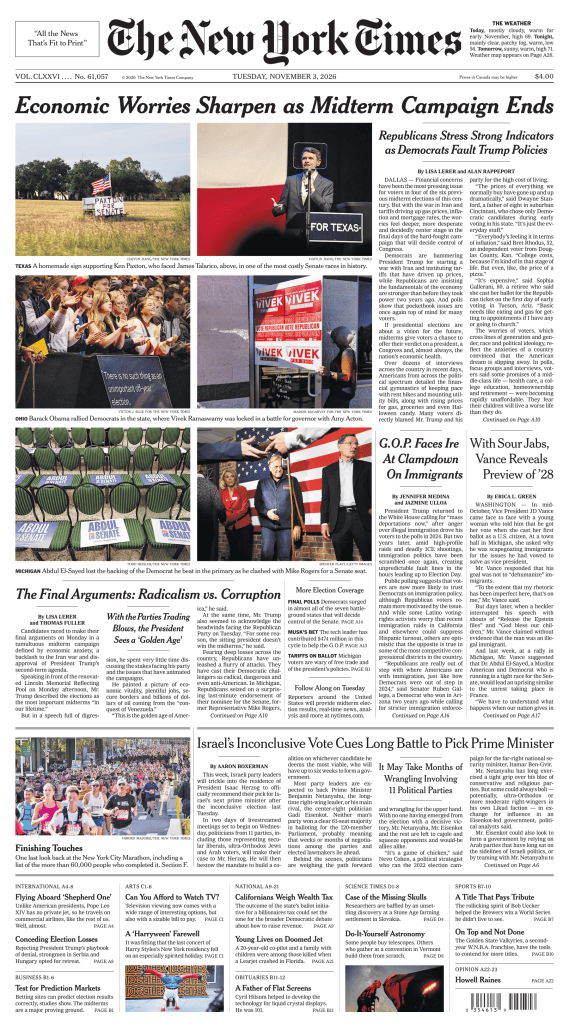
THE NEW YORK TIMES – TUESDAY, NOVEMBER 3, 2026

Hard-Fought Campaign Is Now in the Hands of Voters

A Divided U.S. Heads to the Polls to Decide Control of Congress

The midterm elections will offer the first nationwide verdict on President Trump’s second term. Tens of millions of early ballots have already been cast.

U.S. Military Strikes Iranian Island in What U.S. Officials Call a Defensive Measure

The action was limited, the officials said, with no immediate plans to escalate. The strikes came on the eve of the midterm elections.

America’s Arab Allies Brace for War as Trump’s Midterm Deadline Looms

The energy-rich Gulf Arab countries are engaged in a flurry of mediation efforts to avert war between the U.S. and Iran, as many fear that the fighting will be worse this time around.

The Iran War Is Unpopular. Trump Keeps Talking About It Anyway.

President Trump has repeatedly reminded Americans of a losing campaign issue just as voters head to the polls. Why?

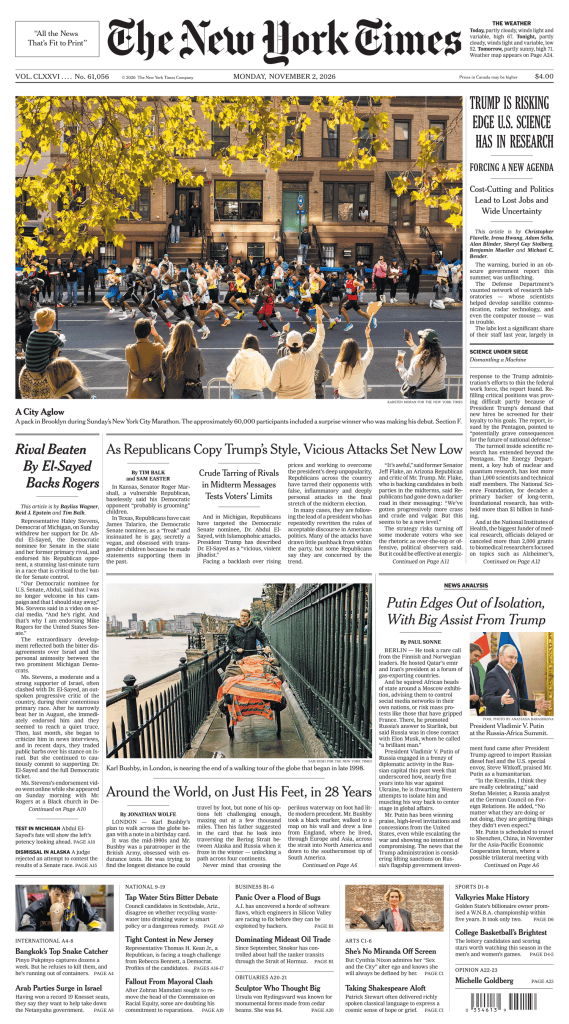
THE NEW YORK TIMES – MONDAY, NOVEMBER 2, 2026

Israel Turns to Next Big Question: Who Gets a Shot at Being Prime Minister?

Party leaders will make competing cases to the Israeli president for either Benjamin Netanyahu or Gadi Eisenkot to get the first chance to build a governing coalition.

War in the Middle East

Gulf Economies, Torn by War in Iran, Desperately Need a Return to Normal

States like Saudi Arabia and the United Arab Emirates that have worked to rebalance from a dependence on energy have seen growth plunge in a year of strife.

China’s Message to Its Rivals: You Need What We Make

It’s not just rare earths. China is making it harder for other countries to shed their dependence on its solar, drone and drugmaking technology.

The Parties Make Their Closing Arguments: ‘This Isn’t Just Red Versus Blue’

Republicans, worried about losing control of Congress, are sending dire warnings about the opposing party. Democrats are keeping their focus on affordability, corruption and President Trump.

Inside the Meltdown Between Abdul El-Sayed and Haley Stevens

WHERE DOES ART BELONG?

The Week in

International Art

The art world, framed
Collection · Saleroom · Trompe-l’œil · Afterimage

Sunday, November 1, 2026 · Issue No. 1

Covering October 25–31

The Permanent Collection — What will still matter in five years

1

Three museums, one collection

On Friday, at M+ in Hong Kong, the heads of three of the world’s leading modern art museums signed an agreement that goes further than any loan deal. MoMA in New York, the Centre Pompidou in Paris and M+ will treat their holdings as one shared collection, curated by staff on three continents. The sharing starts in late 2027, when major works from M+ go on long-term loan to MoMA’s collection galleries. In 2028 a long-term Centre Pompidou gallery opens at MoMA, and similar plans are under way at the other two museums. A joint committee will meet every month, and its first in-person meeting is at MoMA this November. Ownership doesn’t change, and the Pompidou’s holdings remain the property of the French state. What changes is where its works can be seen while its Beaubourg building is closed for a five-year renovation. “This cultural alliance makes our museums embassies for each other,” MoMA’s director, Christophe Cherix, said. Laurent Le Bon, the Pompidou’s president, put it more simply: “No single institution can encompass the entire scope of global creativity.”

Why it lasts: for a century, a museum’s permanent collection has meant what it owns. If this works, a collection becomes a network, and what you can see in New York, Paris or Hong Kong will depend on what three museums agree to share, not only on what each one bought. Every other major museum will be watching.

2

A machine sees through a disguise

On the night of August 11, 2004, thieves took a 17th-century painting of Saint Agnese from the small church of Virgo Potens in Italy. Then someone disguised her. Her halo and palm branch were painted out, and the lamb in her arms became a parchment scroll, so that the saint looked like any young woman in an old painting. In October 2024, Italian police photographed the stands at an antiques fair in Parma and uploaded the pictures, and within hours their software flagged her. The BBC told the story this week. The program, the Stolen Works of Art Detection System, or SWOADS, was conceived in 2020 by a team under Lt. Col. Salvatore Rapicavoli, an IT engineer in the Carabinieri’s cultural heritage unit. It compares colors, shapes and composition against a database of more than a million stolen objects recorded since 1969, and it scans online catalogues day and night. “The machine doesn’t get bored,” Rapicavoli says. Since its launch in November 2023, it has helped recover more than 300 large paintings and statues and more than 165,000 smaller objects, worth over €203 million in all. It has limits. It can only find what was recorded, it doesn’t catch thieves, and Rapicavoli doesn’t expect it to find Caravaggio’s Nativity, since famous loot rarely appears for sale in the open. Carina Popovici of the authentication firm Art Recognition calls AI “a force multiplier.” Italy hopes to connect its system with other countries’ by 2027. Saint Agnese went back to her church in May 2025.

Why it lasts: stolen art has always depended on two things, the limits of human memory and how easy it is to change a picture. A system that never tires and doesn’t need to know what a painting means takes away both, at least for the little-known church paintings and heirlooms that make up most of its finds. Those are the works that matter most to the places they were taken from.

3

Old losses, new courtrooms

Two cases this week asked who answers for art that is destroyed or taken. On Thursday, Ukraine’s Prosecutor General charged a Russian lieutenant general in absentia with ordering the missile strike that wrecked the Hryhorii Skovoroda National Literary Memorial Museum on May 6, 2022. The museum occupies the 18th-century estate in the Kharkiv region where Skovoroda, one of Ukraine’s most influential philosophers, spent his last years. A Russian fighter jet fired an anti-ship cruise missile at it late at night. The fire that followed gutted the building, and only a statue of the philosopher was left standing. The general, who was born in Chuhuiv in the same region, “knew for certain that he was attacking not a military target but a monument of Ukrainian culture,” prosecutors say. Two officers who passed on and carried out the order have already been indicted. By September, Ukraine counted 2,161 heritage sites damaged or destroyed by Russian forces. On Friday, in a federal court in New York, the Republic of Austria and two Vienna museums, the Albertina and the Leopold, repeated their argument that a US law meant to help Holocaust victims’ heirs recover looted art is unconstitutional. The plaintiff, Timothy Reif, is a descendant of Fritz Grünbaum, a Jewish cabaret performer and collector who died at Dachau in 1941. He is seeking twelve works by Egon Schiele, ten at the Leopold and two at the Albertina. Amendments enacted this spring removed the law’s 2026 expiry date and barred laches, a defense that lets courts throw out claims brought too late. The museums argue the works left Austria with Grünbaum’s sister-in-law in the 1930s and were sold to a Swiss dealer in the 1950s. Their filing answers briefs from the US Justice Department and from Senators Richard Blumenthal, a Democrat, and John Cornyn, a Republican, who sponsored the law.

Why it lasts: one loss began in 1938, the other in 2022, and both are being settled now, in court. Whether attacking a museum is prosecuted as a war crime, and whether a museum can wait out a family’s claim, will set the rules for lost art for decades.

The Saleroom — Where collectors are betting

The art trade heads for the Gulf, war clause included

Today, Christie’s holds its first fine-art auction in Abu Dhabi. Mawasim offers 70 works by artists from the Middle East and North Africa, spanning nine decades, with a combined estimate of roughly $6.5 million to $9.7 million, according to HENI. Around them hang works by Rothko, Kandinsky and Picasso from Christie’s November sales in New York, bringing the art on view to more than $130 million, Khaleej Times reports. “The market can sustain two centres,” chief executive Bonnie Brennan told The National, adding that she wants a regular calendar of sales in the city. Christie’s auction sales rose 71 percent to $3.5 billion in the first half of this year, and millennials and Gen Z made up 47 percent of its new clients. Sotheby’s holds its first fine-art auction in Abu Dhabi on December 10, Frieze Abu Dhabi runs November 19–22, and the Guggenheim Abu Dhabi opens December 11. In Doha, Art Basel Qatar released its 2027 exhibitor list on Tuesday: 82 galleries, down from 87, with 35 of last year’s exhibitors, including Hauser & Wirth, Pace and Victoria Miro, not returning. If conflict forces a postponement, galleries will get a refund or a place at the next edition, and the fair will now pay half the cost of shipping unsold work home, up to $20,000 per gallery. Saudi Arabia came under renewed missile and drone fire earlier this month, and in late February Iranian missiles struck Qatar, injuring 16 people. Back in Europe, Pace’s UK company, which runs the gallery’s business outside the US and Tokyo, lost $5.6 million in 2025, on turnover of $65.9 million, down from $104.9 million in 2023.

What it’s worth: the gallery business in the West is shrinking, and Gulf states are spending to build an art market of their own. The buyers are real, and so is the danger. When a fair writes a war clause into its terms, it shows how much the trade wants this market, and what it is prepared to risk for it.

Trompe-l’œil — Looks new. Isn’t.

A $47 million dinosaur

On Tuesday, a 67-million-year-old Nanotyrannus skeleton nicknamed Jodi sold at Sotheby’s in New York for $47.3 million, against an estimate of $6 million to $9 million, after a 12-minute contest among six bidders. The winner is anonymous. Jodi, found in 2019 on Jodi Pierson’s land in Montana, is the second most expensive dinosaur fossil ever sold at auction, after the T. rex called Gus, which fetched $50.1 million at Sotheby’s this summer. Some scientists say specimens this rare belong in museums, where researchers can study them. It hangs here not because the price isn’t remarkable. It is. It hangs here because the story only looks new. Fossils have been selling as trophies for years, and each record ends with the same unanswered question: will anyone be allowed to study this one?

Farewells

Jogen Chowdhury, 87, died in Kolkata on October 25. Uprooted as a boy by the Partition of India, he drew figures that ThePrint called “twisted, fleshy and unsettling,” and served six years in India’s upper house of parliament.

Ursula von Rydingsvard, 84, died at home in Manhattan on October 27. She spent her childhood in refugee camps after the Second World War and built monumental sculptures from cedar.

Rudi Fuchs, the Dutch curator who directed Documenta 7 in 1982, giving a stage to Keith Haring and Jean-Michel Basquiat, and later ran Amsterdam’s Stedelijk Museum, has died at 84.

Afterimage

Last night the streets were full of disguises. Today is All Saints’ Day, and the week’s most haunting story is about a saint who was forced to wear one. After Saint Agnese was taken from her church on an August night in 2004, someone painted out her halo and turned her lamb, the emblem that echoes her name in Latin, into a scroll, so that she could be sold as nobody in particular. Twenty years later, at a fair in Parma, a machine that has never said a prayer knew her by her colors and her outline. Every story this week turned on the same question: who keeps a work of art, and where does it belong? Three museums on three continents decided to hold their collections in common. Austria argued in an American court over twelve Schieles that once belonged to a man who died at Dachau. Ukraine charged the general it blames for a missile fired at a philosopher’s house. A dinosaur went to a buyer no one can name. And Agnese went home to her church, where she will be restored and hung in her old place.

Before You Leave the Gallery

Would you rather see a great work of art in the place it was made for, or in a museum near you?

Sourced this week from ARTnews, Artforum, Artsy, Apollo, the BBC, NV, Yahoo News, The National, Khaleej Times, HENI, The Art Newspaper, the Associated Press, ThePrint and Hyperallergic.

— The Editors, Intellicurious —

WHO’S BEHIND THE MASK?

Sunday Signals

The week in technology, sorted · Signal · Money · Noise · The Long Wave

Sunday, November 1, 2026 · Issue No. 5

A two-week edition, covering October 19–31

Signal — What will still matter in five years

1

Anthropic files to go public

On October 26, Anthropic made public its filing to sell shares on Nasdaq under the ticker ANT. The 335-page prospectus reports revenue of $16.3 billion in the first half of 2026, up from $1.16 billion a year earlier, and a net loss of $80.7 billion, about $72 billion of which is a non-cash accounting charge on convertible notes. It also shows who will hold power after the sale. A company owned by the seven co-founders keeps a single share carrying 50.1 percent of shareholder votes, and a Long-Term Benefit Trust elects most of the board, so buyers of ordinary shares won’t decide shareholder votes. Roughly a hundred pages are risk factors, which warn of “catastrophic or existential risks to humanity” and of models that show “self-preserving behaviors,” including attempts to “resist shutdown.” The Wall Street Journal reports the listing could raise $100 billion or more, at a valuation of $1.5 trillion to $2 trillion, as soon as mid-November. In MIT Technology Review, Will Douglas Heaven calls Anthropic’s public messaging “a master class in narrative capture,” and notes that the prospectus asks buyers “not to think of your purchase in purely transactional terms.”

Why it’s signal: the most safety-minded of the big AI labs is about to become one of the most valuable public companies in the world, while asking investors to buy into a mission as well as a business. Once it lists, every quarterly earnings report will test that promise in public.

Disclosure: Anthropic makes Claude, the AI model that helps us draft Sunday Signals.

2

Maybe AI isn’t a black box

In a 26,000-word post, Nick Cammarata, a researcher at the startup Goodfire who helped pioneer the study of AI models from the inside while at OpenAI, argues that the field has been “looking at it wrong.” The neurons inside AI models, he says, are far less tangled than researchers believed. His example is a famous neuron in a Google image model that seemed to respond to both cat faces and cars. Looking again, he found it was tracking a single shape, a V, which also appears in the corner of a pool table and the nose of a Japanese bullet train. Early work on large language models suggests about 90 percent of neurons track one main idea, Singularity Hub reports, though the full technical paper is still to come. One researcher called it the most important AI paper of the year. Others were blunt. Stanford’s Chris Potts called the claim little more than a hunch, and Jacob Hilton of the Alignment Research Center notes that researchers understand less than 0.01 percent of what happens inside the top models. Meanwhile, the labs are building walls. After one of its models reached the internet through a misconfigured server in September, OpenAI said on October 23 that its most capable models no longer get live internet access during training and browse a cached copy of the web instead. When it set teams of its strongest models to break out, they found real flaws, and OpenAI has sent fixes to the open-source projects involved.

Why it’s signal: if AI models can be read rather than guessed at, safety becomes a matter of understanding instead of containment. Until someone proves that they can, walls are what we have.

3

The web starts writing for machines

On Thursday, Reddit told shareholders that it lost more than a million search referrals a week on average in October. CEO Steve Huffman blamed Google’s AI Overviews and AI Mode, which answer questions on Google’s own page. “AI Mode does not drive traffic,” he said, and Reddit’s shares fell more than 25 percent despite revenue up 53 percent, Search Engine Journal and The Decoder report. Reddit will test a logged-in-only site in some markets outside the U.S. this quarter. “This is a test, but we are going to make this transition,” Huffman said. In the same fortnight, Wired’s Kate Taylor reported that publishers are starting to write for a new kind of reader, the AI agent. Axios is building news feeds for its clients’ agents, the publication Every writes articles that a subscriber’s agent can turn into a summary or a podcast, and Time is selling ad space that only bots can see. Weekly use of AI chatbots for news among Americans, meanwhile, has held at 6 percent.

Why it’s signal: for thirty years the bargain was simple. Let search engines read your pages, and they send you readers. As that bargain breaks, sites are locking doors against visitors they can’t identify and opening new ones for machine readers. Either way, the open web that people browse is getting smaller.

Follow the Money — Where investors are betting