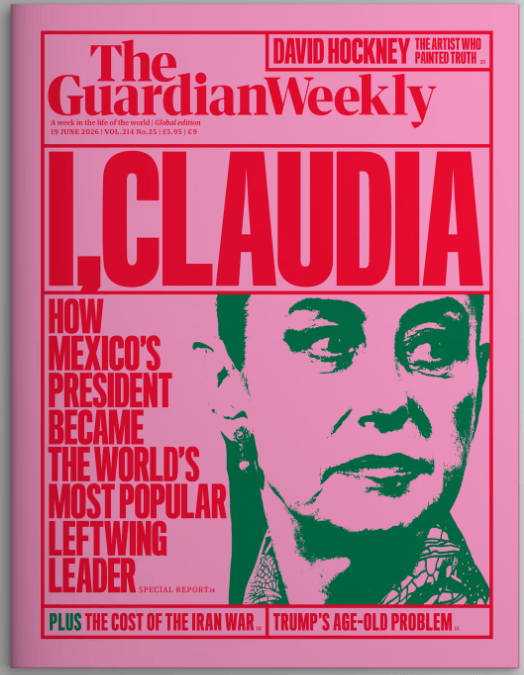
Claudia Sheinbaum must be doing something right. With a consistent approval rating of around 70% since becoming Mexico’s president in 2024, the former climate scientist – and protege of her predecessor, Andrés Manuel López Obrador – is the world’s most popular leftwing leader. She is also the first female leader of one of Latin America’s most macho countries.
Yet despite her soaring popularity, driven in part by major universal healthcare reforms, there is a curious tension between Sheinbaum’s disciplined, scientific approach to governing and the messy, often violent politics of modern Mexico. Her handling of the country’s ongoing crisis of disappearances, the continuing influence of organised crime and the rising presence of the army in national life are all issues she has faced criticism over.
The big story | Counting the cost of the war on Iran With a peace deal expected to be signed later this week, Oliver Holmes examines the human, economic and environmental toll of a conflict that appears to have achieved nothing
Science | How the loss of wild bees impacts human health Crops and flowers rely on them for survival, but wild bees are declining – and crucial nutrients will go missing from our diets as a result. Gloria Dickie reports
Feature | How personal taste fell out of fashion Our favourite music, clothes and books used to be markers of individuality – but algorithms have made us all sheep. Rachel Aroestimeets the style rebels fighting back
Opinion | If Kyiv has really got Putin on the run, he won’t accept peace meekly Don’t expect the Russian president to pursue peace, says Simon Tisdall – instead, he could continue to expand the war beyond Ukraine’s borders, with dire risks for us all
Culture | The revolutionary art of David Hockney Guardian critic Jonathan Jones pays tribute to the artist whose work was a feast of visual pleasures
“I love inflation,” said Donald Trump earlier this month, when asked about the latest increase in the Consumer Prices Index to an annualized 4.2 percent. But the power of the President’s positive thinking cannot overwhelm the enormous threat that rising prices pose to his legacy. The new figure is more than an inconvenience or a technicality. It could bring about a sharp change in the political order. Rising costs will likely prove to be Trump’s undoing and present the Democrats with a free hit for November’s midterms and beyond. There was one reason above all others why Trump returned to the White House in 2024: high inflation during the Biden years. His 2016 slogan, “Make America Great Again,” morphed into “Make America Affordable Again.
“I don’t think there’s anything that’s going to get me into heaven,” Donald Trump told a group of journalists aboard Air Force One in October. “I think I’m not, maybe, heaven-bound.” “My phone started blowing up,” says Paula White-Cain, Trump’s senior advisor to the White House Faith…
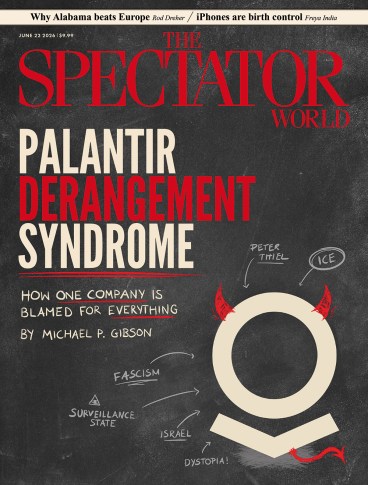
A late spring outbreak of righteous indignation is affecting the United Kingdom. It’s yet another variant of Palantir Derangement Syndrome. Virologists tracked this smug neurosis as it jumped across the Atlantic from the American left to British Labour. Symptoms include selective blindness, performative anguish, a hilarious inability to grasp the facts and Tourette’s-level
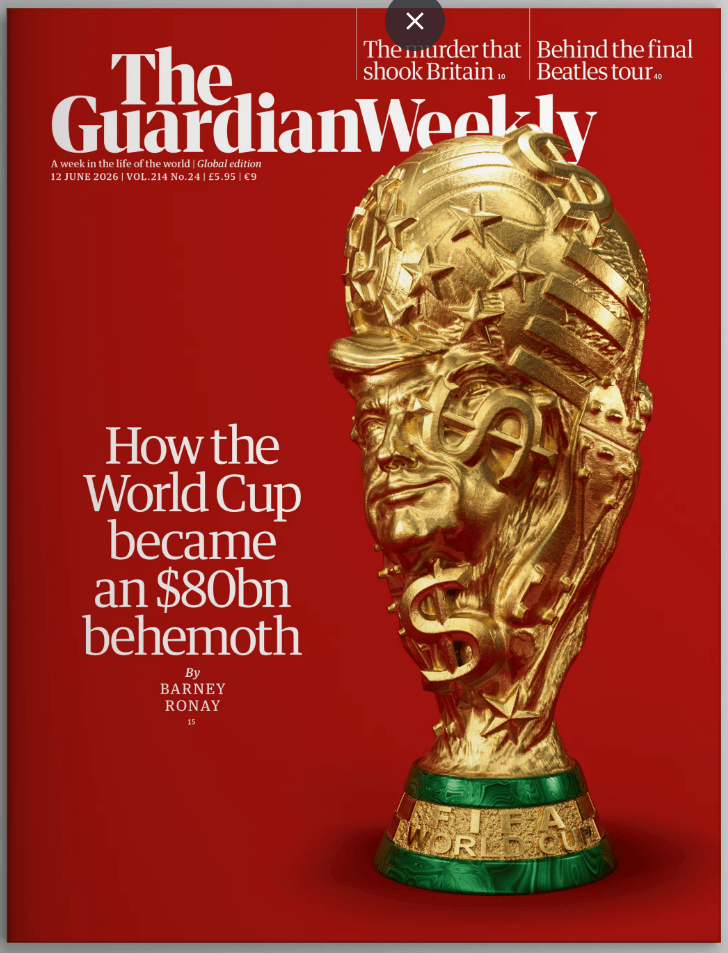
It’s long been a golden rule of sport that football World Cups get bigger and badder every four years. The latest edition of the tournament, however, may put that universal law to the test after a six-week journey through Trump’s America, which is expected to generate $80bn of global economic output through its full timeline.
As the world’s biggest sporting event meets the world’s biggest market, it’s hard to see how even the World Cup can get much more bloated than this. But if anyone can make it happen it’s Gianni Infantino, the opportunist Fifa overlord who has schmoozed with the planet’s most divisive leaders to extract maximum gains from his travelling global roadshow. As Barney Ronay says in his tournament scenesetter for our cover story this week, welcome to the heart of darkness.
The big story | How the murder of Henry Nowak shook Britain The aftermath of a tragedy revealed a country grappling with how easily such events can be co‑opted into a far-right rallying cry. Libby Brooks reports
Technology | Can autonomous AI killer drones be taught morality? While the technology is set to play a growing role in modern warfare, there remains an unresolved ethical challenge. Dan MilmoandAisha Down size up the terrain
Feature | Hello, goodbye: inside the final Beatles tour By the mid-1960s, the Beatles were ready to quit touring for good. A new collection of pictures by rock photographer Jim Marshall captures their last gigs. With a foreword by Ian Leslie
Opinion | Trump’s failure to maintain ceasefires is part of the new world disorder The US president brags about ending wars but look at Ukraine, Gaza, Iran and Lebanon to see what his casual disregard for diplomacy and obsession with instant results have achieved, argues Simon Tisdall
Culture | The ruthlessness and redemption of Rupert Everett The 67-year-old actor lied to his partners, disrespected his audiences and betrayed his friends. But has this indiscreet, unreliable heartbreaker finally grown up and settled down? Simon Hattenstone went to find out
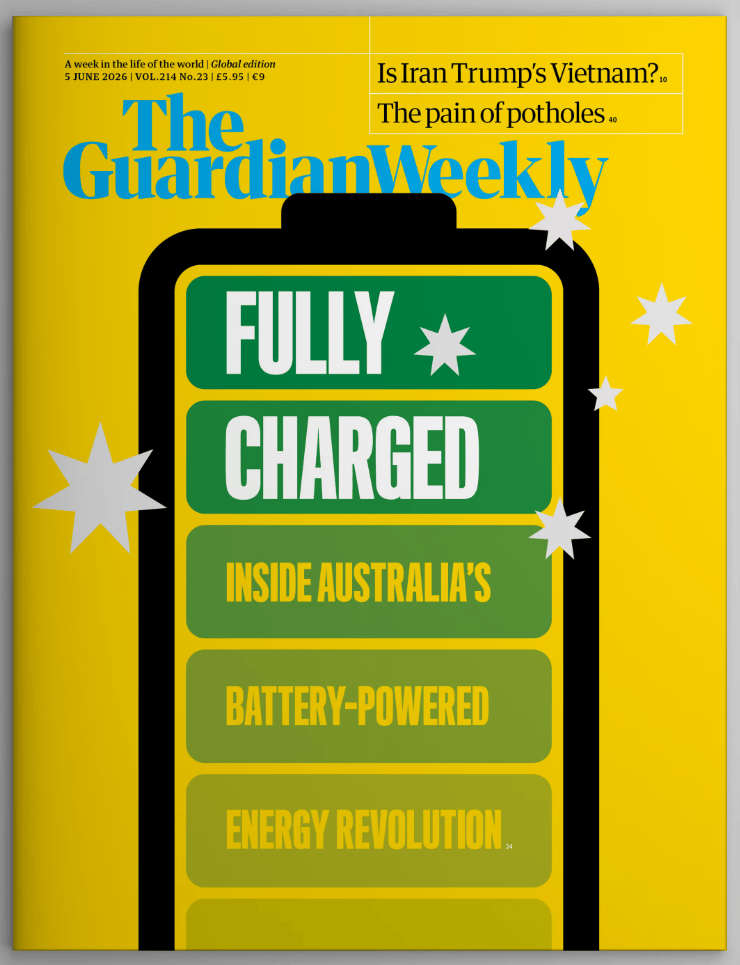
Last week, as the war in Iran continued to choke global oil supplies, the UK government announced a 13% increase in the cap on energy prices. But it was another related story on the other side of the world that caught my eye.
In Australia, the energy minister announced a fall of up to 10% in the benchmark electricity price in parts of the country, driven by record levels of renewables and batteries in the power grid.
Australia was already a world leader in domestic solar power. But with little fanfare, it is also pioneering a revolution in home renewables and battery usage, proving that with the right policy initiatives, profound changes can be made to the ways energy markets work.
Five essential reads in this week’s edition
The big story | Is the Iran war Trump’s Vietnam moment? The current Middle East conflict has been far shorter than the war that defined the 1960s and early 1970s, but it has rapidly revealed the strategic weakness of US firepower in an interconnected world, argues Patrick Wintour
Health | Cancer breakthroughs from the world’s largest oncology conference From groundbreaking genomic tests to tumour-shrinking injections, health editor Andrew Gregory reports from the American Society of Clinical Oncology’s annual meeting in Chicago
Feature | The people fighting back against pothole-riddled roads The dire state of roads has provoked pothole vigilantes and become a political flashpoint from Manchester to Manhattan. How did we get here? Oliver Franklin-Wallis reports
Opinion | If you’re still on Elon Musk’s X, ask yourself this: why? Some argue that quitting the platform formerly known as Twitter cedes the space to malign actors. But it’s an open sewer, beyond redemption, says Jonathan Liew
Culture | Children’s illustrators on the art of storytelling From The Twits to The Gruffalo and an angry bear in search of his hat … famous illustrators talk to Stuart Heritage about how they bring children’s books to life
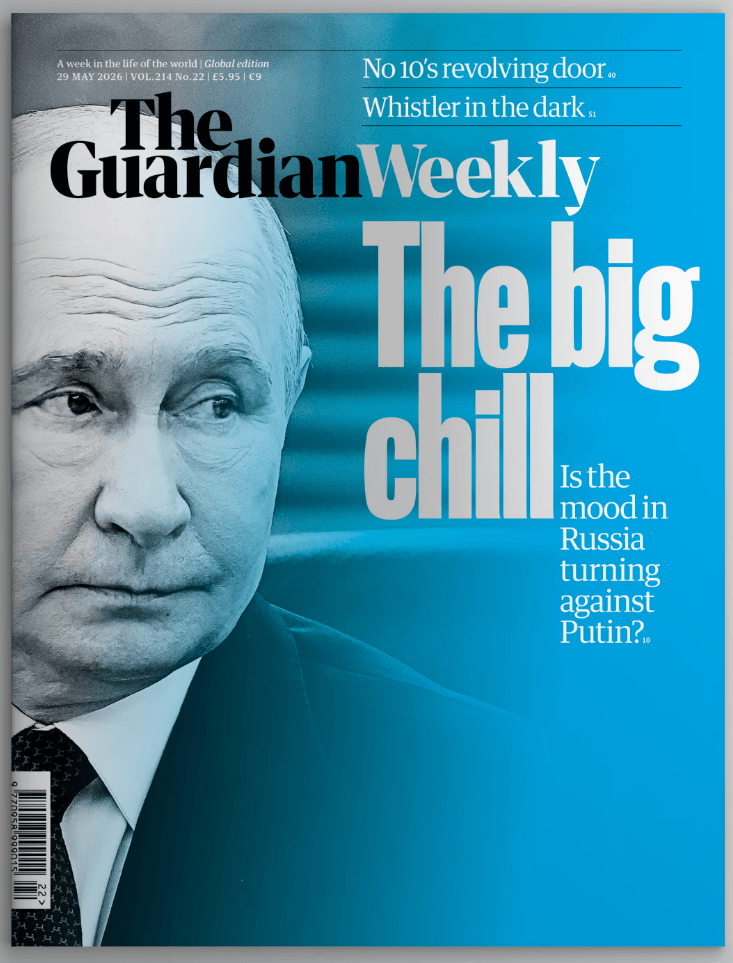
Like the majority of western news organisations, the Guardian has had no correspondent or reporter in Moscow since the invasion of Ukraine. But the Kremlin’s efforts to shut down outside media coverage has not stopped us from taking the political temperature of Russia. Indeed, as Pjotr Sauer and Shaun Walker report, attempts to close off the country have lost Vladimir Putin support among both the elites and ordinary citizens.
Talking to contacts made from many years working inside Russia, Pjotr and Shaun detail a shifting mood as the invasion drags on into its fourth summer with the economic and personal costs being increasingly felt at home. As one insider explains, “there is profound disappointment in Putin”, accompanied by “a growing sense that some kind of catastrophe is looming”.
The narrative of a bunkered ruler surrounded by underlings too scared to tell them the truth historically leads to putsch or revolution but our analysis shows that at present, though the winds may be chilling at home, Putin is far from being frozen out of power.
Spotlight | Ebola: ‘Out of control’ A new strain of virus, aid cuts and conflict in parts of the Democratic Republic of the Congo have hampered efforts to halt the spread of the virus, report Prosper Heri Ngorora in Goma and Carlos Mureithi
Science | Here be monsters An exhibition, Jurassic Oceans, at London’s Natural History Museum, showcases the fearsome creatures that once lurked below the surface – and offers a stark warning about the impact of warming waters on marine ecosystems today. Matthew Pearce dives in
Feature | When the lights went out in Berlin Earlier this year power was cut to a swathe of the German capital. A shadowy organisation, Volcano Group, claimed responsibility. But in the absence of any leads, theories of eco-terrorism, Russian meddling and far-right activity have flourished, discovers Ben Knight
Opinion | Victory doesn’t happen overnight Arsenal’s careful planning to regain the Premier League title is a lesson in long-term thinking that the Labour party, and Arsenal fan Keir Starmer, should pay attention to, argues Jonathan Freedland
Culture | Back to black with Whistler What does restoring Arrangement in Grey and Black No 1, or Whistler’s Mother, teach you about the artist who heralded a century of great American artists and about the craft of painting colour? Sarah Walden uncovers it all