
Tag Archives: Analysis

Airline Travel: Legacy Vs Low-Cost Carriers (WSJ)

Wall Street Journal (May 3, 2023) – United Airlines flies 988 routes globally with around 30,000 departures every week. How do airlines choose where to fly when they have so many flights every week?

Video timeline: 0:00 Meet Patrick Quayle, a global network planning executive 0:27 The hub-and-spoke network structure 2:50 The linear route system, point-to-point 4:45 When to update route networks

It turns out legacy airlines like American and Delta and low-cost airlines like Southwest and Spirit use different models when planning their route networks. WSJ asked United’s global network planning expert to explain how airlines plan and manage their routes.

Opinion: Israel At 75, Is Keir Starmer Ready To Lead UK?, ChatGPT ‘Language’ Issues

The Economist ‘Editor’s Picks’ Podcast (May 1, 2023) A selection of three essential articles read aloud from the latest issue of The Economist. This week, Israel: the survivor nation at 75, is Sir Keir Starmer ready to govern Britain? (10:25) And why ChatGPT raises questions about how humans acquire language (19:05). 

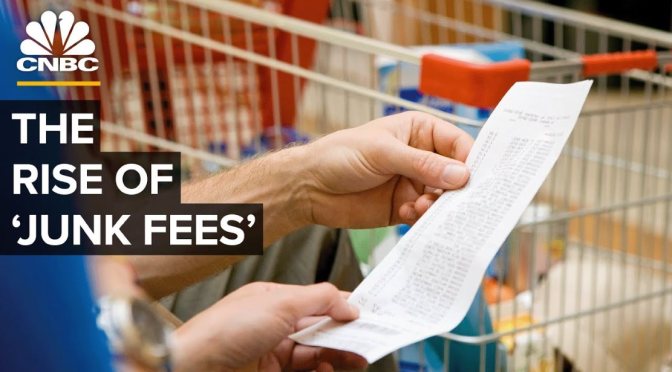
Business: How ‘Junk Fees’ Invaded The U.S. Economy

CNBC (April 25, 2023) – Americans are collectively spending nearly $65 billion on sneaky fees, according to the White House. “It really seems like companies have become addicted to junk fees,” Lina Khan, chair of the Federal Trade Commission, told CNBC.

Junk fees are making companies billions of dollars richer. Watch the video above to learn more about where junk fees hide, details of proposed changes, where policy may fall short and whether increased regulatory oversight may be enough to squash junk fees once and for all. Chapters: 0:00 Introduction 1:26 Defining ‘junk’ fees 5:34 Squashing fees 7:52 Policy problems 10:02 The future of fees

Opinion: Wise Worries On AI, Global Peace Crumbles, The English Identity Myth

The Economist ‘Editor’s Picks’ Podcast (April 24, 2023) This week, how to worry wisely about artificial intelligence, why in Sudan and beyond, the trend towards global peace has been reversed (13:00) and if English nationalism is on the rise, no one has told the English (19:30).

Review: How AI Is Now Disrupting Societies (DW)

DW News (April 23, 2023) – AI systems such as OpenAI’s ChatGPT are dominating headlines. There are concerns that their rise may lead to the displacement of millions of workers, blur the distinction between truth and falsehood, and amplify existing inequalities. Are the worries justified?

Business: Robots Helping Retailers Save Billions

CNBC (April 22, 2023) – Outfitted with cameras and sensors, autonomous inventory robots can verify price signs and look for out-of-stock items. Inventory is one of the biggest challenges retailers face.

Chapters: 0:002:07 Introduction 2:085:11 Chapter 1 Empty Shelves 5:129:26 Chapter 2 Inventory robots 9:2712:31 Chapter 3 The future

Missed sales from empty shelves and out-of-stock items cost U.S. retailers $82 billion in 2021, according to NielsenIQ. But an army of inventory robots is being deployed that could help retailers appease angry customers, boost sales and respond to the ongoing worker shortage.

Electric Vehicles: The 2023 Shanghai Auto Show (WSJ)

Wall Street Journal (April 21, 2023) – At this year’s auto show in Shanghai, international automakers like Volkswagen Group and Porsche are trying to keep up with Chinese EV manufacturers like BYD and Li Auto, who dominate China’s EV market.

Video timeline: 0:00 EVs and plug-in hybrids are in the spotlight at Auto Shanghai 0:37 BYD’s Seagull and Li Auto’s L8 on display 1:58 How international companies like Volkswagen and Porsche are trying to keep up with Chinese EV companies 3:07 What’s next for China’s EV market?

WSJ’s Yoko Kubota heads to the most prestigious car show in China and takes a look at what’s driving the latest trends.

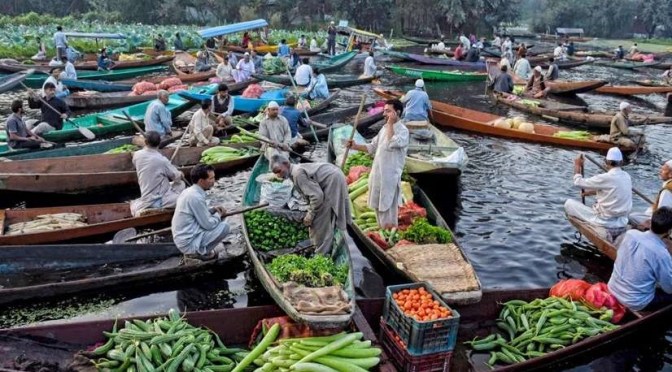
Culture: Dal Lake Floating Market, Srinagar, Kashmir

Insider Business (April 21, 2023) – For generations, farmers in Indian-administered Jammu and Kashmir have been selling their crops on the Dal Lake in a floating market. The lake is an economic hub for people living there – with many working in agriculture, fishing, and tourism. But decades of pollution have threatened their livelihoods.

The floating vegetable market on Dal Lake is in Srinagar, Kashmir, where locals trade out of their canoes. The produce sold here is grown in floating gardens.. The rich ecosystem of this wetland produces plenty of tomatoes, cucumbers, water chestnuts and the famous nadru (lotus roots, a delicacy in the Kashmir Valley).

They gather in the centre of the lake at dawn, and disappear just as sunlight hits the waters.

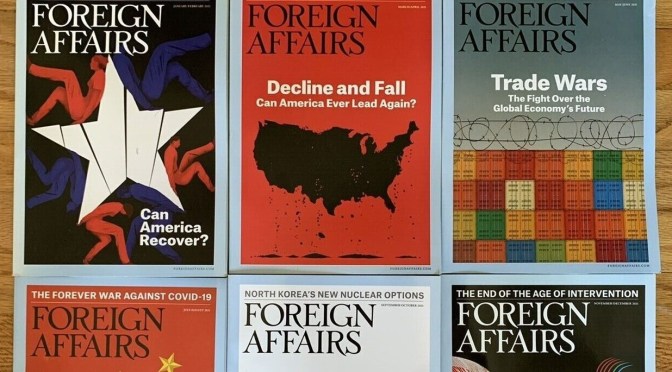
Preview: Foreign Affairs Magazine- May/June 2023

May/June 2023

Foreign Affairs – May/June 2023 issue:

In Defense of the Fence Sitters

What the West Gets Wrong About Hedging

Kumé Pather

As countries in the global South refuse to take a side in the war in Ukraine, many in the West are struggling to understand why. Some speculate that these countries have opted for neutrality out of economic interest. Others see ideological alignments with Moscow and Beijing behind their unwillingness to take a stand—or even a lack of morals. But the behavior of large developing countries can be explained by something much simpler: the desire to avoid being trampled in a brawl among China, Russia, and the United States.   

The Upside of Rivalry

India’s Great-Power Opportunity

Kumé Pather

For China, Russia, and the West, the last year has been one of fear and conflict. Russia’s invasion of Ukraine has killed tens of thousands, perhaps even hundreds of thousands, of people. It has prompted the United States and Europe to rearm and has pushed Moscow and Washington back into Cold War–style competition. 

Climate Change: 10 Foods That Keep Getting Pricier

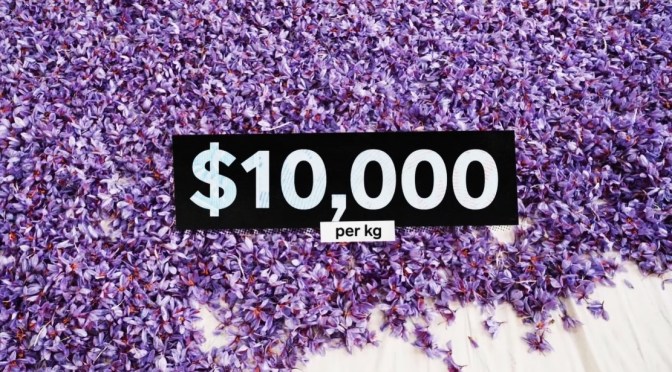
Insider Business (April 4, 2023) – Purple flowers in Kashmir produce the world’s most expensive spice — saffron. While it can sell for $10,000 per kilogram, climate change is making it even more expensive. Because of lower-than-usual rainfall over the last few years, production has dropped significantly.

And fields that once yielded this delicate spice have become sites for new housing construction. Climate change is threatening the production of all kinds of foods from cloves in India to eels in Japan and Spain. Here are 10 expensive, and vulnerable, foods and why climate change is making them so much more expensive.