From Christie’s article (April 16, 2020):
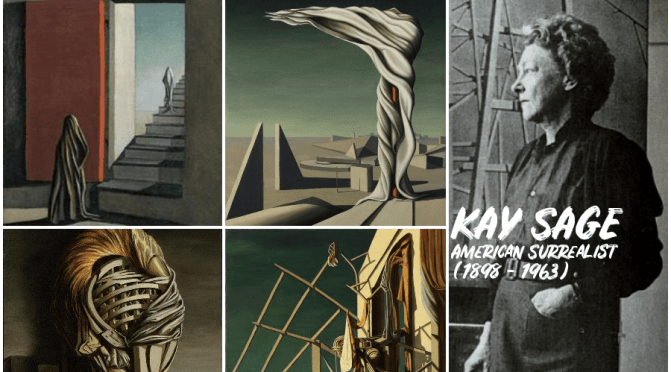
 Sage is renowned for her empty, enigmatic, eerily lit landscapes. Human figures are markedly absent — their presence felt only by the monolithic, architectural structures and unidentifiable, draped objects they seem to have left behind. In this respect, 1945’s Other Answers is a quintessential Sage painting.
In 1939, with clouds of war hovering over Europe, Kay Sage returned to the United States after more than two decades away. Her lover and fellow Surrealist, Yves Tanguy, soon followed her across the Atlantic, despite the fact that both of them were married to other people. In Sage’s case to an Italian prince — her official title was La principessa di San Faustino.
 In the summer of 1940, Sage had her first solo show, at the influential Pierre Matisse Gallery in Manhattan. Then, in early 1943, she was part of the landmark Exhibition by 31 Women, curated and staged by Peggy Guggenheim in her Art of This Century Gallery.
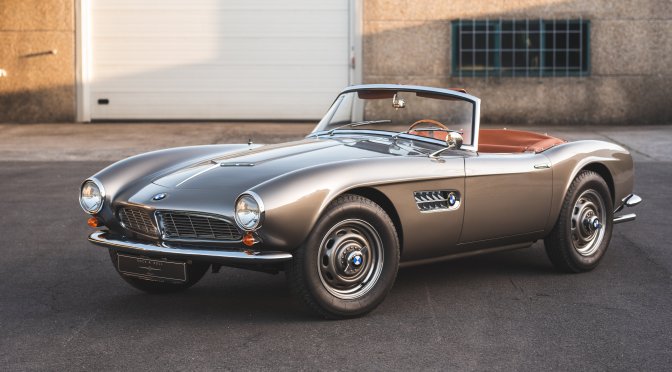
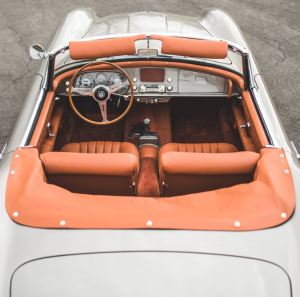 “Astonishing” is the word we are looking to describe this BMW 507. A word we use a lot if it comes to selling classic cars, but only a little few deserve this ‘title’ like this 507 does. When an exceptional model, with an unique story, from what the historical documents are well archieved, it just makes us going crazy. Add matching numbers and -colors tot his list and we are losing it totally. That’s no different with this 507.
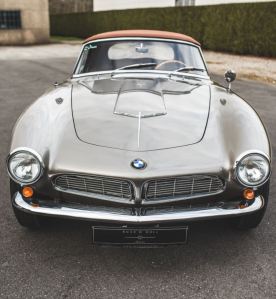 Max Hoffman convinced BMW that if they built a competitor to the Mercedes-Benz 300SL, he would sell it profitable in the United States. The BMW was intended to fill the gap between the affordable sports cars like the triumph and MG and the exclusive cars like the Mercedes-Benz 300SL and Ferrari 250 GT California. Though, BMW couldn’t achieve their target price, for what the BMW 507 was even more expensive than the 300SL. BMW found itself in a financial difficult situation and almost went bankrupt. At the end of the day, BMW recovered from this “failure” and the 507 even became a true flagship in the whole history of automotive.
 In the ‘50s BMW disposed over all fundamental ingredients which would make the 507 complete. An all-aluminium 3.2-litre V8 engine was placed in a shortened chassis of the 502. This ingenious masterpiece produced no less than 150hp and sounds like a guitar solo in your ears. To save weigt, the body was made of aluminium, which results in a 1280kg’s for a fully finished 507. Besides the phenomenal results, BMW wanted to offer luxury as well. Both aspects are just spot on.

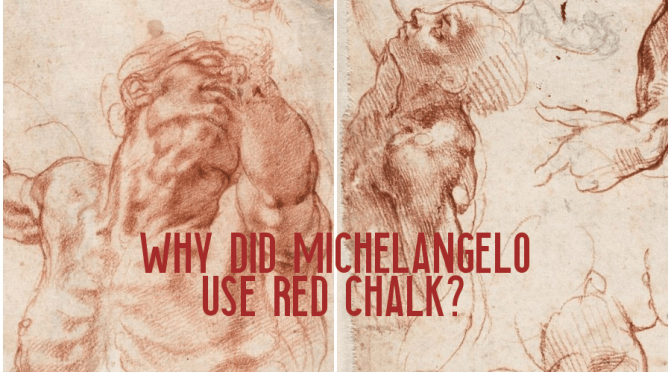
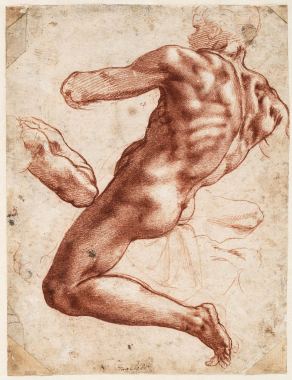 To work out the details of all the figures in pen and ink would have been extremely labor-intensive, and sharpening quills and mixing inks would’ve added an additional distraction. Drawing in chalk necessitated great skill, but it also allowed Michelangelo a flexibility. He could create subtle tonal variations by applying more or less pressure onto the chalk or by wetting it. The red chalk also provided an immediate mid-tone on the paper and could be easily blended when modeling and shading forms. Being a naturally occurring material that was available to artists in sticks that could be sharpened as desired, it was also convenient and portable.
 During his lifetime, Michelangelo likely produced tens of thousands of drawings. But being protective of his ideas, and to give an impression of effortless genius, he destroyed many of them. Today only about 600 drawings by the Renaissance artist survive.




 As gyms are closed and many of us are stuck at home, it’s an opportune time for home fitness platforms. We speak to Bruce Smith, founder of Hydrow, while Jason de Savary of London’s Core Collective talks about the gym’s new CCTV platform.
 Life-long entrepreneur and rower, Head of the Charles winner, coached the US Lightweight Eight to a Bronze medal at the 2015 World Rowing Championships and former Executive Director of Community Rowing – Boston.
 Benjamin Thompson, Noah Baker, and Amy Maxmen discuss Trump withholding funds from the WHO, and how COVID-19 kills. We also hear about controlling misinformation while communicating risk.