
Smithsonian · December 2026
Parrots, Palaces & Prime Ministers
The Spix’s macaw, Churchill’s Christmas with FDR, a Minoan road trip and California’s desert homesteads
Smithsonian’s December issue is about bringing things back, and what it costs to try. A project to return Brazil’s Spix’s macaw to the wild ends in a dawn police raid; a new breed of homesteader moves into the abandoned shacks of California’s high desert; Winston Churchill crosses the Atlantic in wartime to rescue an alliance he feared was slipping away; and a road trip around Crete goes looking for a Bronze Age civilisation that vanished almost without a trace.
Here is the issue, with our notes on the threads that run through it.
The Cover
Trouble in Paradise
Cover · December 2026
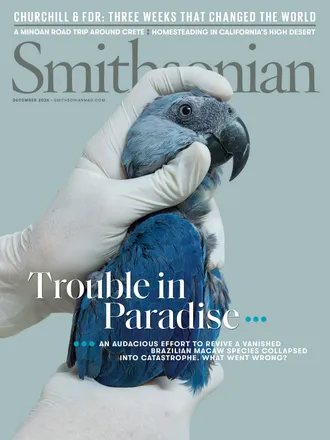
Two hands in white surgical gloves cradle a Spix’s macaw against a pale blue-green ground. The bird’s head is a soft grey-blue, its wings a deep cobalt, and it looks off to one side with something like wariness. The cover line asks what went wrong with an audacious effort to revive a vanished Brazilian species, and promises Churchill and FDR, a Minoan road trip and homesteading in California’s high desert.
The Cover Story
1. Flight Risk
By Joshua Hammer · Photographs by Miguel Monteiro · Cover Story
Hammer opens on a raid. At dawn on May 27, officers from ICMBio, Brazil’s environmental agency, backed by the Federal Police, descended on a breeding compound near Petrolina that held 103 Spix’s macaws, among the rarest animals on Earth. Many were disfigured by beak and feather disease, a viral infection that attacks the immune system, and the officers left with only the birds that had tested clean.
The raid marked the collapse of a multimillion-dollar experiment. The blue parrot, made famous by the 2011 animated film Rio, had vanished from the wild decades ago and been bred back from a tiny captive population. In 2022, 20 birds were released into the Caatinga, where many thrived and began to breed, and 400 more were planned over the next 20 years. For a while it seemed extinction might be reversible. Hammer asks what went wrong.
Features
By Evan Thomas and Oscie Thomas · History
On the morning of December 10, 1941, Churchill was in bed at Downing Street when the first sea lord rang: Japanese aircraft had sunk the Prince of Wales and the Repulse in the South China Sea, and their commander, his friend Tom Phillips, had drowned. Churchill, who loved his battleships, wept in private for two days.
Pearl Harbor, three days earlier, had seemed to promise salvation. But Roosevelt asked Congress to declare war on Japan, not Germany; lend-lease supplies were suspended; and Hong Kong and Singapore now lay exposed. Churchill went straight to the American ambassador, John Winant, to insist on crossing the Atlantic at once to see Roosevelt face to face. The Thomases tell how the three-week Christmas summit that followed changed the course of the war.
3. Embarking on a Minoan Odyssey
By Tony Perrottet · Photographs by Myrto Papadopoulos · Travel
Around 1500 B.C. the Minoans built a network of stone-paved roads across Crete, and Perrottet imagines Europe’s first road-trippers: travellers landing from Egypt on the south coast, riding some 30 miles through vineyards and olive groves, and stopping at the Caravanserai near Knossos, one of the oldest surviving hostels in the world, with its bathhouse, piped water and frescoes of birds, before the palace itself rose before them.
Following them by rental car, he reaches Knossos at dusk in summer, when the site stays open until 8 p.m. and the crowds have gone, leaving only cicadas in the olive trees. His journey across the island traces the rise, splendour and mysterious disappearance of Europe’s most enigmatic Bronze Age civilisation.
By Richard Grant · Photographs by Wayne Martin Belger · Feature
In California’s high desert, the homestead shacks left behind by an earlier era are finding new tenants. Grant meets a new generation of pioneers who see wonder where others saw only desolation.
The Threads
Bringing back the lost. A parrot bred back from near extinction, homesteads reclaimed from the desert, and a palace civilisation reconstructed from its roads and ruins. (1, 3, 4)
Journeys with a purpose. A police convoy across the Caatinga, a prime minister’s wartime crossing of the Atlantic, and a Bronze Age traveller’s chariot ride to Knossos. (1, 2, 3)
Fragile triumphs. The macaw’s release seemed to prove extinction could be undone, and Pearl Harbor seemed to guarantee Britain’s rescue; in both cases the relief came too soon. (1, 2)
Before You Close the Issue
What does it take to bring back something that has vanished, whether a bird, an alliance or a whole civilisation, and how do we know when we have?
Drawn from Smithsonian, December 2026. Visit the homepage at smithsonianmag.com.
— The Editors, Intellicurious —

