
The New Statesman · 20–26 November 2026
Brussels, Bond & Backlash
The rejoin dilemma, the prophecies of Ted Heath and the hidden costs of #MeToo
Ten years after the referendum, this week’s New Statesman asks whether Britain can go on facing both ways. Tom McTague’s cover essay sees a country pulled between Washington and Brussels and running out of time to choose, and his editor’s note finds an unlikely prophet of that choice in Ted Heath. Elsewhere the issue weighs the hidden costs of #MeToo, the crisis of young people out of work, the Democrats’ dilemmas after the midterms and a James Bond about to get strange.
Here is the issue, with our notes on the threads that run through it.
The Cover
The Rejoin Dilemma
Cover · 20–26 November 2026
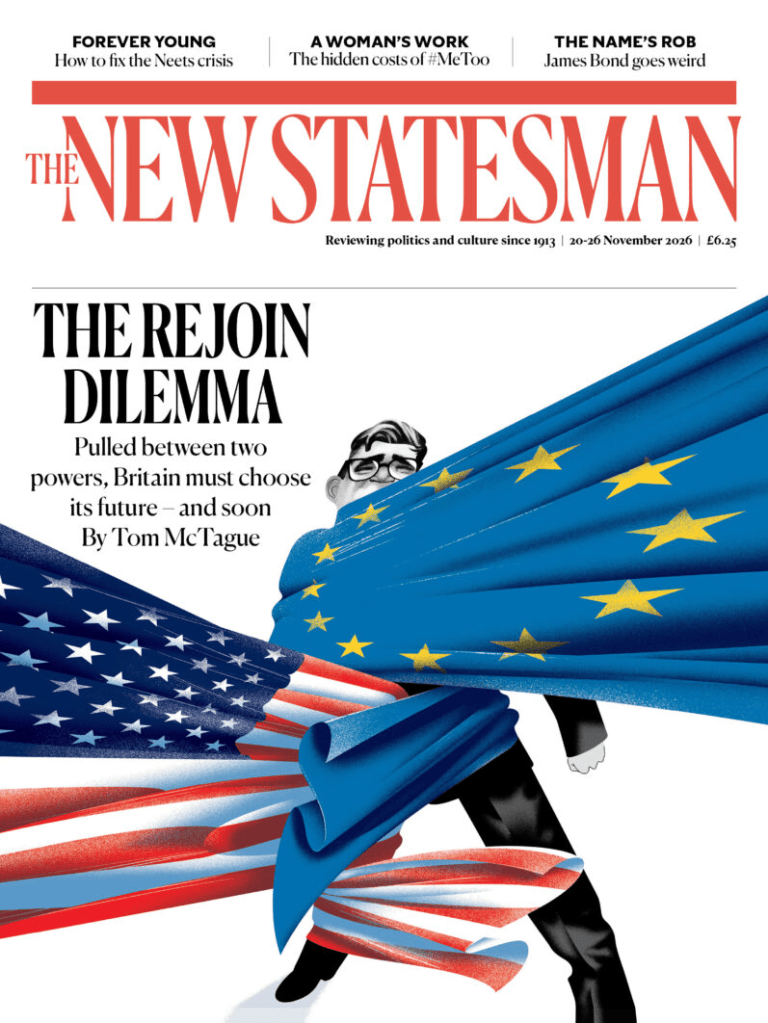
A bespectacled man in a dark suit is caught in a tug of war between two flags. The European Union’s blue banner with its gold stars streams off to the right and wraps around his shoulders, while the Stars and Stripes pulls hard from the left and tangles itself around his legs. Above the masthead, three more cover lines: how to fix the Neets crisis, the hidden costs of #MeToo, and “The name’s Rob: James Bond goes weird”.
The Front Pages
1. The Prophecies of Ted Heath
By Tom McTague · Editor’s Note
Researching his book on the long history of Brexit, Between the Waves, McTague expected to find Heath the dullest of the postwar prime ministers. He came away with a grudging admiration. Heath was sulky, rude, arrogant and often wrong, but he was also an idealist who saw Europe not merely as an economic necessity but as Britain’s own civilisation. McTague now judges him the most radical prime minister on foreign policy since 1945: the only one who believed in Europe as a principle, who had little time for the special relationship, and who wanted to put the Continent ahead of Washington.
By Tom McTague · Cover Story
Squeezed between two rival powers, America and the European Union, Britain cannot put off its choice much longer, McTague argues. The cover essay asks which way the country should turn, and how soon it must decide.
Features
By Mary Ann Sieghart · Feature
Sieghart begins with fame and power, and how they change what a man assumes he can do. She writes in the week Russell Brand was sentenced to ten and a half years for rape and sexual assault, and the Guardian and ITV News published an investigation in which several women accused David Walliams of grooming them as teenagers, which he denies. Her argument concerns an unintended consequence: for many women, the informal sponsorship of a senior man, once a route up in many careers, has disappeared.
4. Jolyon Maugham, Britain’s Loneliest Liberal
By Luke O’Reilly · Feature
A portrait of the barrister and campaigner who went from darling of polite society to the most divisive lawyer in Britain.
Columns
5. Should the Democrats Impeach, Reach Out or Fight Each Other?
By Freddie Hayward · Only in America
After the midterms, Hayward finds weariness with partisanship back in fashion, and weighs the party’s options.
6. Cutting Welfare Won’t Save Our Neets
By Anoosh Chakelian · Bursting the Bubble
The cover’s “Forever young”: Chakelian argues that the crisis of young people not in education, employment or training is the product of decades of change in the nature of work, and that benefits are a red herring.
7. The Real Problem With Britain’s Consent Laws
By Oli Dugmore
Dugmore argues that the law’s definition of adulthood is so confused that it cannot work.
Culture
8. Prepare for James Bond to Get Freaky
By David Jenkins · Film
“The name’s Rob”: Robert Pattinson, Jenkins argues, has a rare chance to bring his taste for the strange to the role of 007.
9. The Rise of Television’s Women Assassins
By Natasha Livingstone · Television
Why the female killer has become one of television’s rising tropes, appealing at once to female rage and to the male gaze.
The Threads
Between Washington and Brussels. Heath wanted to put Europe ahead of America half a century ago; McTague argues the choice can no longer be dodged; and across the Atlantic the Democrats are deciding what kind of opposition to be. (1, 2, 5)
Power, sex and the law. Sieghart on what #MeToo has cost women’s careers, Dugmore on a confused legal idea of adulthood, and Livingstone on the women who kill on screen. (3, 7, 9)
Starting out. Young people locked out of work and young women cut off from informal mentors face the same problem: the old ladders are gone. (3, 6)
Divisive figures. A lawyer who has fallen out with the polite society that once admired him, and a prime minister history is starting to rate more highly. (1, 4)
Before You Close the Issue
If Ted Heath was right too early, is Britain about to be right too late?
Drawn from the New Statesman, 20–26 November 2026. Visit the homepage at newstatesman.com.
— The Editors, Intellicurious —

