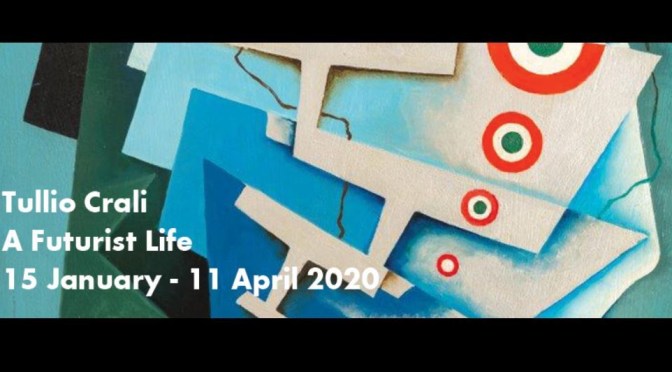
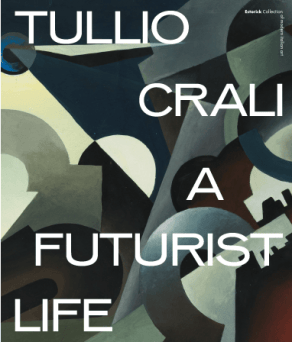
London – For Tullio Crali (1910-2000) Futurism was not just a school of painting, but an attitude to life itself. Reflecting the movement’s enthusiasm for the modern world, his imagery embraced technology and the machine as important sources of creative inspiration. However, with its particular focus on “the immense visual and sensory drama of flight”, Crali’s work is most closely associated with the genre of ‘aeropainting’, which dominated Futurist research during the 1930s.
Crali discovered Futurism when he was just fifteen years old. An immediate convert, he officially joined the movement in 1929 and quickly developed his own distinctive interpretation of its artistic principles. Despite incorporating recognisable details such as clouds, wings and propellers, Crali’s thrilling
Tullio Crali – Jonathan Monoplane 1988
imagery challenged conventional notions of realism by means of its dynamic perspectives, simultaneous viewpoints and powerful combination of both figurative and abstract elements.
As a result of his talent, versatility and unshakable commitment to Futurist ideas, Crali swiftly became one of the movement’s key representatives. He continued to be its staunchest advocate during the post-war era, remaining faithful to Futurism’s aesthetic tenets throughout his life.
Featuring rarely seen works from the 1920s to the 1980s, this exhilarating exhibition covers every phase of the artist’s remarkably coherent career, including iconic aeropaintings, experimental works of visual poetry and mixed-media reliefs, as well as examples of ‘cosmic’ imagery dating from the 1960s, inspired by advances in space exploration. Also featured are a large number of Crali’s famous Sassintesi: enigmatic compositions of stone and rock, ‘sculpted’ by natural forces.
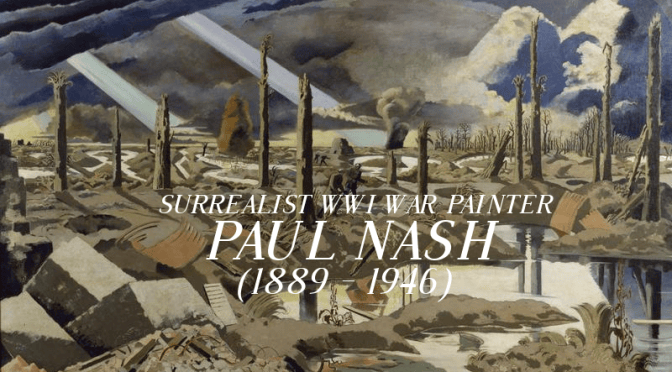
Paul Nash (11 May 1889 – 11 July 1946) was a British Surrealist painter and war artist, as well as a photographer, writer and designer of applied art. Nash was among the most important landscape artists of the first half of the twentieth century. He played a key role in the development of Modernism in English art.
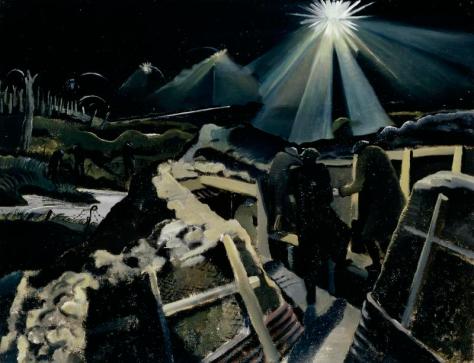
Paul Nash: The Ypres Salient at Night, 1918.PAUL NASH in a woodcut self-portrait (1923)
Born in London, Nash grew up in Buckinghamshire where he developed a love of the landscape. He entered the Slade School of Art but was poor at figure drawing and concentrated on landscape painting. Nash found much inspiration in landscapes with elements of ancient history, such as burial mounds, Iron Age hill forts such as Wittenham Clumps and the standing stones at Avebury in Wiltshire. The artworks he produced during World War I are among the most iconic images of the conflict. After the war Nash continued to focus on landscape painting, originally in a formalized, decorative style but, throughout the 1930s, in an increasingly abstract and surreal manner. In his paintings he often placed everyday objects into a landscape to give them a new identity and symbolism.
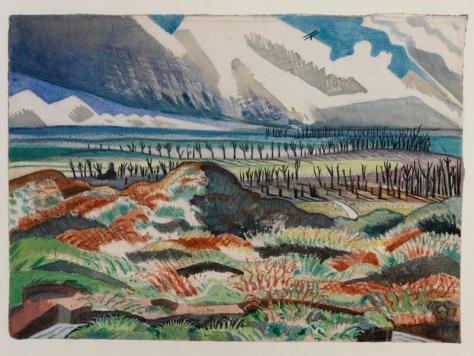
Paul Nash: Ruined Country – Old Battlefield, Vimy, near La Folie Wood, 1918.
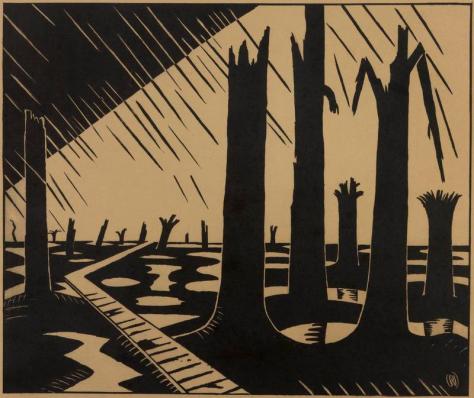
Official World War I Artist – In November 1917 Nash returned to the Ypres Salient as a uniformed observer with a batman and chauffeur. At this point the Third Battle of Ypres was three months old and Nash himself frequently came under shellfire after arriving in Flanders. The winter landscape he found was very different from the one he had last seen in spring. The system of ditches, small canals and dykes which usually drained the Ypres landscape had been all but destroyed by the constant shellfire. Months of incessant rain had led to widespread flooding and mile upon mile of deep mud. Nash was outraged at this desecration of nature. He believed the landscape was no longer capable of supporting life nor could it recover when spring came. Nash quickly grew angry and disillusioned with the war and made this clear in letters written to his wife. One such written, after a pointless meeting at Brigade HQ, on 16 November 1917 stands out,
I have just returned, last night from a visit to Brigade Headquarters up the line and I shall not forget it as long as I live. I have seen the most frightful nightmere of a country more conceived by Dante or Poe than by nature, unspeakable, utterly indescribable. In the fifteen drawings I have made I may give you some idea of its horror, but only being in it and of it can ever make you sensible of its dreadful nature and of what our men in France have to face. We all have a vague notion of the terrors of a battle, and can conjure up with the aid of some of the more inspired war correspondents and the pictures in the Daily Mirror some vision of battlefield; but no pen or drawing can convey this country—the normal setting of the battles taking place day and night, month after month. Evil and the incarnate fiend alone can be master of this war, and no glimmer of God’s hand is seen anywhere. Sunset and sunrise are blasphemous, they are mockeries to man, only the black rain out of the bruised and swollen clouds all though the bitter black night is fit atmosphere in such a land. The rain drives on, the stinking mud becomes more evilly yellow, the shell holes fill up with green-white water, the roads and tracks are covered in inches of slime, the black dying trees ooze and sweat and the shells never cease. They alone plunge overhead, tearing away the rotting tree stumps, breaking the plank roads, striking down horses and mules, annihilating, maiming, maddening, they plunge into the grave, and cast up on it the poor dead. It is unspeakable, godless, hopeless. I am no longer an artist interested and curious, I am a messenger who will bring back word from the men who are fighting to those who want the war to go on for ever. Feeble, inarticulate, will be my message, but it will have a bitter truth, and may it burn their lousy souls.”
Paul Nash: Void of War, 1918.
Nash’s anger was a great creative stimulus which led him to produce up to a dozen drawings a day. He worked in a frenzy of activity and took great risks to get as close as possible to the frontline trenches. Despite the dangers and hardship, when the opportunity came to extend his visit by a week and work for the Canadians in the Vimy sector, Nash jumped at the chance. He eventually returned to England on 7 December 1917.
Electric planes could soon fly commuters from city to city, a transport minister has disclosed. George Freeman, minister for transport and innovation, told The Telegraph’s “Chopper’s Brexit Podcast” that there was “a whole opportunity for short-haul transport at low altitude” that the country was yet to grasp.
In an episode of 2020 predictions, Mr Freeman said: “This will be the year where we begin to see a whole new world of low level aviation, Velocopters, electric planes. We already run the world’s first commercial electric plane service and Boris and I have been looking at how we can develop UK leadership in electric plane technology.” Mr Freeman said the planes could take eight passengers and fly at 2,500ft and could be used for “short hops between cities that take you an hour or two in the car, pumping out carbon monoxide.”
“At the moment the electric plane seats eight. But you know what the aerospace industry is like – eight soon becomes 18, and that soon becomes 28. We are determined to lead in the revolution of clean transport.”
In London, some 12,000 fireworks lit up the capital’s skyline, with 100,000 tickets being bought for the event. Big Ben’s chimes sounded the start of the display, despite them being silent this year while renovation work is completed.
British painter J.M.W. Turner was both prolific and peripatetic, producing more than 30,000 watercolors during a lifetime in which he traveled throughout Europe.
But these works are extremely susceptible to light damage and can be shown only once in a generation. Now, they’re on view at the Mystic Seaport Museum in Connecticut — their only North American stop. Jared Bowen of WGBH reports.
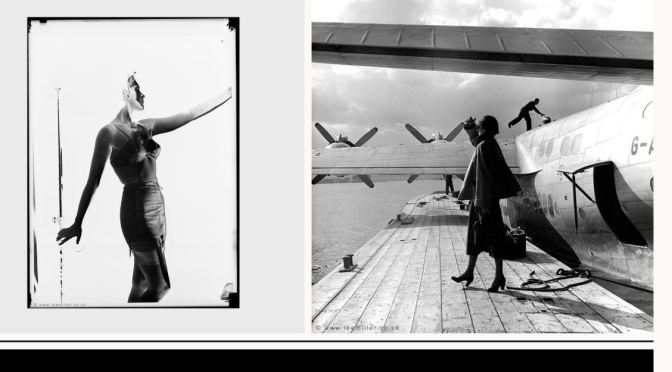
The Surrealist eye informed everything Miller did, and her work presents the world in a way that encourages us to view it in a different manner. Written and collected by her son Antony, Surrealist Lee Miller amasses more than one hundred full-page images from throughout the artist’s life as an attestation to her wonderful way of seeing.
A Surrealist before she even knew of the movement, Lee Miller was one of the most original photographic artists of the twentieth century. David E. Scherman, LIFE photographer and Miller’s close friend, described her as “caustically brilliant, yet totally loyal, unpretentious, human and intolerant of sham.
She was a consummate artist and a consummate clown; at once an upstate New York hick and cosmopolitan grande dame; a cold, soignée fashion model and a hoyden. . . . She was the nearest thing I knew to a mid-20th century renaissance woman.”
“Nikas combines extensive research into a previously unavailable and highly detailed archive of Donald Healey’s personal records with the author’s masterful ability to weave together an amazing level of detail while making it an eminently readable story. The result is a book that both seasoned automotive historians and anyone with an interest in the story of a life well lived will enjoy. Until you’ve read this book, you don’t know the true story of Donald Healey and his cars” (Reid Trummel, Editor in Chief, Healey Marque)
Written in collaboration with Gerry Coker, the designer responsible for the iconic Austin-Healey 100 and Sprite, this volume represents the most complete account ever of the sports cars built at Warwick, Longbridge, Abingdon and West Bromwich. With unprecedented access to Donald and Geoffrey Healey’s private papers, diaries, scrapbooks and photo albums, corporate and financial records from BMC, Donald Healey Motor Company and Healey Automobile Consultants, the files of Jensen Motors and Nash-Kelvinator, dozens of personal interviews and exhaustive research into previously unavailable primary source material, this book provides a thorough account of the true story behind these automobiles and the individuals who created them.
With just four tables, a few counter seats and no reservations, getting a spot at Kiln can be a challenge. But it is one that is absolutely worth the wait.
Chosen as the UK’s Best Restaurant in the 2018 National Restaurant Awards, this Soho hotspot specialises in a roadside barbeque style of Thai cooking. The kiln it is named after is the hulking stove which dominates the restaurant. On it sits countless rustic claypots from which wafts a tempting mix of palm sugar, sweet basil and hot charcoal.The 22 seats along the steel counter are the best in the house, as you can watch the chefs scrupulously chopping, flipping and searing ingredients – most of which have been picked or caught just a few hours before.
Fitzroy Park, London N6 A stunning 6,200 sq ft space, this remarkable and sprawling house rises up through its surrounding landscaped gardens. Described by the Architects’ Journal as having a “beguilingly cave-like relationship to the outside world”, it is a bold vision of contemporary architecture in which the natural world has been thoroughly entwined with the design.
Recline by the pool, listen to the artificial stream winding its way through the gardens, meander across the footbridge: this home was conceived for those long, dreamy summer days.

 London – For Tullio Crali (1910-2000) Futurism was not just a school of painting, but an attitude to life itself. Reflecting the movement’s enthusiasm for the modern world, his imagery embraced technology and the machine as important sources of creative inspiration. However, with its particular focus on “the immense visual and sensory drama of flight”, Crali’s work is most closely associated with the genre of ‘aeropainting’, which dominated Futurist research during the 1930s.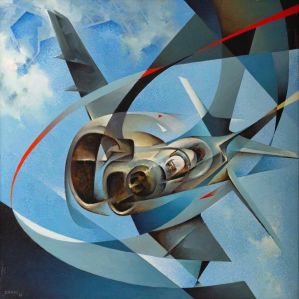






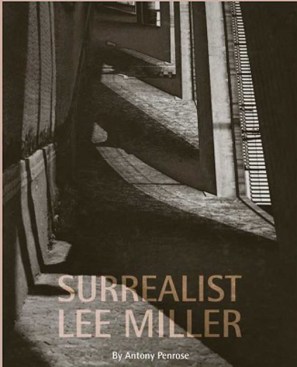 The Surrealist eye informed everything Miller did, and her work presents the world in a way that encourages us to view it in a different manner. Written and collected by her son Antony, Surrealist Lee Miller amasses more than one hundred full-page images from throughout the artist’s life as an attestation to her wonderful way of seeing.






 “Nikas combines extensive research into a previously unavailable and highly detailed archive of Donald Healey’s personal records with the author’s masterful ability to weave together an amazing level of detail while making it an eminently readable story. The result is a book that both seasoned automotive historians and anyone with an interest in the story of a life well lived will enjoy. Until you’ve read this book, you don’t know the true story of Donald Healey and his cars”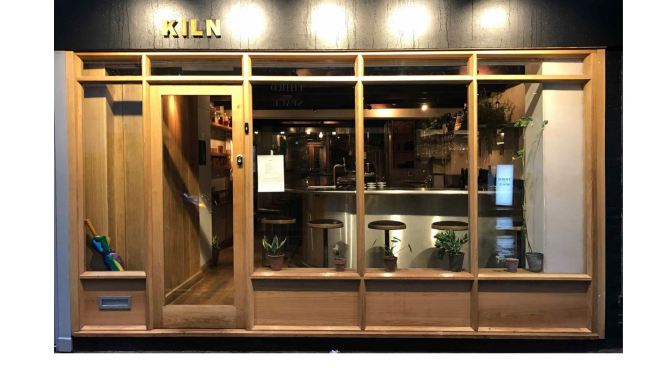
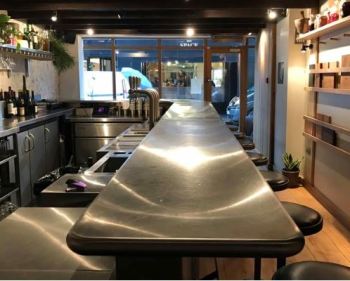 With just four tables, a few counter seats and no reservations, getting a spot at Kiln can be a challenge. But it is one that is absolutely worth the wait.
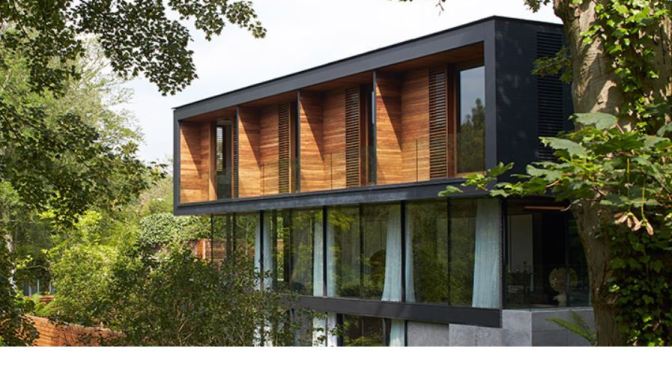
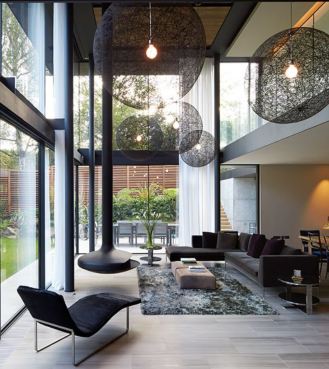 A stunning 6,200 sq ft space, this remarkable and sprawling house rises up through its surrounding landscaped gardens. Described by the Architects’ Journal as having a “beguilingly cave-like relationship to the outside world”, it is a bold vision of contemporary architecture in which the natural world has been thoroughly entwined with the design.
 Recline by the pool, listen to the artificial stream winding its way through the gardens, meander across the footbridge: this home was conceived for those long, dreamy summer days.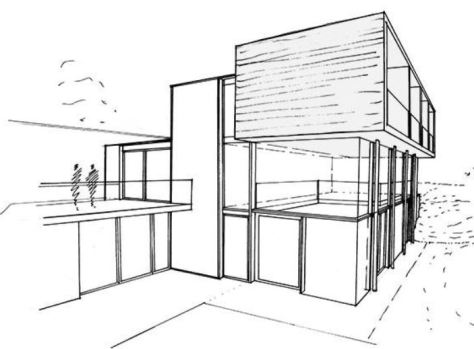

 Intellicurious