
The New York Times Book Review · November 22, 2026
Nobodies, Mysteries & Marionettes
Dustin Hoffman’s memoir, Pinocchio at 200, and the limits of air power
This week’s Book Review opens with an actor who was sure he would amount to nothing: Dustin Hoffman, whose long-awaited memoir proves him gloriously wrong. Around it, the issue celebrates Pinocchio at 200, follows curare from the Amazon to the pharmaceutical industry, weighs what bombing can and cannot achieve, and finds a memoir of Yosemite that may change how you see the wild, with crime fiction, a bestselling murder puzzle and a playwright’s debut at the Comédie-Française along the way.
Here is the issue, with our notes on the threads that run through it.
The Cover
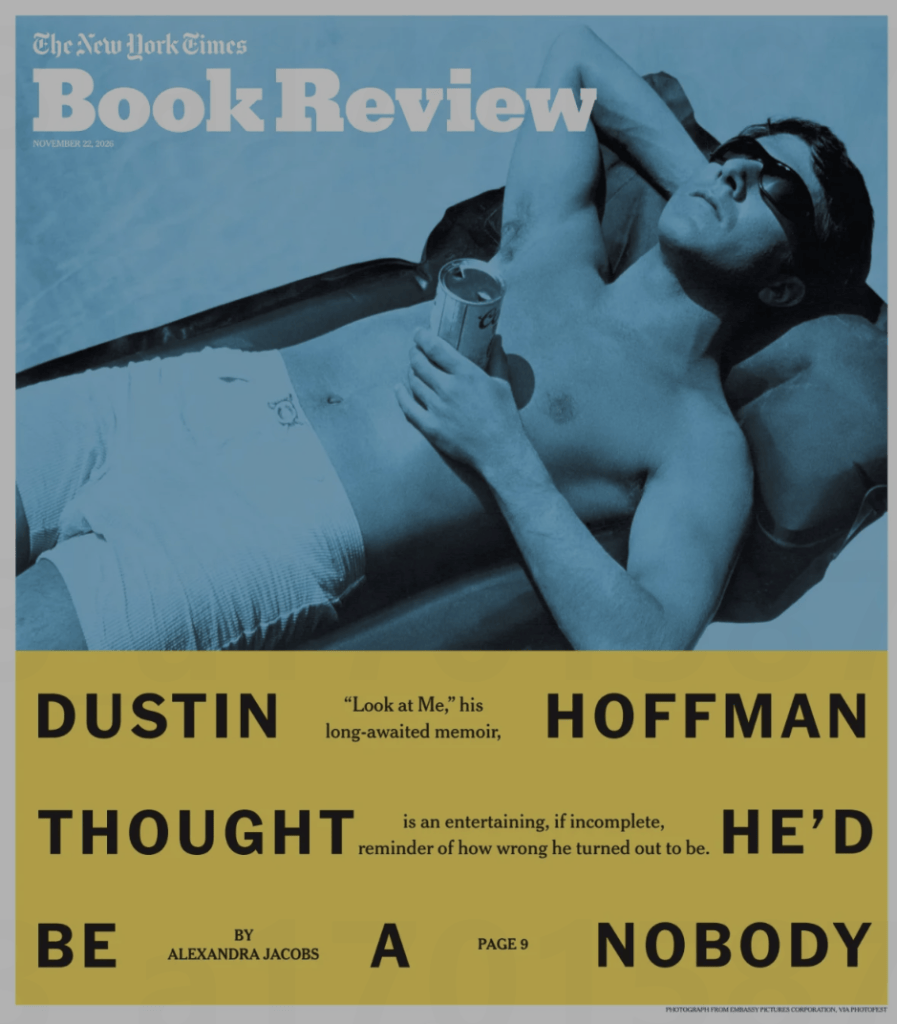
Dustin Hoffman Thought He’d Be a Nobody
Cover · Photograph from Embassy Pictures
A blue-tinted still shows a young Hoffman stretched out shirtless on a pool float in dark glasses, a can resting on his chest, an image of youthful drift that recalls the role that made him famous. Below, on a mustard band, the headline runs in bold capitals, with the verdict tucked between the words.
The Cover Review
1. Look at Me
Reviewed by Alexandra Jacobs · Cover Review
Hoffman expected to be a nobody. His long-awaited memoir, Jacobs finds, is an entertaining if incomplete record of how wrong he turned out to be.
Nonfiction
2. A Brilliantly Ambivalent Memoir May Change How You See Nature Forever
Yosemite Falls, by Daniel Duane · Reviewed by Blair Braverman
Duane braids together the story of the great national park, John Muir and his own family, and Braverman finds his ambivalence about the wild is the book’s strength.
3. The Rich Get Richer, and the Rest of Us Applaud. What’s Up With That?
Nancy Isenberg · Nonfiction
The historian examines America’s homegrown aristocracy and the curious admiration it inspires in everyone else.
4. The Black Artist and Choreographer Who Transformed Dance
Lynn Garafola on Arthur Mitchell · Nonfiction
A life of Arthur Mitchell, the dancer and founder of the Dance Theatre of Harlem, who changed American ballet.
5. He Thought Poison Would Change Medicine, and Make Him Rich
The Flying Death, by Matt O’Hara · Reviewed by W. M. Akers
The story of curare, the arrow poison that found its way into medicine, and of the beginnings of big pharma.
6. A Memoir of Depression and Electroshock Therapy
Jolt, by Ted Scheinman · Reviewed by Julia Scheeres
Scheinman writes about his battle with depression, and the treatment that helped, with humour and empathy.
7. How Much Can You Accomplish by Dropping Bombs?
By Thomas E. Ricks · Military History
Three new books capture both the promise of aviation and the limits of air power.
Pinocchio at 200
8. Reading ‘Pinocchio’ in the Post-Real-Boy Era
By Sadie Stein · Essay
As Carlo Collodi turns 200, Stein notes how much else in the book has become an anachronism: wooden toys, live theatre, whales in abundance, amusement parks and skies full of stars.
9. How Pinocchio Paved the Way for Italian Children’s Characters in America
By Leonard S. Marcus · Essay
First came hard-working Italian immigrants in American books for children; then came the designer Bruno Munari.
Also This Week
10. Crime, Catastrophe and a Fireball of Reckoning in New Mysteries
By Sarah Weinman · Great Genre Fiction
The crime columnist picks four new mysteries worth your time.
11. How a ‘Killer’ Puzzle Changed Their Lives
By Elisabeth Egan
A married pair of escape-room fanatics invented a murder-mystery puzzle book that has sold more than a hundred thousand copies.
12. She Forgot Posing for the Shot, Until She Saw the Book Cover
Stephanie Wambugu’s Lonely Crowds
A woman discovers an old photograph of herself on the cover of a new novel.
13. With Tolstoy as Her Guide, a Hit Novelist Stages a ‘Resurrection’
By Laura Cappelle · Theatre
Leïla Slimani, author of The Perfect Nanny, long struggled with dialogue. Now her first play opens at the Comédie-Française in Paris.
14. 6 New Books We Love This Week
Editors’ Choice
Recommendations from the Times’s critics and editors.
15. This Poem Is a Three-Minute Vacation
TimesVideo · With A. O. Scott
The critic at large on Yeats’s “The Lake Isle of Innisfree,” a dream of escape whose speaker never leaves the grey city pavement, and how its final stanza changes everything.
The Threads
Becoming somebody. An actor who expected to be a nobody, a puppet who longs to be a real boy, and a dancer who changed an art form. (1, 4, 8)
Power and its limits. What bombs can achieve, why we cheer the rich, and how a poison became an industry. (3, 5, 7)
Body and mind. A memoir of depression and electroshock, a family history written into a landscape, and a poem about a peace its speaker never reaches. (2, 6, 15)
Whodunits. Four new mysteries and a murder puzzle that became a bestseller. (10, 11)
Before You Close the Book
If a nobody can become Dustin Hoffman and a puppet can become a boy, what does it take for any of us to become real?
Drawn from The New York Times Book Review, November 22, 2026. Visit the homepage at nytimes.com.
— The Editors, Intellicurious —

