
The Guardian Weekly · 27 November 2026
Verdicts, Votes & Van Eyck
Justice for the Rohingya, Burnham’s European bet, and the secrets in a Flemish master’s faces
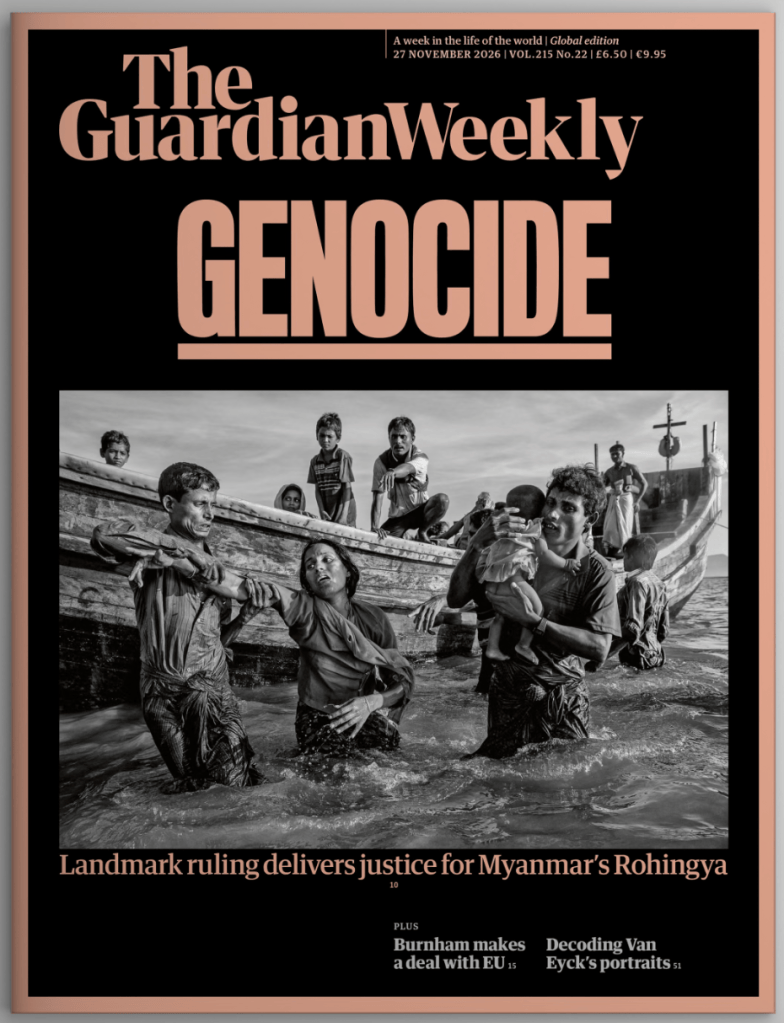
History was made in The Hague last week, and the 27 November Guardian Weekly puts it on the cover: the International Court of Justice has ruled that Myanmar committed genocide against the Rohingya, the first time any state has been held responsible for genocide under the 1948 convention. The rest of the issue ranges from Andy Burnham’s bet on Europe and the wreckage of the Cop31 climate summit to the strange appeal of “sovereign citizens” and the hidden messages in Jan van Eyck’s faces.
Here is the issue, with our notes on the threads that run through it.
The Cover Story: Justice for the Rohingya
By Kaamil Ahmed and Oliver Holmes · Cover Story
The ICJ found that Myanmar’s government committed genocide against its mostly Muslim Rohingya minority during the military campaign of 2016–17, which drove more than 700,000 people across the border into Bangladesh. They arrived with accounts of mass killings of adults and children, gang rapes and villages burned to the ground. It is the first time since the genocide convention was adopted in 1948 that a state has been found responsible for the crime itself.
2. Tears in The Hague, Applause in the Camps
By Kaamil Ahmed and Yassin Abdumonab · Reaction
In the courtroom there were tears; in the refugee camps of Bangladesh, where the Rohingya who fled still live, there was applause. For survivors, the verdict shifts the burden to the rest of the world. As one Rohingya at the hearing put it, “It has been declared genocide now and they have to act.”
By Julian Borger · Analysis
Borger argues that the ruling gives the 1948 convention new force in governing how states behave, and that it will have been read with particular care in Israel, the only other country currently before the ICJ accused of genocide.
Israel rejects the genocide accusation brought against it at the ICJ; that case has not been decided.
Five Essential Reads
By Peter Walker · Spotlight
Walker assesses Andy Burnham’s gamble on closer ties with the European Union, a bet that rests, he suggests, on the assumption that most British voters want the same.
5. Cop Out
By Fiona Harvey and Graham Readfearn · Environment
The UN climate summit in Antalya, Turkey, ended in failure, to the open anger of protesting activists. Yet in the real world, Harvey and Readfearn argue, the shift away from fossil fuels is now unstoppable, whatever negotiators manage to agree.
By Mark Blacklock · Feature
Sovereign citizenship, an anti-government ideology whose followers claim they are not bound by the state’s laws, began in the United States and has spread around the world, wasting public money and wrecking lives. Blacklock investigates why its wild ideas have become so appealing.
7. The Threat of a Trump-Putin Alliance
By Steve Bloomfield · Opinion
Europe’s future, Bloomfield writes, will be decided at the ballot box and on Ukraine’s front line, and the danger is that Donald Trump and Vladimir Putin end up reaping the rewards.
8. Face Time
By Charlotte Higgins · Culture
Jan van Eyck’s portraits look startlingly real, yet they are full of coded messages. Higgins asks what they mean.
What Else We’re Reading
Edible packaging. A staff pick explores alternatives to plastic you can eat, coffee cups included.
Sugar as sculpture. Fresh from the Great British Bake Off final, another pick on food as art and fashion, from a brioche armchair to Laila Gohar’s hand-spun sugar chandelier.
Online. The UK lands the 2035 Women’s World Cup; a video asking why Jensen Huang is back at Nvidia; Richard Avedon’s rarely seen Hollywood portraits; and an interactive on the buried history of Australia’s enslaved South Sea Islanders.
The Threads
Naming the crime. The ICJ’s verdict on Myanmar, the Rohingya call for governments to act and Borger’s reading of what it means for the genocide convention, and for Israel’s pending case. (1, 2, 3)
Europe’s choices. Burnham’s wager on closer EU ties and Bloomfield’s warning about a Trump-Putin axis both turn on how European voters choose. (4, 7)
Rules and refusers. A court enforcing international law, a climate summit that failed to agree rules, and sovereign citizens who reject the law altogether. (1, 5, 6)
Hidden messages. Van Eyck’s coded portraits and the conspiratorial reasoning of the sovereign-citizen movement: two very different exercises in reading signs. (8, 6)
Before You Close the Issue
A court has at last named a genocide. Will the governments the Rohingya are now looking to actually act?
Drawn from the editors’ introduction to the Guardian Weekly, 27 November 2026. Visit the homepage at theguardian.com.
— The Editors, Intellicurious —

