

MOTION:
“This House Believes AI Will Bring More Harm Than Good”
This debate was run in association with IBM Research.
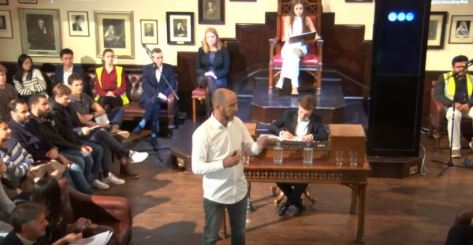
Proposition:
Project Debater Project Debater is designed by IBM research. It will deliver a speech based on over 1,100 arguments collected from Union members and others over the past week. It will not be taking points of information.
Sharmila Parmanand
Sharmila Parmanand is a PhD Candidate in Gender Studies at the University of Cambridge and a Gates Scholar. She has served as a debate trainer or chief judge in debating events in 45 countries. She served as a chief judge for most major global debating competitions (World Universities, World Schools, European Universities, Asian Universities, Austral-Asian Universities, North American Universities, and PanAmerican Universities).
Professor Neil Lawrence
Neil Lawrence is the DeepMind Professor of Machine Learning at the University of Cambridge and the co-host of Talking Machines. Neil’s main research interest is machine learning through probabilistic models. He focuses on both the algorithmic side of these models and their application. His recent focus has been on the deployment of machine learning technology in practice, particularly under the banner of data science.
Opposition
Project Debater
Project Debater is designed by IBM research. It will deliver a speech based on over 1,100 arguments collected from Union members and others over the past week. It will not be taking points of information.
Harish Natarajan
Harish Natarajan is a graduate of the University of Oxford and the University of Cambridge. He was a grand fnalist and 2nd best speaker at the 2016 World Debating Championships and won the European Debating Championship in 2012. Harish holds the record for most competition victories. He currently works as the Head of Economic Risk Analysis at AKE International in London.
Professor Sylvie Delacroix
Sylvie Delacroix is professor in Law and Ethics at the University of Birmingham. Her work has notably been funded by the Wellcome Trust, the NHS and the Leverhulme Trust, from whom she received the Leverhulme Prize. She has recently been appointed to the Public Policy Commission on the use of algorithms in the justice system.
Website: https://www.cus.org/
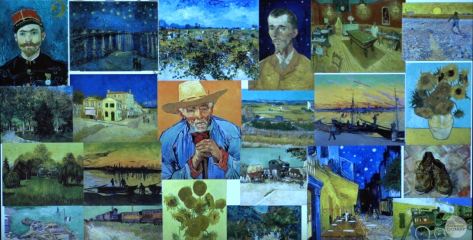
 The Credit Suisse Exhibition: Gauguin Portraits 7 October 2019 – 26 January 2020 Book tickets online and save, Members go free: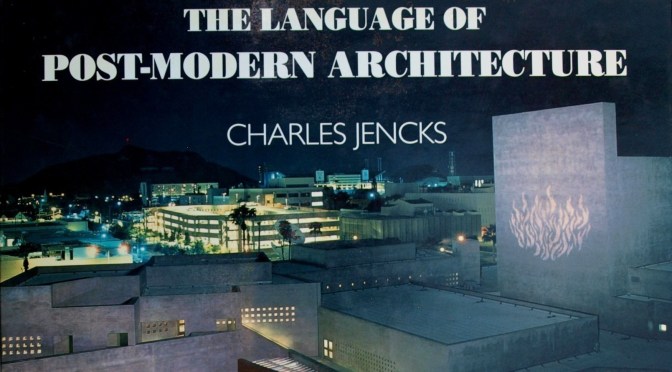
 Jencks’s book grew out of his PhD thesis, supervised by Reyner Banham at the University of London in the late 1960s, and paved the way for his later, more explicitly polemical The Language of Post-Modern Architecture (1977). In this bestselling book, Jencks set out his stall for a pluralist architecture that rejected what he saw as modernism’s reductive ‘univalent’ approach, swapping it for a symbolically rich and historically engaged ‘multivalent’ postmodernism. For good or bad it became the defining book of its era, an unabashed rejection of mainstream modernism that ushered in a new architectural style.
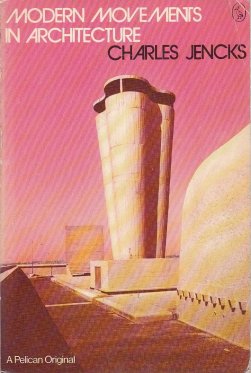 Modern Movements in Architecture (1973) by Charles Jencks was one of the first books on architecture I read, a birthday present given to me the summer before I started my degree. In some ways, it spoiled things: I thought all architecture books would be that much fun. Modern Movements in Architecture is a complex and sophisticated history, but it wears its learning lightly. It relates architecture to a wider cultural discourse and it is unafraid to be critical, even of some architects, such as Mies van der Rohe, who were previously considered to be above criticism.

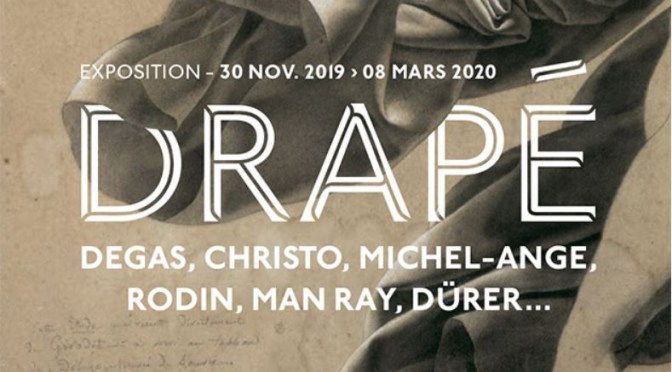
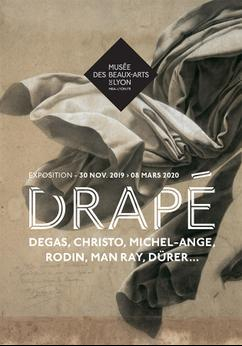 How is a drapery put in place? For what reasons does this motive persist until today? How to explain its power of fascination? These are the questions that this exhibition intends to pose, in order to enter the “factory” of the drapery and to get closer to the artistic gesture. By showing the stages of making a drapery, the visitor will discover the singular practices of artists from the Renaissance to the second half of the 20th century.
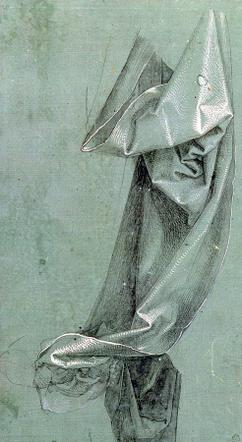 Albrecht Dürer, Drapery Study, 1508, Brush and Indian Ink, heightened white on dark green paper
 “Everywhere is the wait and the gathering,” concludes “Resort.” A kind of soporific haze has seeped into de Chirico’s imagination, asserted through evocations of sleeping and dreaming. Even the violence and ambiguous sexual imagery of “The Mysterious Night” yield to a final note of definitive somnolence: “Everything sleeps; even the owls and the bats who also in the dream dream of sleeping.”
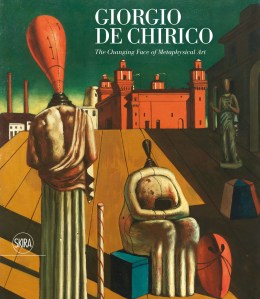 He daydreams of Mexico or Alaska and invokes a future-oriented “avant-city” and a distant day where he is immortalized, albeit in an old-fashioned mode as a “man of marble.”
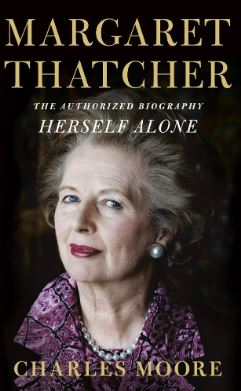 “I don’t think you can think about British politics or British history without thinking about her a very great deal,” Charles Moore, the authorized biographer of Margaret Thatcher, says of his subject on this week’s podcast. “And to some extent, you can’t think about the history of the modern West without thinking about her a very great deal.”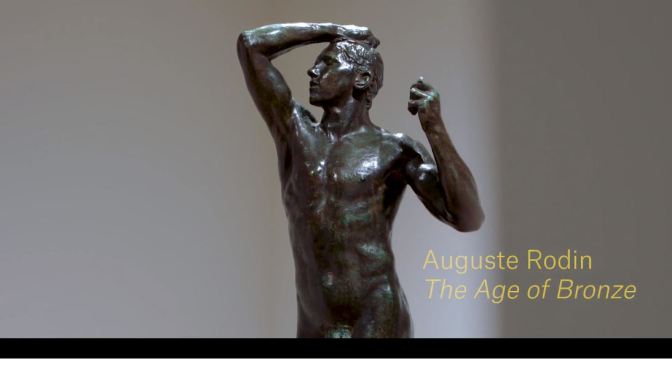
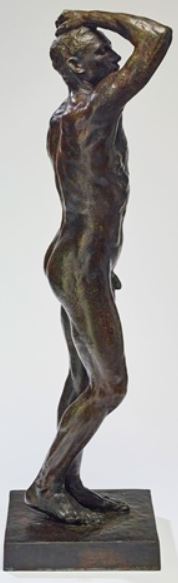 Rodin first exhibited a bronze and a plaster version of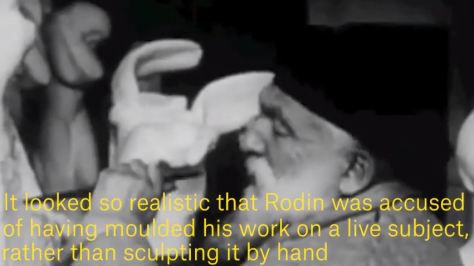

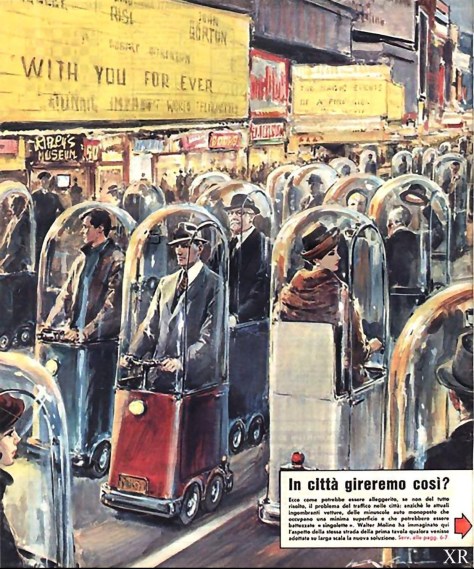 It is unclear why people in the 1950s thought this was a practical way to travel; not only it looks like it is impossible to breathe in there, who would want to stand upright while driving? It would definitely ease the traffic; however, probably no one would want to use it.
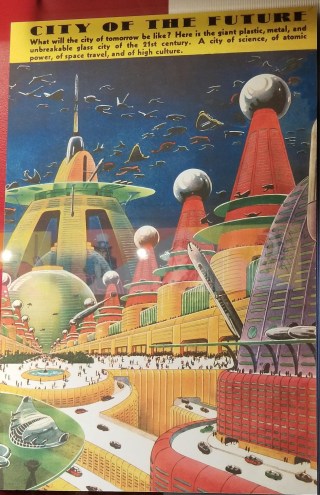 Towering transmitters in the city and private-jet traffic in the sky… This is a prediction that was made probably too early and it is definitely not so far from reality. Today, we paint a similar future for smart-cities and sci-fi movies depict the future cities in the same manner. It seems that older generations and we have a similar vision of the future look of the world.
 Intellicurious