Category Archives: Health

Healthcare Interviews: Centers For Medicare And Medicaid Services Director Seema Verma

Seema Verma, administrator for the Centers for Medicare and Medicaid Services, sits down for a rare one-on-one interview with special correspondent Sarah Varney of Kaiser Health News. They discuss President Trump’s plan for sustaining public health insurance programs, how the administration would respond if Obamacare is struck down by the courts in the future, and the latest Medicare for all proposals.

Research: “The Human Microbiome – A New Frontier In Health” (UCTV)

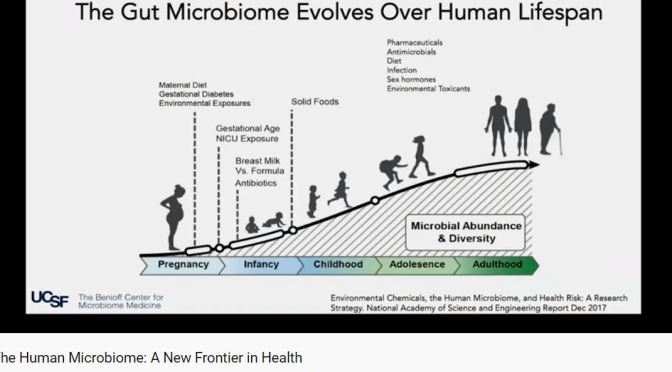
Microbiome expands the genetic and functional capacity of its human host. Susan Lynch explains that human microbiome develops early in life and that gut microbes shape immune function and relate to disease outcomes in childhood.

The Human Microbiome A New Frontier in Health UCTV

She also explores next-generation microbiome therapeutics and research.

New Brain Health Books: “Successful Aging” By Daniel J. Levitin (Jan 7, 2020)

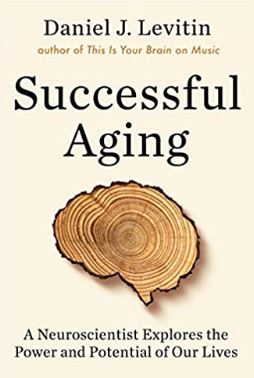
Successful Aging Daniel J. Levitin A Neuroscientist Explores the Power and Potential of Our Lives January 2020 Cover‘Successful Aging’ uses research from developmental neuroscience and the psychology of individual differences to show that sixty-plus years is a unique developmental stage that, like infancy or adolescence, has its own demands and distinct advantages. Levitin looks at the science behind what we all can learn from those who age joyously, as well as how to adapt our culture to take full advantage of older people’s wisdom and experience. Throughout his exploration of what aging really means, Levitin reveals resilience strategies and practical, cognitive enhancing tricks everyone should do as they age.

Author of the iconic bestsellers This Is Your Brain on Music and The Organized Mind, Daniel Levitin turns his keen insights to what happens in our brains as we age, why we should think about health span, not life span, and, based on a rigorous analysis of neuroscientific evidence, what you can do to make the most of your seventies, eighties, and nineties today no matter how old you are now.

To read more and/or purchase

Healthiest Adults: Early Risers With 7-8 Hours Of Sleep, No Insomnia Or Daytime Drowsiness

From a European Heart Journal study:

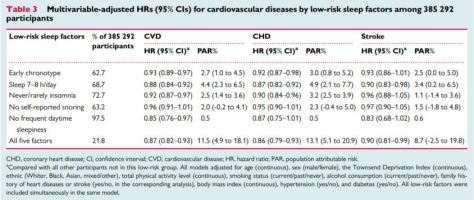
European Society of Cardiology logoWhen the five sleep factors were collapsed into binary categories of low risk vs. high risk (reference group), early chronotype, adequate sleep duration, free of insomnia, and no frequent daytime sleepiness were each independently associated with incident CVD, with a 7%, 12%, 8%, and 15% lower risk, respectively (Table 3). Early chronotype, adequate sleep duration, and free of insomnia were independently associated with a significantly reduced risk of CHD; while only adequate sleep duration was associated with stroke.European Society of Cardiology Sleep patterns, genetic susceptibity and incident cardiovascular disease a prospective study of 385,292 participants lowest risk factorsCardiovascular disease (CVD), including coronary heart disease (CHD) and stroke, is among the leading causes of mortality globally.1 In addition to traditional lifestyle behaviours, emerging evidence has implicated several unhealthy sleep behaviours were important risk factors for CVD.2,3 For example, short or long sleep duration,4–9 late chronotype,10,11 insomnia,12–17 snoring,18,19 and excessive daytime sleepiness20,21 were associated with a 10–40% increased CVD risk. European Society of Cardiology Sleep patterns, genetic susceptibity and incident cardiovascular disease a prospective study of 385,292 participants


To read more: https://academic.oup.com/eurheartj/advance-article/doi/10.1093/eurheartj/ehz849/5678714

New Study: Nearly 50% Of Americans Will Have Obesity By 2030, 25% Severely Obese (NEJM)

From a New England Journal of Medicine online study release:

The findings from our approach suggest with high predictive accuracy that by 2030 nearly 1 in 2 adults will have obesity (48.9%; 95% confidence interval [CI], 47.7 to 50.1), and the prevalence will be higher than 50% in 29 states and not below 35% in any state.

New England Journal of Medicine logo

Nearly 1 in 4 adults is projected to have severe obesity by 2030 (24.2%; 95% CI, 22.9 to 25.5), and the prevalence will be higher than 25% in 25 states. We predict that, nationally, severe obesity is likely to become the most common BMI category among women (27.6%; 95% CI, 26.1 to 29.2), non-Hispanic black adults (31.7%; 95% CI, 29.9 to 33.4), and low-income adults (31.7%; 95% CI, 30.2 to 33.2).
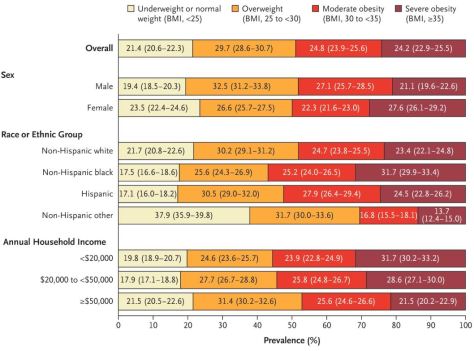
Projected National Prevalence of BMI Categories in 2030, According to Demographic Subgroup. New England Journal of Medicine December 2019

Although severe obesity was once a rare condition, our findings suggest that it will soon be the most common BMI category in the patient populations of many health care providers. Given that health professionals are often poorly prepared to treat obesity,27 this impending burden of severe obesity and associated medical complications has implications for medical practice and education.

In addition to the profound health effects, such as increased rates of chronic disease and negative consequences on life expectancy,25,28 the effect of weight stigma29 may have far-reaching implications for socioeconomic disparities as severe obesity becomes the most common BMI category among low-income adults in nearly every state.

To read more: https://www.nejm.org/doi/full/10.1056/NEJMsa1909301?query=featured_home

Studies: “Why Your Brain Needs Exercise” (Scientific American)

From a Scientic American online article:

Scientific American logoIn our own study of more than 7,000 middle-aged to older adults in the U.K., published in 2019 in Brain Imaging and Behavior, we demonstrated that people who spent more time engaged in moderate to vigorous physical activity had larger hippocampal volumes. Although it is not yet possible to say whether these effects in humans are related to neurogenesis or other forms of brain plasticity, such as increasing connections among existing neurons, together the results clearly indicate that exercise can benefit the brain’s hippocampus and its cognitive functions.
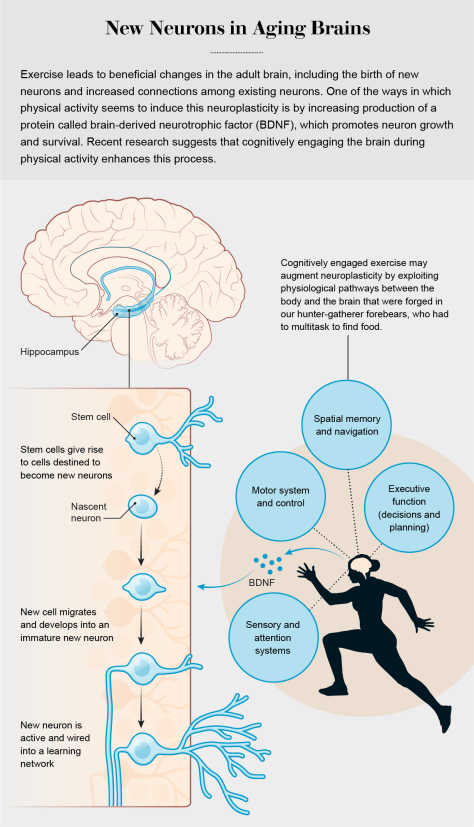
New Neurons in Aging Brains Why Your Brain Needs Exercise Scientific American December 18 2019

In fact, a growing body of research suggests that exercise that is cognitively stimulating may indeed benefit the brain more than exercise that does not make such cognitive demands. For example, Gerd Kempermann and his colleagues at the Center for Regenerative Therapies Dresden in Germany explored this possibility by comparing the growth and survival of new neurons in the mouse hippocampus after exercise alone or after exercise combined with access to a cognitively enriched environment. They found an additive effect: exercise alone was good for the hippocampus, but combining physical activity with cognitive demands in a stimulating environment was even better, leading to even more new neurons. Using the brain during and after exercise seemed to trigger enhanced neuron survival.

To read more: https://www.scientificamerican.com/article/why-your-brain-needs-exercise/

Exercise Studies: Aerobic Exercise Benefits Not Seen In Current “Low Levels” Of Prescribed Activity (BJSM)

From a British Journal of Sports Medicine online study release:

British Journal of Sport & Exercise MedicineIn studies of aerobic exercise in patients with knee OA, very few interventions met guideline-recommended dose; there were small to moderate changes in markers of cardiovascular health and no decrease in markers of systemic inflammation. These findings question whether aerobic exercise is being used to its full potential in patients with knee OA.

Objectives We systemically reviewed published studies that evaluated aerobic exercise interventions in patients with knee osteoarthritis (OA) to: (1) report the frequency, intensity, type and time (FITT) of exercise prescriptions and (2) quantify the changes in markers of cardiovascular health and systemic inflammation.

To read more: https://bjsm.bmj.com/content/early/2019/12/17/bjsports-2018-100231

Studies: “Home Hospital” Model Of Care Reduces Costs By 38%, Improves Recovery (Harvard)

From a Harvard Gazette online article:

“This work cements the idea that, for the right patients, we can deliver hospital-level care outside of the four walls of the traditional hospital, and provides more of the data we need to make home hospital care the standard of care in our country,” said corresponding author David Levine, a physician and researcher in the Division of General Internal Medicine and Primary Care.

“It opens up so many exciting possibilities — it’s exciting for patients because it gives them the opportunity to be in a familiar setting, and it’s exciting for clinicians because we get to be with a patient in that person’s own surroundings. As a community-minded hospital, this is a way for us to bring excellent care to our community.”

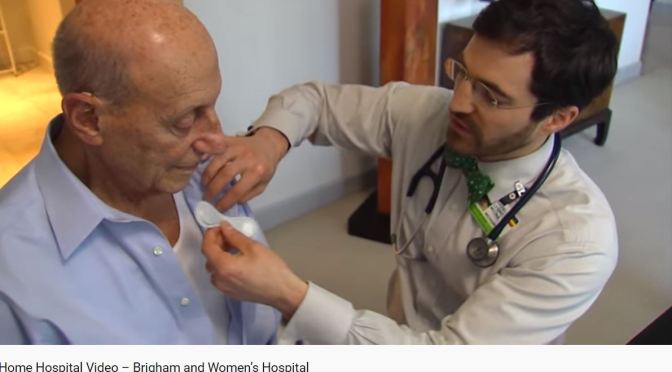
The home hospital model of care — in which select patients receive hospital-level care for an acute illness from the comfort of their own home instead of in a traditional hospital — has become increasingly popular across the U.S.

To read more: https://news.harvard.edu/gazette/story/2019/12/home-hospital-model-reduces-costs-by-38-improves-care/