
Nature · 26 November 2026
Viruses, Voyager & Vampires
Smallpox’s ancestors in the gut, a probe one light day out, and the bats that live on blood
This week’s Nature goes looking for the origins of smallpox in an unlikely place: the gut. Its cover story reports a new order of giant viruses living in human and animal digestive systems, and suggests the poxviruses descend from them. Around it, the journal’s editors take stock of a failed climate summit and a rare chance on HIV, and the news pages run from Voyager 1’s milestone and a Neanderthal gene in our brains to blood-drinking bats, a fatal gene-editing trial and a record Ebola outbreak.
Here is the issue, with our notes on the threads that run through it.
The Cover
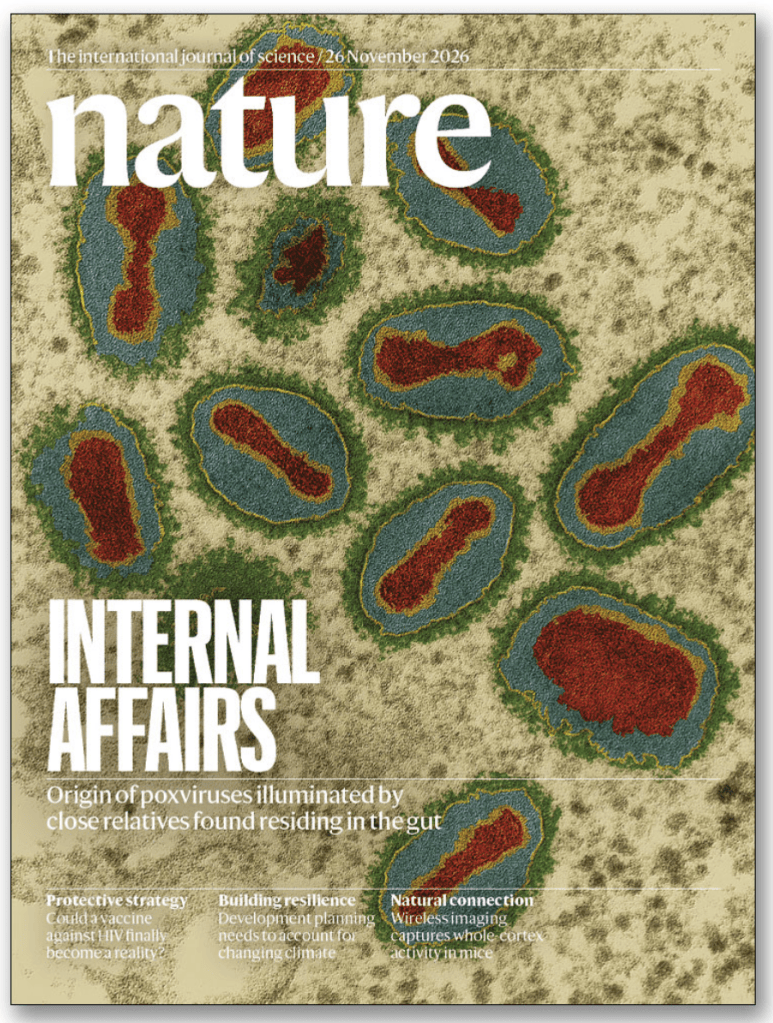
1. Internal Affairs: Where Poxviruses Came From
Tom Delmont and colleagues · Cover Story · Volume 659, Issue 8142
Nucleocytoviruses, the large and giant double-stranded DNA viruses, mostly infect single-celled organisms. One branch, the poxviruses, including the variola virus that caused smallpox, infects animals and people, and how it made that leap has long been unclear. Delmont’s team reasoned that single-celled organisms in the guts of early animals might have been the stepping stone, even though earlier studies found such viruses rarely turn up in the gut microbiome.
Screening large numbers of metagenomes sequenced from human and animal microbiomes, the researchers found a new order of large DNA viruses, the egoviruses, whose closest relatives are the poxviruses. Egoviruses occur almost exclusively in the guts of humans and of domestic and wild animals, where they appear to infect single-celled organisms; one is projected to live in the gut of more than 1% of people. The team argues that poxviruses evolved from egovirus ancestors in animal guts hundreds of millions of years ago.
The cover image is credited to Eye of Science/Science Photo Library.
Editorials
2. The World Has a Golden Chance to Improve HIV Prevention: Don’t Squander It
Editorial
With generic versions of an effective HIV drug now approved and a vaccine on the horizon, Nature’s editors urge funders not to ease off.
3. ‘The Worst COP Ever’ Offers a Chance to Learn from Failure
Editorial
COP31 ended without agreement. The editors still defend consensus-based diplomacy as essential for global problems, and argue that failures can set up decisive action at future talks.
World View
4. AI Must Be Held Accountable: Value Statements Won’t Protect Human Dignity
By Cindy Skach · World View
Skach argues that technology companies cannot be the judges of their own regulatory compliance, and draws on centuries of history to explain why.
5. These Gaps in Weather Data Affect Forecasts Everywhere: Plugging Them Is Not Charity
By Markus Repnik · World View
Investing in weather observations in low-income countries, Repnik writes, will help to prevent climate disasters worldwide.
Research Highlights
6. More Tropical Cyclones Hit Peak Fury at the Worst Possible Time
Research Highlight
Climate change is creating conditions that intensify hurricanes and typhoons just as they reach the coast.
7. Meet the ‘Celestial Bodies of Fathomless Powerful Darkness’
Research Highlight
Astronomers report a rare pair of extremely bright black holes that were feeding on gas less than a billion years after the Big Bang.
8. Dinosaur’s Rest Break Leaves a Lasting Impression
Research Highlight
A fossilized print preserves the marks of the feet and rump of a resting juvenile dinosaur that stood a metre tall at the hip.
9. Lifting Weights Reduces Muscle Loss from Obesity Drugs
Research Highlight
Resistance exercise could help middle-aged and older people keep muscle mass and strength during weight-loss treatment.
News in Focus
10. Voyager 1 Achieves a Cosmic First: One ‘Light Day’ from Earth
By Alexandra Witze · News
Launched in 1977, the probe is now so far away that its signals take a full day to reach Earth. Its power supply is faltering and most of its instruments are switched off, but it is still sending back data.
11. ‘Light and Sound’ Therapy for Alzheimer’s Flops in Long-Anticipated Trial
By Asher Mullard · News
A closely watched study of a brain-stimulating headset designed to treat Alzheimer’s disease found no cognitive benefit.
12. Chinese Scientist Sacked After Child Died in Gene-Editing Trial
By Xiaoying You · News
The institutions and other researchers involved have also been reprimanded.
13. Number of International Students Arriving in US Plunges, Worrying Scientists
By Dan Garisto · News
Falling numbers of students from China and India are driving the decline, which researchers fear could slow the progress of American science.
14. Record-Breaking Ebola Outbreak: Phone Data Reconstruct First Weeks of Spread
By Mohana Basu · News
The Bundibugyo strain circulated for weeks before it was detected in May. Researchers blame surveillance failures, testing gaps and funding cuts for the delay.
15. Can AI Actually Help the Climate? Nations Want to Harness the Technology to Cut Emissions
By James Dinneen · News
Countries have pledged to use artificial-intelligence tools to speed the adoption of clean energy, though that potential is so far unproven.
16. Genetic Variant That Reshaped the Human Brain Was Inherited from Neanderthals
By Michael Marshall · News
DNA inherited from our ancient cousins may make parts of the brain smaller, and may protect against schizophrenia.
17. Secrets of the Vampires: Genomes Reveal How These Bats Live Off Blood Alone
By Max Kozlov · News
Expandable stomachs let vampire bats gulp large volumes of blood, and genes for handling fluid help them fly home afterwards.
The Threads
Strangers within. Poxviruses born from gut-dwelling ancestors, a Neanderthal variant shaping our brains, and the genomes that let bats live on blood: inheritance from unexpected sources. (1, 16, 17)
Who checks the checkers? Skach’s case that AI companies cannot police themselves, a scientist dismissed after a fatal gene-editing trial, and climate promises for AI that remain unproven. (4, 12, 15)
After the summit. A failed COP31, cyclones peaking as they make landfall, and the case for funding weather stations in poorer countries. (3, 6, 5)
Gaps in the defences. A golden chance on HIV, an Ebola outbreak missed for weeks, an Alzheimer’s device that failed, and how to keep muscle on weight-loss drugs. (2, 14, 11, 9)
A long way out. Voyager 1 a light day from home, and two blazing black holes from the early Universe. (10, 7)
Before You Close the Issue
Smallpox may have begun in an ancient gut, and part of your brain in a Neanderthal. How much of what we are did we inherit from strangers?
Drawn from Nature, Volume 659, Issue 8142, 26 November 2026. Visit the homepage at nature.com/nature.
— The Editors, Intellicurious —

