
The Economist · November 17, 2026
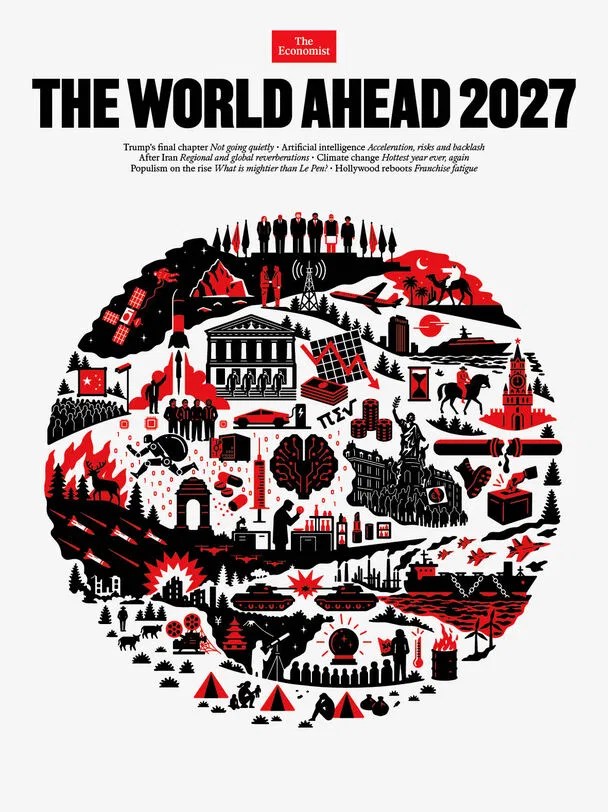
The World Ahead 2027
Tom Standage’s ten trends to watch, from Trump’s last act to “Star Wars” at fifty
Every November, The Economist looks a year ahead. In his letter introducing The World Ahead 2027, the editor, Tom Standage, starts from a simple observation: the present already reads like science fiction. A rocket entrepreneur who wants to put computers in space has become the world’s first trillionaire. Drones have remade warfare, taxis drive themselves, AI models misbehave, humanoid robots keep advancing, and weight-loss jabs improve the health of anyone who can afford them. Only aliens are absent, and Standage doesn’t expect them in 2027 either.
His ten trends run from Donald Trump’s last act to Xi Jinping’s deadline for Taiwan, from a record-breaking El Niño to the bond markets, and end, fittingly, with “Star Wars” at 50. Here they are, grouped by theme, with our notes on what to watch.
Power & Politics
1. The post-Trump era
United States
With the midterms behind him, the race to succeed Donald Trump begins. Standage expects no lame duck. He likens Trump instead to a “destructive Angry Bird”, lashing out with executive orders, court battles, abrupt renamings, showpiece construction and foreign military action as he tries to hold on to influence and fix his legacy. Meanwhile, the world starts to imagine America after him.
What to watch: the early contenders to succeed him, and how much of his late agenda outlasts him.
2. Aftershocks from Iran
Middle East
No tidy resolution is in sight, so the uncertainty will linger. The Economist calls the war ill-advised and says it has diminished America: friends trust it less and foes fear it less. Through 2027 the fallout will redraw regional politics, reroute energy supplies and put food supplies at risk as fertiliser grows scarce. Inside Iran, expect a harsher crackdown.
What to watch: energy and fertiliser prices, and shifting alliances across the region.
5. Europe’s populist right
France
Right-wing populism has been rising for years, but in 2027 all eyes turn to France. Marine Le Pen of the National Rally has a good chance of winning the presidency. Her victory would jam the Franco-German engine that drives the European Union and deepen worries about France’s heavy debts and fragile public finances.
What to watch: the French presidential campaign, and what bond investors charge France to borrow.
7. Taiwan’s deadline
China and Taiwan
New military technology helps small countries hold off big ones, as Ukraine and Iran have shown, which raises hard questions about China’s ambitions for Taiwan. Xi Jinping has reportedly ordered his forces to be able to seize the island by 2027, and America’s attention is elsewhere. China may move, or wait for Taiwan’s 2028 elections. Either way, the next two years will be perilous.
What to watch: Chinese military drills around the island, and how far Washington’s attention wanders.
Money & Markets
6. Bond-market pressure
The rich world
France is not the only country making bond markets nervous. Fiscal profligacy, the AI construction boom and renewed inflation from dearer energy are pushing up borrowing costs across rich countries, and higher rates are squeezing companies and households too. Standage’s verdict is blunt: the strain is unsustainable, and sooner or later something will snap.
What to watch: government bond yields, and the first sign of a crack in an over-borrowed state or company.
4. The AI backlash grows
Technology
Scrutiny of AI is intensifying. The chance of a crash grows as AI firms borrow heavily through complicated, hard-to-see deals. Whatever markets do, stronger models will fuel a wave of cyber-attacks, and firms and governments will worry about politics disrupting AI supply chains. Yet Standage argues the evidence does not support fears about lost jobs or data centres’ thirst for power and water. In his view the backlash is driven by imagined harms rather than measured ones.
What to watch: AI-sector debt, and the scale of AI-assisted cyber-attacks.
The Planet
3. Hottest year ever, again
Climate
2027 is forecast to set a new temperature record. A “super El Niño” will give a foretaste of a hotter, less stable climate: more drought, heat, fire and storms unless emissions fall quickly. The irony is that by rattling energy markets, Trump has done more than anyone to sell renewables, which now offer shelter from oil and gas price shocks as well as a climate fix.
What to watch: El Niño’s toll in extreme weather, and whether energy security speeds the switch to clean power.
Science & Space
8. The Ozempic effect
Health
Slimming drugs are changing what people buy as well as how they look. People who have slimmed down are celebrating with “revenge shopping” on clothes, cosmetics and gym memberships. The drugs’ success has also revived drugmakers’ interest in therapies to extend healthy lifespans.
What to watch: which industries ride the new spending, and the race for longevity drugs.
9. Cheaper space launch
Space
SpaceX’s giant Starship will begin regular satellite launches, and Chinese rocket firms will show they can reuse their boosters. Falling launch costs open the door to commercial space stations and even orbiting data centres, an idea Standage thinks is less far-fetched than it sounds.
What to watch: how often Starship flies, and the first serious plans for computing in orbit.
Culture
10. Rebooting Hollywood
Film
“Star Wars” returns for its 50th anniversary, alongside a new film meant to reboot the franchise. The Avengers return once more and a new James Bond is in the works. But cheap hits made by YouTube creators raise the question of whether audiences want something new. Standage’s closing twist is that the 1977 film now reads like a briefing: a mighty military undone by small, inexpensive ships, robots with minds of their own, and the cost of careless security and stolen plans.
What to watch: box-office returns for the big reboots against the creator-made upstarts.
The Threads
America’s diminished pull. Trump’s final stretch, the fallout from Iran and a distracted Washington leave allies hedging and rivals testing limits. (Trends 1, 2, 3, 7)
Energy as the transmission belt. Disrupted energy flows feed inflation, which lifts bond yields and squeezes governments and households, while strengthening the case for renewables. (Trends 2, 3, 6)
Small and cheap beats big and costly. Drones and low-cost weapons link Ukraine, Iran, Taiwan and, in the closing riff, a galaxy far, far away. (Trends 7, 10)
AI everywhere. A financial risk, a cyber threat, a driver of borrowing and a reason to build data centres in space. (Trends 4, 6, 9)
Strain seeking a breaking point. Debt-financed AI deals, stretched public finances and rising rates make a market accident a live possibility. (Trends 4, 5, 6)
Dates for the Diary
November 19, 2026. The full edition of The World Ahead 2027 is published.
Through 2027. A forecast “super El Niño” and a likely new global temperature record.
2027. France elects a president; China’s reported deadline for readiness to take Taiwan; “Star Wars” turns 50; Starship begins regular launches.
2028. Taiwan votes, and America elects Trump’s successor.
Before You Close the Issue
If reality has caught up with science fiction, who gets to write the ending?
Drawn from Tom Standage’s letter introducing The World Ahead 2027, The Economist, November 17, 2026. The full edition is published on November 19.
— The Editors, Intellicurious —

