
History Today · December 2026
Infants, Exiles & Ink
Child kings, a Bonaparte in the Abbey, the font of the Revolution and a federal Europe
History Today’s December issue closes the magazine’s 75th anniversary year with a gallery of inheritances that went wrong or went strange: a nine-month-old who became king of two countries, the last Bonaparte heir killed in a British war and refused a place in Westminster Abbey, a Birmingham typeface that became the voice of the French Revolution, and a London merchant’s dream of a federal Europe that war cut short.
Here is the issue, with our notes on the threads that run through it.
The Cover
Born to Rule: The Problem of Child Kings
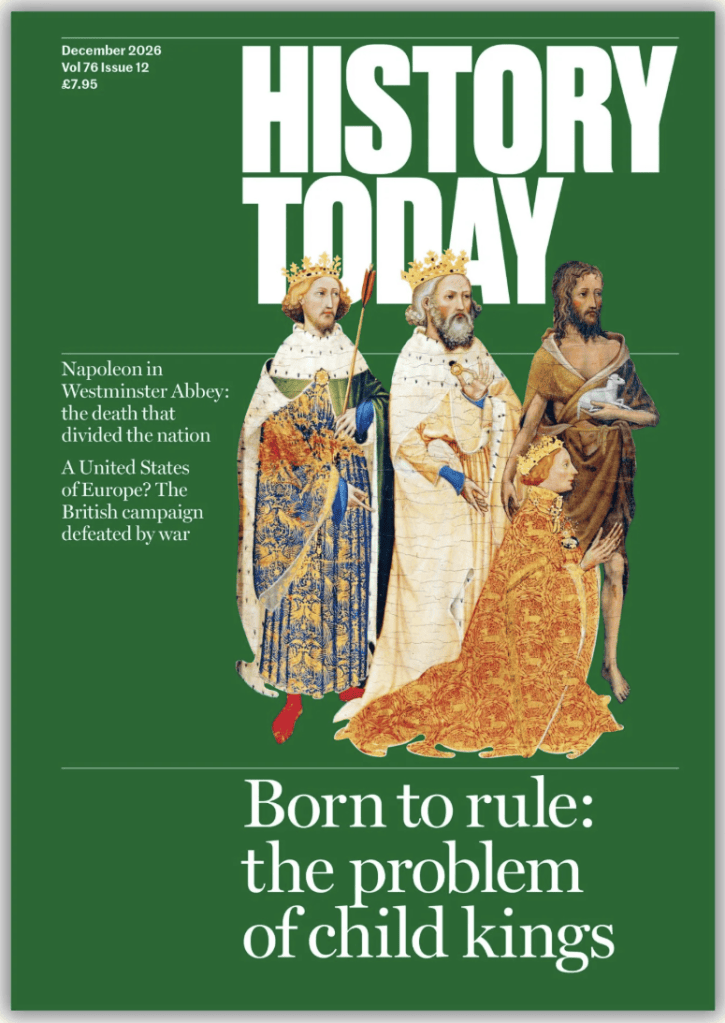
Cover · Vol. 76 Issue 12
On a deep green ground stand four figures from the Wilton Diptych, the jewel-like altarpiece painted for Richard II, himself a king at ten. Two crowned royal saints, Edmund with his arrow and Edward the Confessor, stand beside a barefoot John the Baptist cradling a lamb, presenting the young king, who kneels in a gold robe at their feet. The choice is pointed: the issue’s lead feature is about the boy kings who came before and after him.
Features
1. Born to Rule: The Problem of Child Kings
By Meredith Guthrie · Feature
In May 1420 the Treaty of Troyes seemed to give Henry V what Edward III had only dreamed of: recognition that he and his heirs would inherit the French crown. Then, within two months of each other in 1422, Henry V and Charles VI of France both died, leaving a nine-month-old as claimant to two kingdoms that had spent most of a century at war.
England had been ruled by children before: Henry III came to the throne at nine, Edward III at 14, Richard II at ten. But it had never had a king this young. Medieval government could run without the king in the room, Guthrie explains, but not without his personal authority, since every writ, pardon and charter drew its force from powers his coronation oath made his alone. Her question is what legitimacy could look like when the king could not yet speak, let alone command.
2. Napoleon in Westminster Abbey
By F.S.T. Skerrett · Feature
Louis-Napoléon, the prince imperial, was born in the Tuileries in 1856 as the hope of a third generation of Bonaparte emperors. After the Franco-Prussian War he grew up in exile in Chislehurst, trained as a cadet at Woolwich, and, after the British disaster at Isandlwana in 1879, used his mother’s friendship with Queen Victoria to sail for South Africa as an observer. On 1 June his patrol was ambushed by Zulu warriors; thrown from his horse and abandoned by his escort, he died at 23.
Britain raised four memorials to him in 1880, France only one. Three passed without fuss. The fourth, a marble effigy meant for Westminster Abbey, became a year-long national quarrel that Parliament settled by vote on 17 July 1880; it ended up in St George’s Chapel, Windsor. For Skerrett, the fight was about British identity as much as about a French prince.
3. The Font of the French Revolution
By Caroline Archer-Parré · Feature
John Baskerville (1707–75) was the leading printer of his age, and also a writing master, gravestone cutter, japanner, type founder, industrialist and deist: a neglected figure of the Industrial Enlightenment. His typeface has survived 250 years of technological change and now sits, much altered, on billions of computers.
Archer-Parré follows the original punches, now in Cambridge University Library, through three centuries, three countries and 11 owners, and asks how a font made in a Birmingham workshop became the typeface of the French Revolution and a symbol of Anglo-French fraternity.
Feature
At the start of the 20th century Max Waechter, a wealthy London merchant, set out on an unprecedented private diplomatic mission: to persuade Europe to federate. The feature traces what became of his pan-European vision, a British campaign, as the cover puts it, defeated by war.
75th Anniversary
Review · 75th Anniversary
To close its 75th anniversary year, the magazine picks the best history books published in its lifetime: the field-defining works that have appeared since History Today was founded in 1951.
Also in the Issue
6. And More
In the issue
Also in the issue: the libels of James VI and I, plus reviews, opinion, the debate and the crossword.
The Threads
Heirs in trouble. A baby king expected to rule England and France, and a prince raised to restore an empire who died in someone else’s war. (1, 2)
Britain and France, entangled. The Treaty of Troyes’ dream of a double crown, a Bonaparte trained and mourned in England, and a Birmingham typeface that spoke for Revolutionary Paris. (1, 2, 3)
Unions that never were. Henry VI’s two kingdoms and Max Waechter’s federal Europe both foundered on war. (1, 4)
What a nation chooses to remember. An effigy refused by the Abbey, punches kept in a library, and 75 years of history books weighed and ranked. (2, 3, 5)
Before You Close the Issue
When the rightful heir cannot speak, or does not come home, who carries a nation’s authority, and who decides how it is remembered?
Drawn from History Today, Volume 76 Issue 12, December 2026. Visit the homepage at historytoday.com.
— The Editors, Intellicurious —

