Tag Archives: France

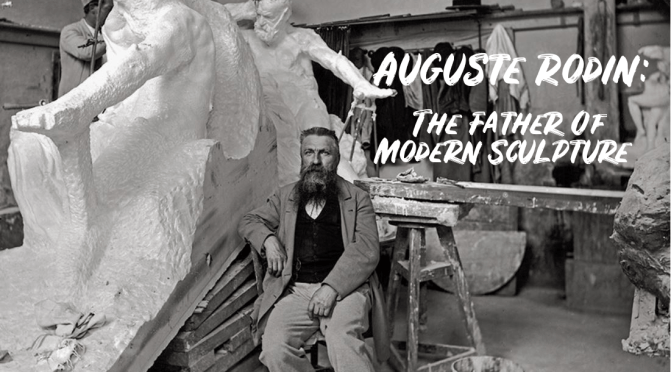
Art History: “Auguste Rodin – The Father Of Modern Sculpture”

From Christie’s online magazine (May 2020):

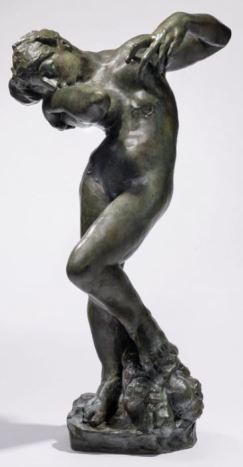
Auguste Rodin (1840-1917) Meditation, small model, type I version

Rodin travelled to Italy in 1875, a trip described by the late art historian Kirk Varnedoe as, ‘one of the seminal events in modern art’.

Here, in his mid-thirties, he fell under the spell of the Renaissance master, Michelangelo. His monumental, exaggerated nude figures would have a deep and lasting influence on the artist. ‘My liberation from academicism was via Michelangelo,’ Rodin later recalled. ‘He is the bridge by which I passed from one circle to another.’

Auguste Rodin (1840-1917) is renowned for breathing life into clay, creating naturalistic, often vigorously modelled sculptures which convey intense human emotions: love, ecstasy, agony or grief. Breaking the rules of academic convention and classical idealism, Rodin ushered in a new form of highly expressive sculpture that went on to influence generations of artists that followed.

Christie's logo

Read full article at Christie’s


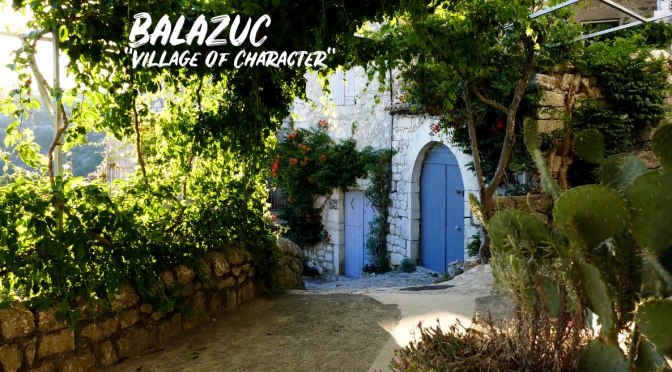
Top New Travel Videos: “Balazuc – Village Of Character” In France

Filmed and Edited by: Cineliv

Perched on a cliff overlooking the River Ardèche, the superb village of Balazuc has restored its heritage remarkably well. A former stronghold of the lords of Balazuc, this little village, with its rich medieval past, is today listed amongst the most beautiful villages in France.

A charming labyrinth of tortuous streets interspersed by arched passages, arcades and stairways, to be enjoyed on foot, during a delightful stroll. (English subtitles)

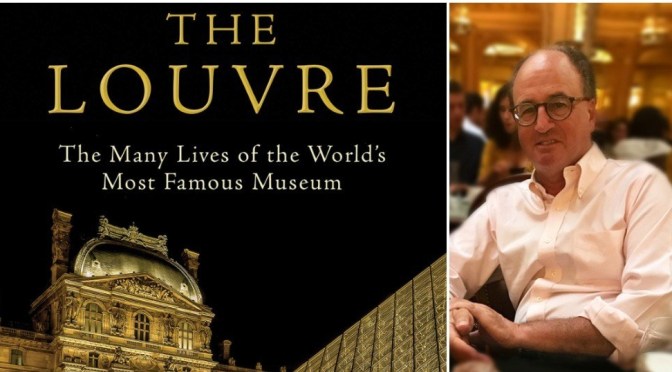
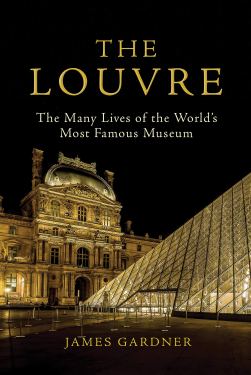
New Books: “The Louvre – The Many Lives Of The World’s Most Famous Museum” (James Gardner)

The Louvre James GardnerThe fascinating and little-known story of the Louvre, from its inception as a humble fortress to its transformation into the palatial residence of the kings of France and then into the world’s greatest art museum.

Some ten million people from all over the world flock to the Louvre each year to enjoy its incomparable art collection. Yet few of them are aware of the remarkable history of that place and of the buildings themselves―a fascinating story that historian James Gardner elegantly chronicles in the first full-length history of the Louvre in English.

More than 7,000 years ago, men and women camped on a spot called le Louvre for reasons unknown; a clay quarry and a vineyard supported a society there in the first centuries AD. A thousand years later, King Philippe Auguste of France constructed a fortress there in 1191, just outside the walls of a city far smaller than the Paris we know today. Intended to protect the capital against English soldiers stationed in Normandy, the fortress became a royal residence under Charles V two centuries later, and then the monarchy’s principal residence under the great Renaissance king François I in 1546.

It remained so until 1682, when Louis XIV moved his entire court to Versailles. Thereafter the fortunes of the Louvre languished until the tumultuous days of the French Revolution when, during the Reign of Terror in 1793, it first opened its doors to display the nation’s treasures. Ever since―through the Napoleonic era, the Commune, two World Wars, to the present―the Louvre has been a witness to French history, and expanded to become home to a legendary collection, including such masterpieces as the Mona Lisa and Venus de Milo, whose often-complicated and mysterious origins form a spectacular narrative that rivals the building’s grand stature.

James Gardner

James Gardner is an American art critic and literary critic based in New York and Buenos Aires. He is the author of six books, including Buenos Aires: The Biography of a City. His writings have appeared in the New York Times, the Wall Street Journal, the New Republic, and the British Spectator. He was the art critic at the New York Post and wrote architecture criticism for the New York Observer, before serving as the architecture critic at the New York Sun. He is now a contributing editor at The Magazine Antiques.

Read more or purchase

Artists: Watercolor Painter Alex Hillkurtz

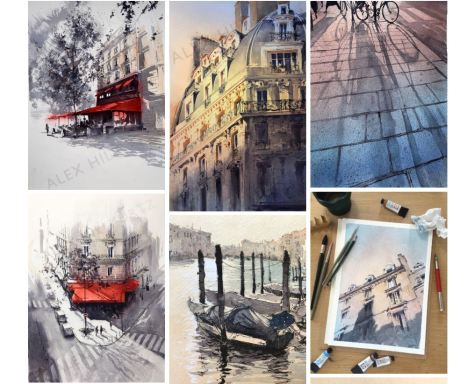
Alex Hillkurtz was born in England and grew up in California where he is a renowned storyboard artist for feature films, television, and commercials. His film credits include “Argo”, “Almost Famous”, “It’s Complicated”, and many others.

Alex Hillkurtz WatercolorAlex currently lives in Paris with his film editor wife, Tiffany, and enjoys discovering the hidden corners of the city that sketching and plein air painting allow. He uses the language of cinema to inform his images, moving beyond what one sees, and depicting what he wants others to see. He believes that in our too-crowded lives, sketching and plein air painting invite us to move at a more deliberate pace… a true sense of place, and sometimes unexpected stories are revealed.
Website

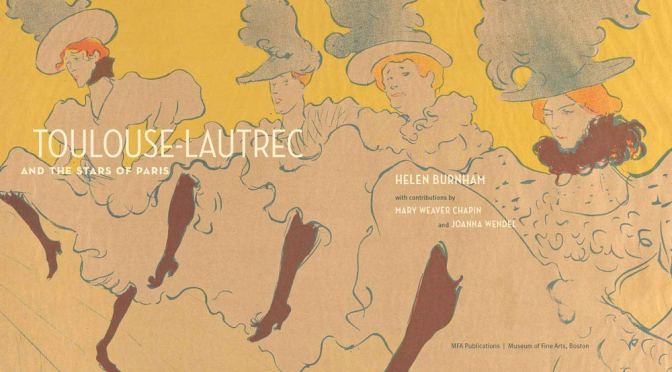
Art History: “Toulouse-Lautrec And The Stars Of Paris” (MFA, Boston Video)

Curator Helen Burnham, Pamela and Peter Voss Curator of Prints and Drawings, introduces us to the celebrities of 19th-century Paris made famous by Henri de Toulouse-Lautrec and his contemporaries. The exhibition features the rich holdings of the MFA and its organizing partner, the Boston Public Library.

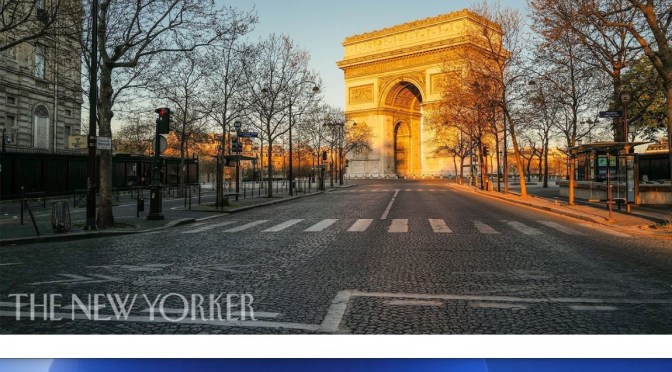
Travel: Streets Of Paris Under Quarantine – April 2020 (New Yorker Videos)

Scenes from a day of weirdness in quarantine in Paris, France as Parisians socially distance to avoid spreading the coronavirus. The city’s landmarks and streets appear eerily empty while residents have taken shelter at home to curb the outbreak of COVID-19.

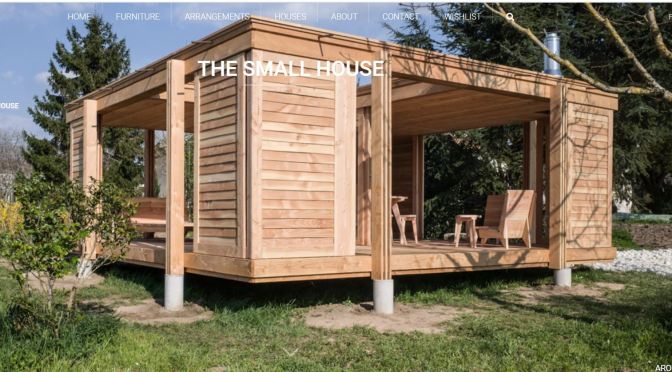
Top Prefab Housing: “Le Petit Maison” By French Firm 2m26 – “Wood Design Fit To The Landscape”

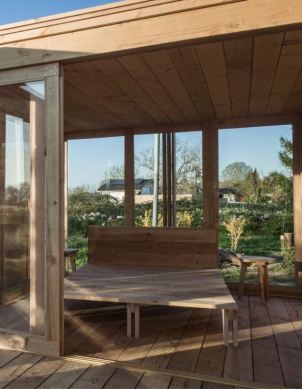
Le Petit Maison by 2m26 Architects Interior April 2020From reception pavilion to proper house, 2m26’s houses are unique pieces. They are produced made to measure, on demand. They absolutely fit to the landscape. The houses are made of pine planks, rough cuted. The structure is protected with linseed oil to resist to weather conditions and walnut stain can be added to obtain a dark color.
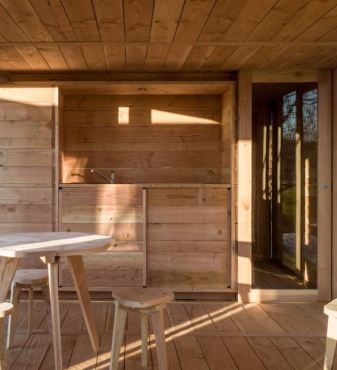
The Small House by 2m26 Architects April 2020The building process / prefab gives the opportunity to prepare all the pieces at the Atelier. Moreover, it reduces on site time of construction, damages on plants and minimizes noise pollution. On site construction can be scheduled from a week to a month.


Techniques used are mostly cutting, drilling, screwing, so that the assembly work can be done together with the customer, reducing costs for him.

About 2m26: Born in 2015, 2m26 summarizes ten years of researches and experiments about inhabiting.

Proceeding between design and architecture, 2m26 offers tools for living / handmade, thrifty and luxury / unique pieces designed and produced on demand / raw materials, natural processings and mastered development / simple, handsome and functional.

The crew :
mélanie heresbach / artist / architect.
sébastien renauld / artist / architect.

Website

Top New Camper Trailers: “Carapate” From France – “Innovation, Design And Detailed Woodwork”

Whether called “teardrop” or “mini-caravan”, the Carapate is distinguished by its design, technical innovations and careful finishes.

The Carapate offers a maximum of possibilities in a minimum of space. Ingenious and comfortable, it accompanies you during your weekends and trips

canape-mini-caravane-interieur-400x267Its optimal weight, around 450kg depending on the options, allows it to be towed by most cars with just its B license in its pocket. Its optimized dimensions (3.20m / 1.90m) make it a handy vehicle, easy to move and winter. It will pass all the parking gantries and tolls at no additional cost. Its studied height (1.70m) ensures good handling and low consumption during your getaways.
The insulating qualities of its wooden structure (marine plywood) promise you great nights, summer and winter. Its carefully studied bedding is delivered with the compliments of the sandman.

Solar panel, shore socket, 220 volt sockets, USB ports, cigarette lighter; so many possibilities to enjoy the “Carapate” while traveling or at the campsite. Freedom is yours!

Website

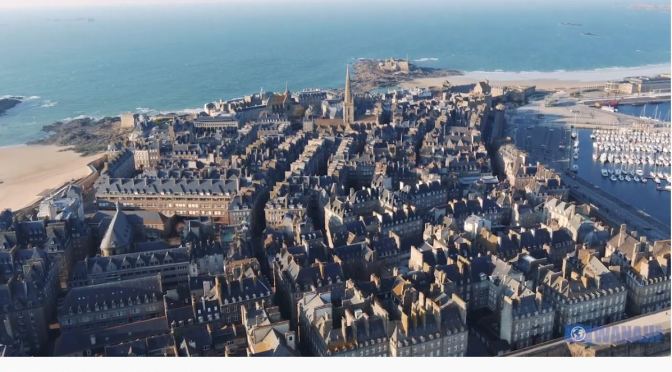
Travel Videos: “Saint Malo” In Northern France (2020)

Filmed and Edited by: JÉRÉMIE ELOY, Wanali Films

Filmed on April 1, 2020

Saint-Malo is a historic French port in Ille-et-Vilaine, Brittany on the English Channel coast.

The walled city had a long history of piracy, earning much wealth from local extortion and overseas adventures. In 1944, the Allies heavily bombarded Saint-Malo, which was garrisoned by German troops. The city changed into a popular tourist centre, with a ferry terminal serving the Channel Islands of Jersey and Guernsey, as well as the Southern English settlements of Portsmouth, Hampshire and Poole, Dorset.

Founded by Gauls in the 1st century BC, the ancient town on the site of Saint-Malo was known as the Roman Reginca or Aletum. By the late 4th century AD, the Saint-Servan district was the site of a major Saxon Shore promontory fort that protected the Rance estuary from seaborne raiders from beyond the frontiers. According to the Notitia Dignitatum, the fort was garrisoned by the militum Martensium under a dux (commander) of the Tractus Armoricanus and Nervicanus section of the litus Saxonicum. During the decline of the Western Roman Empire, Armorica (modern-day Brittany) rebelled from Roman rule under the Bagaudae and in the 5th and 6th centuries received many Celtic Britons fleeing instability across the Channel. The modern Saint-Malo traces its origins to a monastic settlement founded by Saint Aaron and Saint Brendan early in the sixth century. Its name is derived from a man said to have been a follower of Brendan the Navigator, Saint Malo or Maclou, an immigrant from what is now Wales.

Saint-Malo is the setting of Marie de France’s poem “Laüstic,” an 11th-century love story. The city had a tradition of asserting its autonomy in dealings with the French authorities and even with the local Breton authorities. From 1590 to 1593, Saint-Malo declared itself to be an independent republic, taking the motto “not French, not Breton, but Malouin.

From Wikipedia