
From Wikipedia:
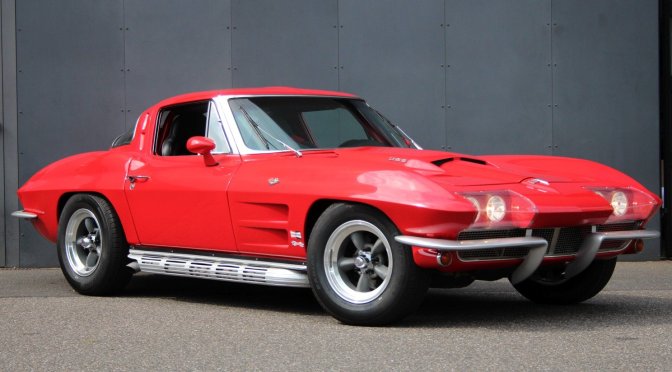
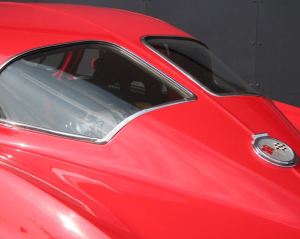 The 1963 Sting Ray production car’s lineage can be traced to two separate GM projects: the Q-Corvette, and perhaps more directly, Mitchell’s racing Sting Ray. The Q-Corvette, initiated in 1957, envisioned a smaller, more advanced Corvette as a coupe-only model, boasting a rear transaxle, independent rear suspension, and four-wheel disc brakes, with the rear brakes mounted inboard. Exterior styling was purposeful, with peaked fenders, a long nose, and a short, bobbed tail.
While Duntov was developing an innovative new chassis for the 1963 Corvette, designers were adapting and refining the basic look of the racing Sting Ray for the production model. A fully functional space buck (a wooden mock-up created to work out interior dimensions) was completed by early 1960, production coupe styling was locked up for the most part by April, and the interior, instrument panel included was in place by November. Only in the fall of 1960 did the designers turn their creative attention to a new version of the traditional Corvette convertible and, still later, its detachable hardtop. For the first time in the Corvette’s history, wind tunnel testing helped refine the final shape, as did practical matters like interior space, windshield curvatures, and tooling limitations. Both body styles were extensively evaluated as production-ready 3/8-scale models at the Caltech wind tunnel.
To see more photos and listing: https://www.classicdriver.com/en/car/chevrolet/corvette/1963/724523

 “People want to see photography and right now there are not a lot of places to do that,” he says. Showing “the best photography in the world” remains Fotografiska’s core mission, Broman says.





 In people with Type 1 diabetes, the pancreas can’t make insulin. Those with the condition require several doses of insulin a day and spent $5,705 per person on it in 2016, an increase of $2,841, or 99%, per person since 2012, according to the nonprofit
  Costs continue to rise, so much so that almost half of people with diabetes have temporarily skipped taking their insulin, according to a 2018 survey by UpWell Health, a Salt Lake City company that provides home delivery of medications and supplies for chronic conditions.
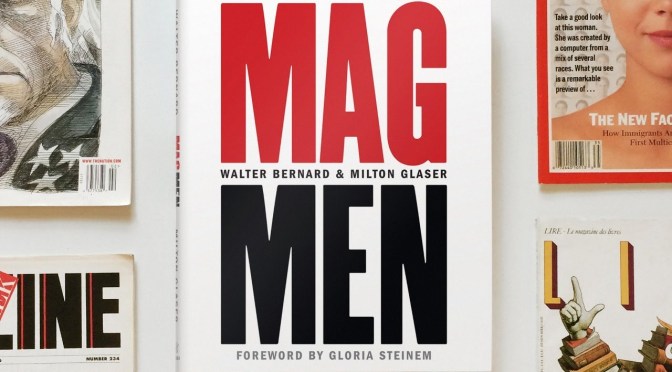
 For more than fifty years, Walter Bernard and Milton Glaser have revolutionized the look of magazine journalism. In Mag Men, Bernard and Glaser recount their storied careers, offering insiders’ perspective on some of the most iconic design work of the twentieth century. The authors look back on and analyze some of their most important and compelling projects, from the creation of New York magazine to redesigns of such publications as Time, Fortune, Paris Match, and The Nation, explaining how their designs complemented a story and shaped the visual identity of a magazine.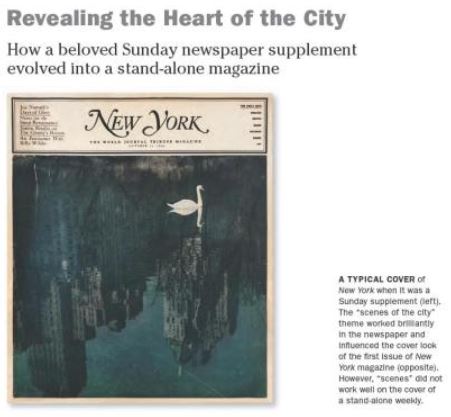

 The premise is simple: a black cat loves scheming a white mouse who incessantly throws bricks at the cat’s head, which police dog Officer Pupp, secretly harboring a passionate love for the cat, tries to prevent.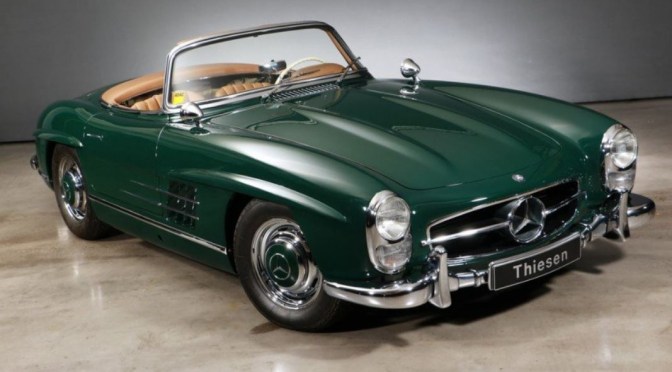
 The 300 SL celebrated its premiere at the? International Motor Sports Show? in New York, which took place from February 6th to 14th, 1954. Mercedes-Benz experienced an enormously positive response from visitors to the 300 SL at the Motor Show, so series production began in August 1954 at the Sindelfingen plant.
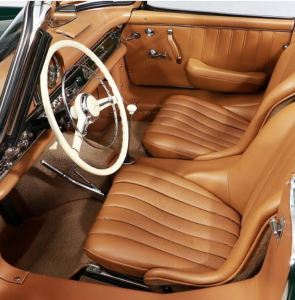
 This 300 SL Roadster was delivered in Germany on September 22, 1960. In the mid-1980s, the car came into the possession of an experienced Mercedes specialist. The roadster underwent extensive restoration under his direction. According to the available documentation, the body was separated from the chassis and completely overhauled. Since then, the car has only been moved about 28,000 km and serviced regularly. A few years ago, the vehicle changed hands within Germany to a businessman and classic car enthusiast who used the roadster for nice trips and events.
