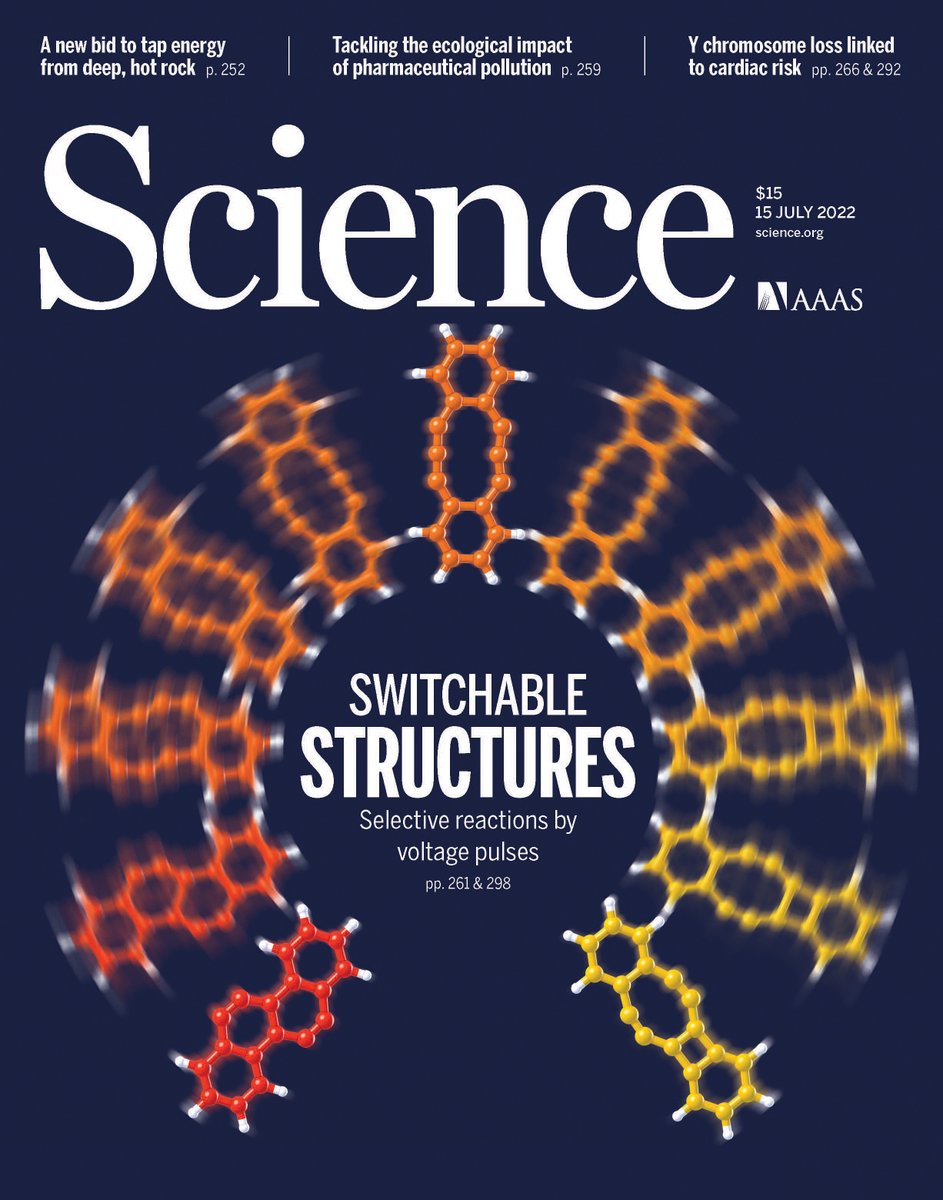
COVER: Voltage pulses from the tip of a scanning probe microscope induce single-molecule chemical reactions with selectivity and reversibility. Different constitutional isomers (distinguished here in shades of red, orange, and yellow) are selected by the polarity and magnitude of the voltage pulse. The findings advance the understanding of tip-induced chemistry and reduction-oxidation reactions in general. See pages 261 and 298.
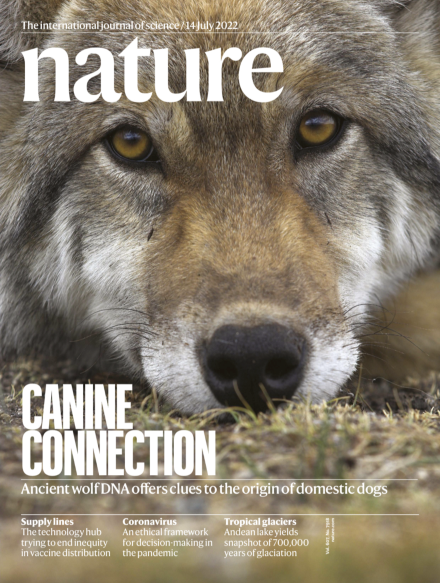
Although the domestic dog can trace its origins to the grey wolf (Canis lupus), exactly when, where and how domestication happened has remained a source of debate. In this week’s issue, Anders Bergström, Pontus Skoglund and their colleagues, take a step towards resolving this question. The researchers analysed the genomes of 72 ancient wolves from across Europe, Siberia and North America, and spanning the past 100,000 years. They found that dogs are most closely related to ancient wolves from eastern Eurasia but that dogs in the Near East and Africa derive
up to half their ancestry from a distinct population related to modern southwest Eurasian wolves. Although none of the genomes analysed was a direct match for either dog ancestry, the researchers say that it has narrowed down where next to look for the ancestors of domestic dogs.
CHILE’S VILLARRICA NATIONAL PARK—As a motley medley of mycologists climbed the basalt slopes of the Lanín volcano earlier this year, the green foliage at lower elevations gave way to autumnal golds and reds. Chile’s famed Araucaria—commonly called monkey puzzle trees—soon appeared, their spiny branches curving jauntily upward like so many cats’ tails.
FEATURES – How to understand your inner voice and control your inner critic
FEATURES – 7 big questions the James Webb Space Telescope is about to answer
NEWS– Covid-19: What are the risks of catching the virus multiple times?
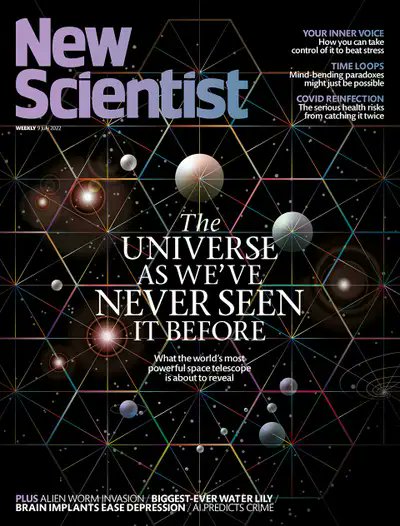
In this week’s issue: We’re about to see the first full-colour images from the James Webb Space Telescope – here’s what we can expect Available at newsstands and via our app for digital and audio editions. https://newscientist.com/issue/3394/
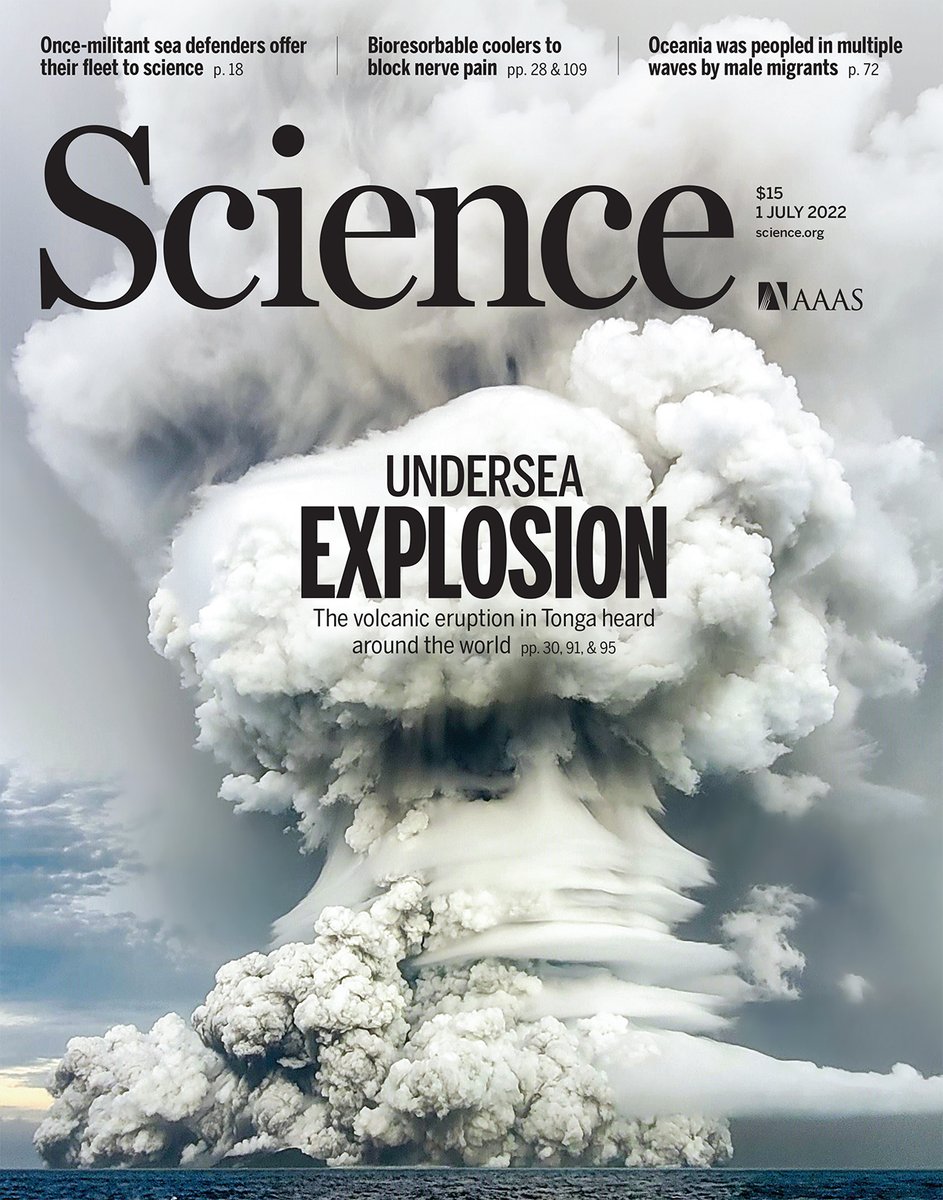
An ash and gas plume rises from Hunga volcano, Tonga, on 14 January 2022. Global geophysical observations reveal that the climactic eruption that followed on 15 January produced a broad range of atmospheric waves, with pressure wave amplitudes comparable with those from the 1883 Krakatau eruption. While propagating over the world’s oceans, the remarkable atmospheric waves generated complex fast-traveling tsunamis. See pages 30, 91, and 95.
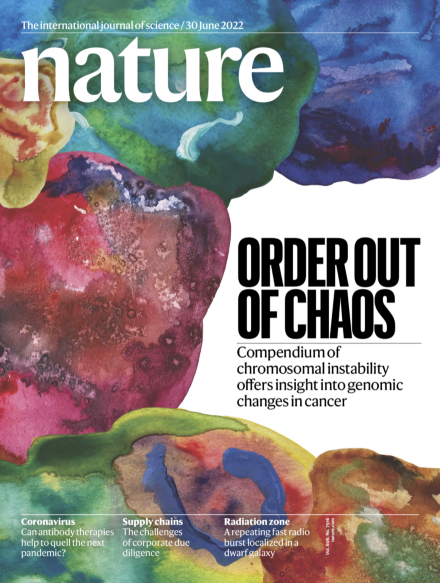
The cover shows an artistic representation of various cancer cells. The large-scale gains, losses and rearrangements of DNA seen in chromosomal instability are a typical feature of cancer — but there is no comprehensive framework to decode the causes of this genomic variability and their possible links to disease. In this week’s issue, Florian Markowetz, Geoff Macintyre and their colleagues present such a framework with a compendium of 17 signatures of chromosomal instability that can be used to predict how tumours might respond to drugs and that help to identify future therapeutic targets. The team created the compendium by examining 7,880 tumours representing 33 types of cancer. In a separate paper, Nischalan Pillay and colleagues examined 9,873 cancers to generate
Enteric viruses, such as norovirus, cause a significant health burden around the world and are generally considered to only spread via the faecal-oral route.
However, new research in mice suggests that saliva may also be a route of transmission for these viruses, which the authors say could have important public health implications.
How devouring space rocks helped Jupiter to get so big, and what analysing teeth has revealed about the diet of the extinct super-sized megalodon shark.
For decades there have been hints of the existence of tetraneutrons, strange systems composed of four neutrons, and now researchers may have created one in the lab. This breakthrough could tell us more about the strong nuclear force that holds matter together.
Last Friday the US supreme court struck down the constitutional right to abortion. In the wake of this ruling, Nature has been turning to research to ask what we can expect in the coming weeks and months.