Science’s Online News Editor David Grimm joins host Sarah Crespi to talk about a 2000-year-old pet cemetery found in the Egyptian city of Berenice and what it can tell us about the history of human-animal relationships.
Also this week, Dipon Ghosh, a postdoctoral fellow at the Massachusetts Institute of Technology, talks about how scientists missed that the tiny eyeless roundworm Caenorhabditis elegans, which has been intensively studied from top to bottom for decades, somehow has the ability to detect colors.
The pandemic’s unequal toll on the research community, and a newly discovered mitochondria-like symbiosis.
In this episode:
00:48 The pandemic’s unequal toll on researchers
Although 2020 saw a huge uptick in the numbers of research papers submitted, these increases were not evenly distributed among male and female scientists. We look at how this could widen existing disparities in science, and damage future career prospects.
Millions of years ago, a microscopic protist swallowed a bacterium and gained the ability to breathe nitrate. This relationship partially replaced the cell’s mitochondria and allowed it to produce abundant energy without oxygen. This week, researchers describe how this newly discovered symbiosis works.
We discuss some highlights from the Nature Briefing. This time, the weakening of the Gulf Stream, and a new satellite to monitor deforestation in the Amazon.
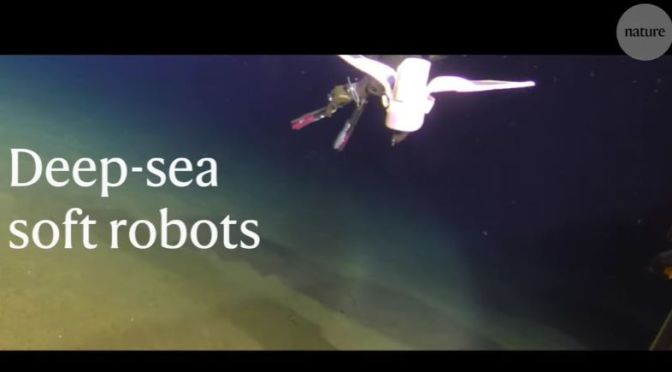
Is the future of deep-sea exploration soft? Researchers have developed a new type of soft robot designed to cope with the crushing pressures at the bottom the ocean. Inspired by the skull of the Mariana Snailfish, the deepest living fish, the researchers distributed their robot’s electronics, creating a machine that can withstand extreme pressure.
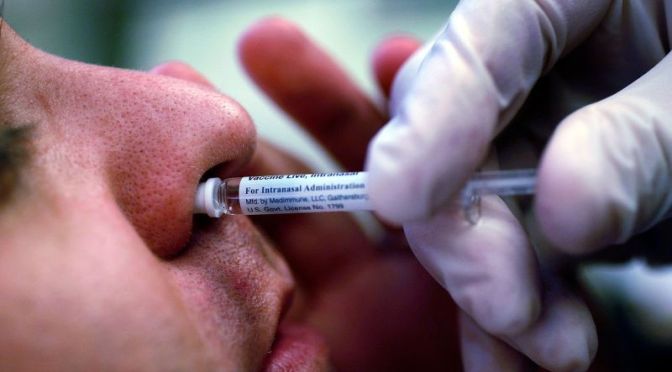
Enter the intranasal vaccine, which abandons the needle and syringe for a spray container that looks more like a nasal decongestant. With a quick spritz up the nose, intranasal vaccines are designed to bolster immune defenses in the mucosa, triggering production of an antibody known as immunoglobulin A, which can block infection. This overwhelming response, called sterilizing immunity, reduces the chance that people will pass on the virus.
The development of highly effective COVID vaccines in less than a year is an extraordinary triumph of science. But several coronavirus variants have emerged that could at least partly evade the immune response induced by the vaccines. These variants should serve as a warning against complacency—and encourage us to explore a different type of vaccination, delivered as a spray in the nose. Intranasal vaccines could provide an additional degree of protection, and help reduce the spread of the virus.
How can you tell if the mask you’re wearing is protective enough against the coronavirus? Correspondent David Pogue volunteers as a test subject to see how N95s work and learns about the science of face coverings.
The surprising structure of protons, and a method for growing small intestines for transplantation.
In this episode:
00:45 Probing the proton’s interior
Although studied for decades, the internal structure of the proton is still throwing up surprises for physicists. This week, a team of researchers report an unexpected imbalance in the antimatter particles that make up the proton.
Short Bowel Syndrome is an often fatal condition that results from the removal of the small intestine. Treatment options are limited to transplantation, but donor intestines are hard to come by and can be rejected by the body. Now researchers may have developed a method to grow a replacement small intestine using stem cells and a small section of colon.
A virus is a submicroscopic infectious agent that replicates only inside the living cells of an organism. Viruses infect all types of life forms, from animals and plants to microorganisms, including bacteria and archaea.
Scientists have used a technique to grow bile duct organoids – often referred to as ‘mini-organs’ – in the lab and shown that these can be used to repair damaged human livers. This is the first time that the technique has been used on human organs. Funding provided by European Research Council, the National Institute for Health Research and the Academy of Medical Sciences
News, Views and Reviews For The Intellectually Curious






 Intellicurious