
Nautilus · Issue 69 · December 2026
Fire, Ice & Demons
The Hot Issue: Maxwell’s demon, the taming of fire, vanishing oceans and thriving polar bears
Nautilus devotes its December issue entirely to heat: the law that says all warmth must eventually spread out and fade, the fire that made us human, the oceans that hot planets cannot keep, and the ice that is disappearing from our own. It is a science magazine’s answer to a warming world, curious rather than despairing, and full of surprises, from polar bears that are doing well to a Victorian physicist who enlisted a demon to save free will.
Here is the issue, with our notes on the threads that run through it.
The Cover
The Hot Issue: Earth in a Twist
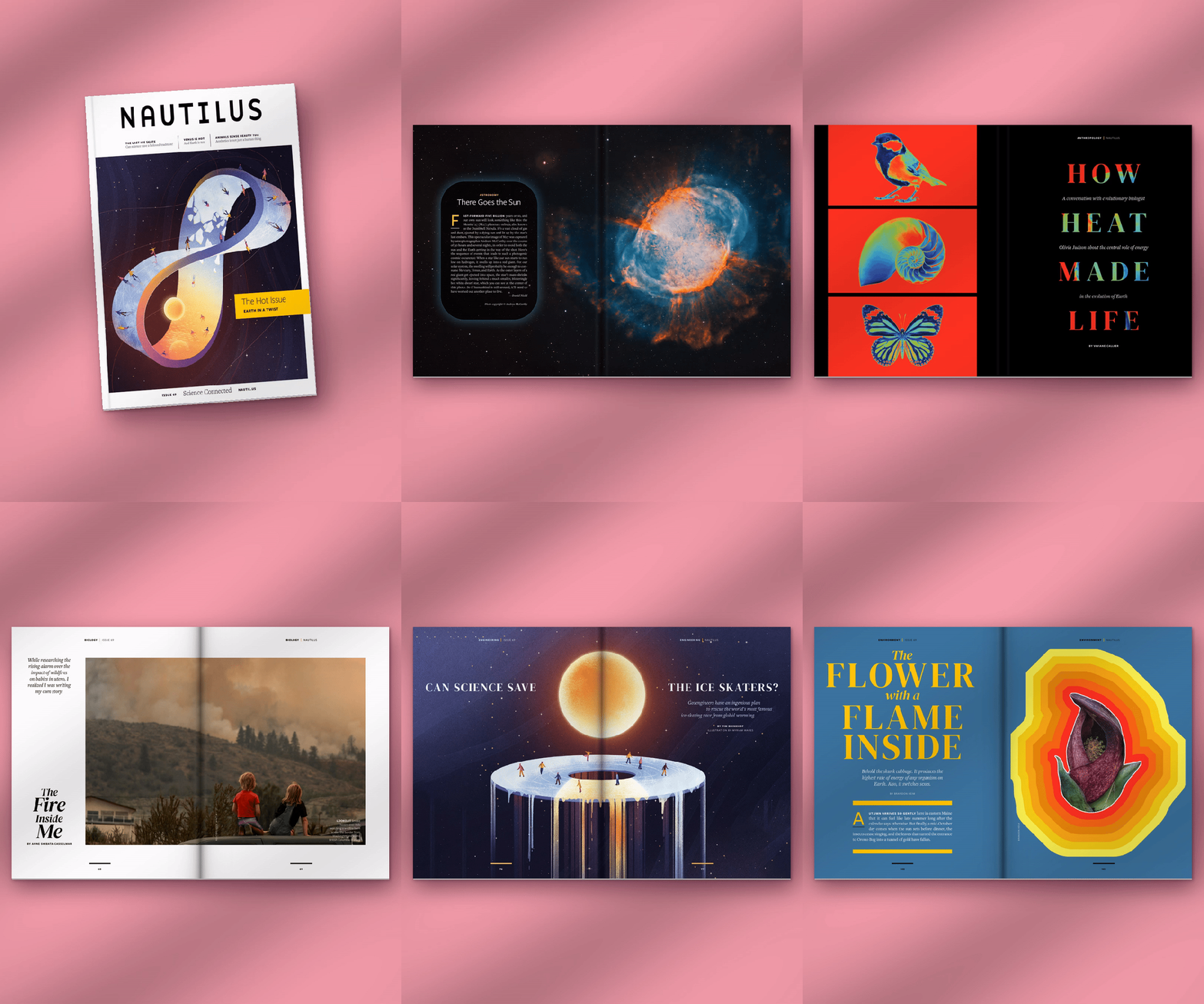
Cover · Art by Myriam Wares · Issue 69
A great twisted ribbon, looped into a figure eight, floats in a starry violet sky. At one end its surface is ice, cracking into floes, with tiny skaters gliding and tumbling across it; as the band twists, the ice gives way to glowing amber water warmed by a small sun, where figures swim and drift. Above, three cover lines: “The last ice skate: can science save a beloved tradition?”, “Venus is hot, and Earth is not”, and “Animals sense beauty too: aesthetics is not just a human thing”.
The Lead Essay
1. The Everlasting Life of Maxwell’s Demon
By Philip Ball · Physics
Ball begins in 1867, with Maxwell at the height of his powers: he had explained gases through molecular motion, unified electricity and magnetism and made the first true colour photograph. Yet one law unsettled him. The second law of thermodynamics, which forbids heat from flowing unaided from cold to hot, seemed to doom the universe to a “heat death”: not a blaze, but a slow, even running-down of everything.
For a devout Christian who believed in eternal life and in the free will by which people seek salvation, that was hard to accept, and Maxwell was too good a scientist to think faith could contradict physics. The historian Matthew Stanley tells Ball that Maxwell was looking for a gap in the laws through which free will could pass. In a letter to his friend Peter Guthrie Tait, Maxwell proposed one: an imaginary being that could sort fast molecules from slow ones and seemingly defy the second law. Ball follows the demon from that letter to its long and lively afterlife in science today.
Also in the Hot Issue
2. How Fire Made Us
By Olivia Judson · Evolution
The evolutionary biologist explains how learning to control fire did more than warm and feed our ancestors: it turned them into a different species.
3. Why Habitable Planets Lose Their Oceans
By Sean Raymond · Astronomy
Raymond asks why worlds that could support life struggle to keep their water, a question that hangs over Venus, as the cover reminds us, and makes Earth’s oceans look all the more fortunate.
4. The Polar Bears That Are Thriving
By Elena Kazamia · Ecology
Kazamia travels to northern Canada to find out why some polar bears are flourishing, against expectations, as the planet warms.
5. A Warming World
Photographs by Edward Burtynsky · Portfolio
The photographer known for his vast images of landscapes reshaped by industry turns his lens on the marks of a hotter planet.
6. The Last Ice Skate
Culture
A traditional Dutch outdoor ice-skating race depends on winters cold enough to freeze the waterways. The piece asks what will become of it, and whether science can save a beloved tradition.
7. Animals Sense Beauty Too
Behaviour
Is a sense of beauty uniquely human? The issue considers the evidence that other animals have an innate aesthetic sense of their own.
This Week on Nautilus
8. Derelict Soviet Spacecraft? Dark Comet? What the Heck Is 1998 KY26?
By Jake Currie · Astronomy
Japan’s Hayabusa2, which returned samples from the asteroid Ryugu laced with organic compounds from the dawn of the solar system, has had its mission extended to reach a stranger target by 2031. Discovered nearly 30 years ago, 1998 KY26 is only about 11 metres across, barely larger than the spacecraft, and spins once every five and a half minutes or so. Its behaviour has puzzled astronomers ever since.
More astronomy at Nautilus → Nine rebel astronomy theories that went dark →
The Threads
Heat as destiny. A law that promises the universe will run down, the fire that remade our ancestors, and the warmth that can strip a planet of its seas. (1, 2, 3)
Ice in retreat. A skating tradition at the mercy of mild winters, polar bears confounding predictions, and Burtynsky’s portraits of a hotter Earth. (4, 5, 6)
What makes us human? Maxwell’s search for room for free will, fire as the spark of a new species, and the suggestion that a taste for beauty is not ours alone. (1, 2, 7)
Before You Close the Issue
Heat made us human. Can we stop it from unmaking the world we built?
Drawn from Nautilus, Issue 69, “The Hot Issue,” December 2026. Cover art by Myriam Wares. Visit the homepage at nautil.us.
— The Editors, Intellicurious —

