
The Policy Digest · November 2026 · Volume 4
Borders, Brokers & Ballots
Militant sanctuaries, Pakistan’s Iran diplomacy, fragile ceasefires and the politics of endorsement
The Policy Digest, Policy Wire’s monthly geopolitics magazine, devotes its 36-page November edition to the fault lines it sees reshaping international security: militant sanctuaries on the Afghanistan–Pakistan border, Pakistan’s bid to broker an end to the Iran war, the fragile ceasefires of Lebanon and Gaza, Sikh separatist politics, India’s military recruitment, Donald Trump’s grip on Republican primaries, and the scramble for critical minerals.
The magazine writes with a strong South Asian perspective, and several of its pieces make contested claims. We summarise each contributor’s argument in their own terms and note where a claim is disputed.
The Cover
Sanctuary Is a Choice
Cover · Volume 4 · November 2026
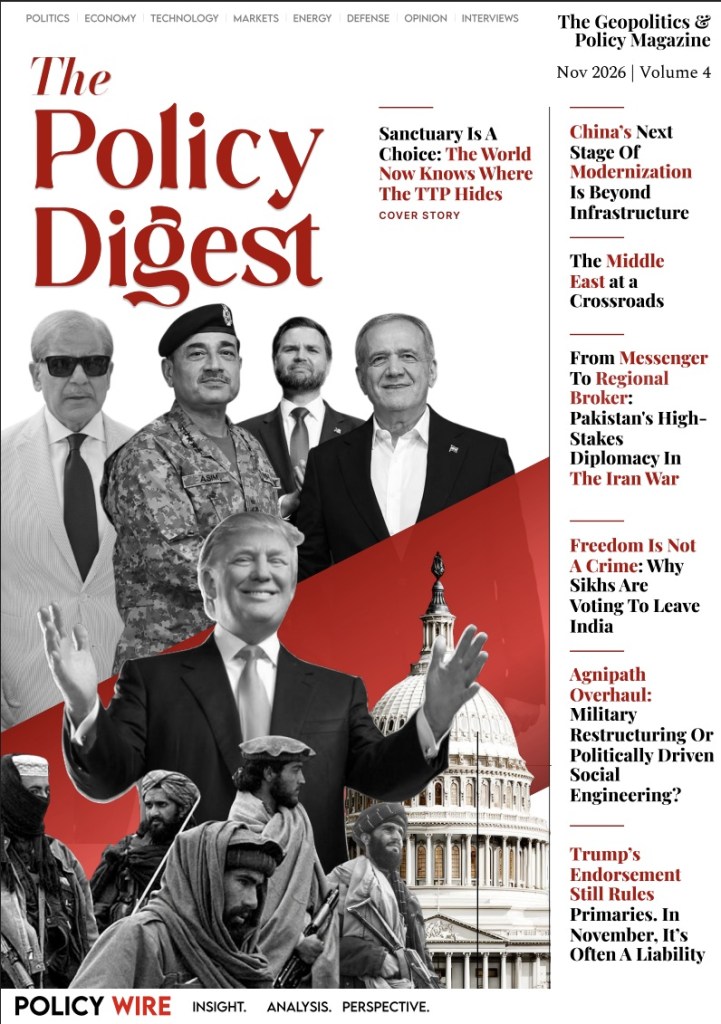
A collage in black, white and red: a row of political and military leaders across the top, one in a general’s uniform and beret, and at the centre a smiling figure in colour, arms raised in greeting, beneath the dome of the U.S. Capitol. Along the bottom stand armed fighters in turbans. A sharp red diagonal slices the frame, and down the right side run the issue’s cover lines, from China’s next stage of modernisation to the Khalistan referendum and Trump’s endorsement power.
Security & Defence
1. Sanctuary Is a Choice: The World Now Knows Where the TTP Hides
Analysis by Sara Adams · Cover Story · Security & Defence
Drawing on United Nations monitoring reports, satellite imagery and ground reporting, the cover dossier argues that the banned Tehrik-e-Taliban Pakistan operates organised safe havens inside Taliban-ruled Afghanistan with official tolerance. It cites UN figures of more than 6,000 TTP fighters in Afghan provinces, describes the spread of night-vision and thermal equipment left behind by American forces, and counts over 400 drone incursions in border areas. It also notes a shift in Washington, where the president and secretary of state have begun to highlight cross-border terrorism from Afghanistan.
Afghanistan’s Taliban authorities have consistently denied that they allow militant groups to use their territory against Pakistan.
2. Agnipath Overhaul
By Saad Riaz · South Asian Defence
India’s Agnipath scheme recruits soldiers on short-term contracts. Riaz asks whether recent revisions are genuine modernisation, aimed at controlling pension costs and building technical skills, or whether they weaken regimental cohesion and send thousands of 22-year-old veterans into an uncertain civilian job market without support.
3. Lebanon, Iran, Gaza and the Limits of Ceasefires
Gregg Roman, Middle East Forum · Q&A
Roman argues that international ceasefire deals too often settle for paperwork rather than verifiable disarmament of proxy militias. In his view the order of steps can be negotiated, but the end state cannot, and without disarmament the region stays unstable.
Diplomacy & the Middle East
4. From Messenger to Regional Broker
By Imad Abbas · Geopolitical Strategy
Abbas traces Pakistan’s shift from go-between to active mediator in the Iran war, centred on Field Marshal Asim Munir’s October 20 mission to Tehran for talks with President Masoud Pezeshkian and Speaker Mohammad Bagher Ghalibaf. He sets out Iran’s seven conditions for de-escalation, the deadlock over the Strait of Hormuz, and security along the 909-kilometre Pakistan–Iran border.
5. The Middle East at a Crossroads
Prof. Tamirace Fakhoury, interviewed by Ali Ahmed · Exclusive Interview
The Fletcher School scholar examines Lebanon’s fragile sovereignty, the argument over whether Hezbollah disarmament or Israeli withdrawal should come first, and the gap left as UN peacekeepers draw down in the south. Ceasefires that halt fighting without a political settlement, she argues, tend to set the stage for worse violence later.
Politics
6. Freedom Is Not a Crime: Why Sikhs Are Voting to Leave India
Jasveer Singh, Sikh Federation UK, and Sikhs for Justice · Global Sikh Affairs
A report from the diaspora campaign for a Khalistan referendum, from a vote in Westminster to Sikh communities in Canada, Australia and the United States, where participants cite safety, dignity and control. The piece alleges Indian state involvement in the 2023 killing of Hardeep Singh Nijjar in Canada and in recent attacks on organisers, and describes Sikh activists’ outreach to China.
The referendum is an unofficial, non-binding vote organised by Sikhs for Justice, which India banned in 2019. India denies any role in Nijjar’s killing.
7. Trump’s Influence: Primary Dominance vs. General-Election Liabilities
Janie Mackenzie, Victor A. Lopez and George Carrillo · US Politics Special
Three political strategists examine a paradox: a Trump endorsement remains close to decisive in Republican primaries, yet in swing districts it can cost votes among suburban moderates and independents. They also discuss the economics of campaign rallies, eroding trust in institutions and the prospects for bipartisan government in Congress.
Economy & Trade
8. Supply Chains, Modernisation and Energy Security
Arnold Platz, Sara Adams, Robert J. Green, Jiang Tao and Dr. Lubna Umar · Markets & Trade
A four-part economics section. Platz and Adams argue that as U.S.–China tariff truces end, the contest will move to the processing of rare earths, gallium, germanium and graphite. Green contends that falling pump prices hide steep rises in diesel, fertiliser and farm costs from the Iran war. Jiang Tao of CGTN reports on China’s shift from concrete mega-projects to data centres, computing grids and high-tech manufacturing inland. And Umar argues that Pakistan must raise its industrial competitiveness, conserve water and improve export quality if CPEC is to become an engine of exports rather than of debt.
The Threads
Wars that will not end. Militant sanctuaries, Hormuz and Lebanon all show conflicts frozen rather than resolved, and several contributors argue that ceasefires without settlements only postpone the next round. (1, 3, 4, 5)
Brokers and borders. Pakistan casts itself as mediator with Tehran while confronting militants across its western frontier. (1, 4)
Politics beyond the state. A diaspora referendum on independence, and an American president whose endorsement remains decisive in primaries but a risk in November. (6, 7)
The economics of security. Minerals, fuel, fertiliser and infrastructure debt show how quickly geopolitics becomes a cost of living. (8)
Before You Close the Issue
When ceasefires freeze wars instead of ending them, who gets to broker the peace, and on whose terms?
Drawn from The Policy Digest, Volume 4, November 2026, published by Policy Wire. The views and claims summarised are those of the magazine’s contributors. Visit the homepage at policy-wire.com.
— The Editors, Intellicurious —

