
National Review · January 2027
Reality, Reckoning & Rebuilding
After the Wave: the right’s post-mortem on the midterms, and where the GOP goes next
National Review’s January issue is the conservative movement’s post-mortem on November’s midterms, which the magazine calls a Republican rout. Under the banner “After the Wave,” a dozen of its writers ask what went wrong, from prices at the pump to corruption, bad candidates and a president its lead essay says lost touch with reality, and what the party should become next, with or without Donald Trump’s example.
Here is the issue, with our notes on the threads that run through it.
The Cover
After the Wave
Cover · January 2027
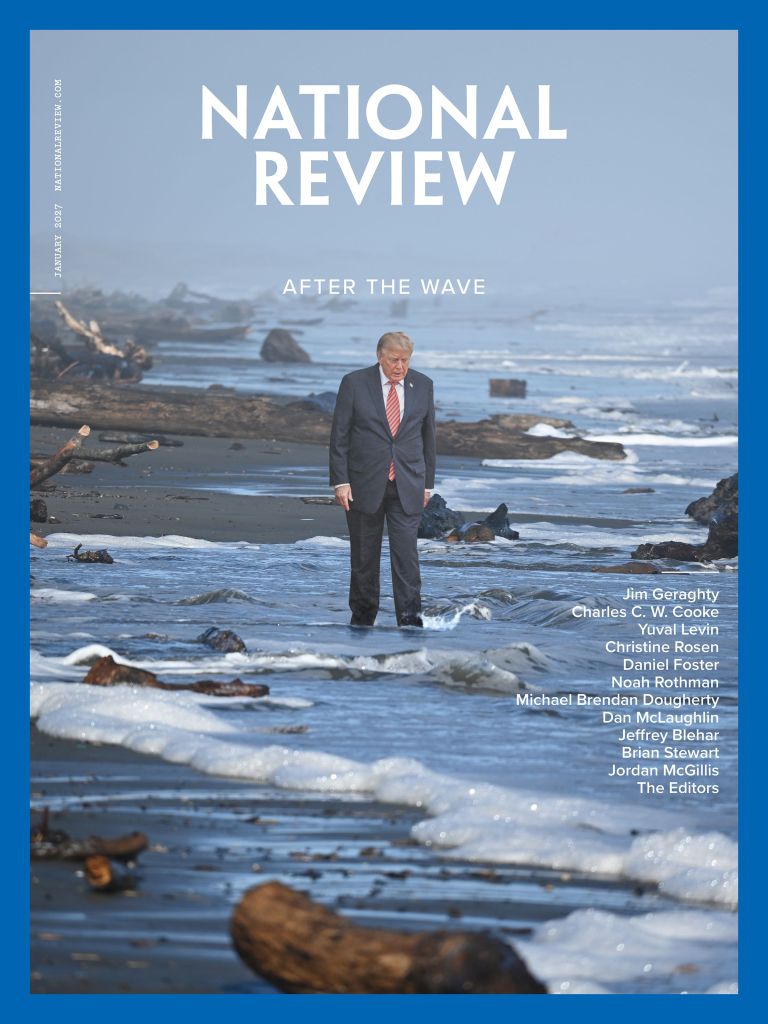
On a misty grey beach strewn with driftwood, Donald Trump stands in a dark suit and striped red tie, ankle-deep in the foam of a receding tide, looking down at the water. The cover line, “After the Wave,” sits in the fog above him, and down the right side runs the list of contributors, from Jim Geraghty to the editors.
After the Wave
By Jim Geraghty · Lead Essay
Geraghty argues that Trump’s career has run on what a former aide called a “reality distortion field”: a salesman’s habit, learned from Norman Vincent Peale’s gospel of positive thinking and polished on The Apprentice, of insisting that everything is going wonderfully. In his second term, Geraghty writes, the gap between the claims and voters’ lives grew too wide: inflation declared beaten, the Iran war said to be going splendidly, gas promised below $3 yet still above $4 after Election Day.
On election night, he notes, Trump blamed Texas’s governor and Fox News, and when the Dow fell 1,800 points told voters they had only themselves to blame. Geraghty’s lesson for any would-be successor: an optimistic attitude helps, but you cannot fix a problem you refuse to see.
2. Six Takes on the GOP’s Midterm Drubbing
By Charles C. W. Cooke · Politics
The morning after the defeat, Cooke drove from Florida to Texas through six Southern states, reading the campaign billboards and arguing with himself. The result is a set of competing, often contradictory explanations. The obvious one is prices: identical Democratic billboards in every state tallied the rising cost of gas, rent and groceries without naming a party, and others reminded voters of tariffs and a war begun without warning.
3. Populism’s Suicide by Hypocrisy
By Yuval Levin · Politics
Levin agrees the election was about Trump, and that prices, the Iran war, worries about A.I. and the president’s unseriousness weighed on voters. But he points to a striking finding in the exit polls: 90 percent of voters called government corruption a crucial or major factor, and 54 percent called it crucial, more than said so of the cost of living or the war. Most of them voted against Trump’s party. A movement that promised to drain the swamp, Levin argues, was undone by its own hypocrisy.
4. Hey, Could You Just Be Normal?
By Christine Rosen · Politics
What voters wanted, Rosen suggests, was something simpler than any programme: a politics that behaves normally.
By Daniel Foster · Elections
Foster on the Republicans’ candidates, and how a sheer quantity of bad ones becomes a problem of its own.
By Noah Rothman · Politics
Rothman examines how Jews and Israel figured in the politics of 2026.
By Michael Brendan Dougherty · Presidential Elections
Dougherty sets out how J.D. Vance might lead a battered party back to the White House.
8. The Republicans’ Next Coalition
By Dan McLaughlin · Political Parties
McLaughlin asks what kind of coalition the Republicans can build after the defeat.
By Jeffrey Blehar · Presidential Elections
The GOP cannot replicate Trump, Blehar argues, and should ask why it would want to.
Also in the Issue
10. The Provincialism of Abdul El-Sayed
By Brian Stewart · Foreign Policy
Stewart criticises the worldview of the Michigan Democrat Abdul El-Sayed and considers what it portends for America.
11. Republicans Must Reject Anti-Indian Bigotry
By Jordan McGillis · Immigration
McGillis urges his party to reject prejudice against Indian Americans, arguing that pluralism wins.
12. The Higher Calling of Higher Ed
By Robert P. George · Education
George makes the case for bringing the universities back to the pursuit of truth.
By James Piereson & Naomi Schaefer Riley · Education
Is there a new kind of self-censorship in the academy? Piereson and Riley investigate.
14. A Lysistrata Strategy for Our Time
By Mary Eberstadt · Gender & Sexuality
Taking her cue from Aristophanes’ comedy, in which women withhold sex to stop a war, Eberstadt writes on women, sex, power and love.
15. The United States of Buc-ee’s
By Kamden Mulder · Our Spacious Skies
How a giant roadside store born in Texas came to capture something of the American spirit.
Books, Arts & Manners
16. Frank Meyer’s Conservative Revolution
By Samuel Goldman · Books
Goldman revisits Frank Meyer, the philosopher of “fusionism,” and asks what his ordered liberty would look like today.
By Rebeccah Heinrichs · Books
America, Heinrichs argues, still draws dividends from the Reagan administration’s far-sighted military investment.
By John Mac Ghlionn · Books
On the French emperor and the human demolition derby of his wars.
By Michael M. Rosen · Books
Two scholars’ visions of artificial intelligence, one of plenty and one of peril.
20. The German’s Great Cliff-Hanger
By Martha Bayles · Television
Bayles argues that The German is too good a series to be cut short.
21. Escaping Venezuela Shows the Price of ‘Progress’
Film
A new documentary sets out in forensic detail what Hugo Chávez destroyed.
The Threads
Reality bites. Geraghty’s president who would not see the gas pump, Cooke’s billboards about the cost of living, and Levin’s voters punishing corruption all describe a party judged on daily life rather than slogans. (1, 2, 3)
After Trump. Vance’s route to 2028, a new coalition, Rosen’s plea for normality, and Blehar’s argument that Trumpism cannot and should not be copied. (4, 7, 8, 9)
Policing the fringes. Bad candidates, the politics of antisemitism and anti-Indian prejudice: several writers urge the right to put its own house in order. (5, 6, 11)
Ideas for the long haul. Truth in the universities, the fear of speaking in them, and Frank Meyer’s vision of ordered liberty. (12, 13, 16)
Before You Close the Issue
After the wave, what will the right rebuild on: Trump’s legacy, or the reality its own writers say he refused to see?
Drawn from National Review, January 2027. The views summarised are those of the magazine’s writers. Visit the homepage at nationalreview.com.
— The Editors, Intellicurious —

