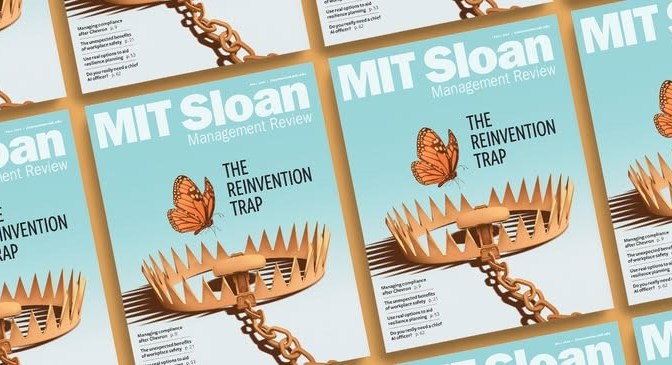
MIT Sloan Management Review (December 4, 2024):Looking beyond AI, many of our top 10 stories involve tough culture and people management challenges, like dealing with the informal meetings that happen after formal meetings (No. 2) and getting people to stop self-censoring with company leaders (No. 5). These two stories, by Phillip G. Clampitt and Jim Detert, respectively, truly struck a nerve with readers. At a time of radical change, communication and trust have never been more important.
In this brief video, learn what the latest research and current examples say about return-to-office mandates — and what leaders can do instead to boost productivity and retain talent.
Most people know what can’t be said in their organization. But leaders can apply these techniques to break through the unwritten rules that make people self-censor.
Michael Schrage, David Kiron, François Candelon, Shervin Khodabandeh, and Michael Chu
This artificial intelligence and business strategy report looks at how organizations are using AI to evolve their key performance indicators to better align with their strategies and deliver on enterprise goals.
MIT Technology Review (Novemer 24, 2024): This week’s round up includes Google DeepMind has a new way to look inside an AI’s “mind”. Inside Clear’s ambitions to manage your identity beyond the airport. Who’s to blame for climate change? And more.
How this grassroots effort could make AI voices more diverse A massive volunteer-led effort to collect training data in more languages, from people of more ages and genders, could help make the next generation of voice AI more inclusive and less exploitative.
The rise of Bluesky, and the splintering of social You may have read that it was a big week for Bluesky. If you’re not familiar, Bluesky is, essentially, a Twitter clone that publishes short-form status updates.
Ben Zhao remembers well the moment he officially jumped into the fight between artists and generative AI: when one artist asked for AI bananas.
MIT Technology Review (Novemer 17, 2024): This week’s round up includes Generative AI taught a robot dog to scramble around a new environment; The AI lab waging a guerrilla war over exploitative AI; Life-seeking, ice-melting robots could punch through and Europa’s icy shell.
The tools Glaze and Nightshade are giving artists hope that they can fight back against AI that hoovers internet data to train. Are they enough?
Generative AI taught a robot dog to scramble around a new environment
A new system could help train robots entirely in generated worlds.
Why AI could eat quantum computing’s lunch
Rapid advances in applying artificial intelligence to simulations in physics and chemistry have some people questioning whether we will even need quantum computers at all.
AI search could break the web
Life-seeking, ice-melting robots could punch through Europa’s icy shell
Researchers are working on technology that could follow NASA’s Europa Clipper mission and hunt for life in the ocean of Jupiter’s moon.
Oil palm plantations, pictured here in Thailand, have displaced native rainforests across Southeast Asia.PHOTO: OLEH_SLOBODENIUK ISTOCK
Oil palm plantations replace diverse tropical forests with monocultures, but restoration can bring biodiversity and ecosystem services back to these highly modified landscapes.
News, Views and Reviews For The Intellectually Curious













 Intellicurious