From a Healthcare Finance news article:
 A third of the nurses who took the survey are baby boomers and 20% of survey takers said they planned to retire in the next five years. More than a quarter, 27%, said they were unlikely to be working at their current job in a year.
The shortage threatens to collide with the impending retirement of the baby boomers, all of whom will be 65 years old by 2030, said the survey titled “A Challenging Decade Ahead.” People over 65 are hospitalized three times as often as middle-aged individuals, according to the Center for Disease Control and Prevention.
Amid a nursing shortage, hospitals are struggling to hire and keep nurses, with burnout and workplace violence cited as contributing factors, according to a new survey.
Flexibility and work-life balance had the most influence for 39% of nurses in whether they decided to stick with a job, though 31% say compensation and benefits were the biggest driving factor, according to AMN Healthcare’s 2019 Survey of Registered Nurses.
To read more: https://www.healthcarefinancenews.com/node/139458

 You may have seen the aftermath of a landslide, driving along a twisty mountain road—a scattering of rocks and scree impinging on the pavement. And up until now, that’s pretty much how scientists have tracked landslides—roadside observations and spotty satellite images. Now, researchers are hoping to track landslides systematically by instrumenting an entire
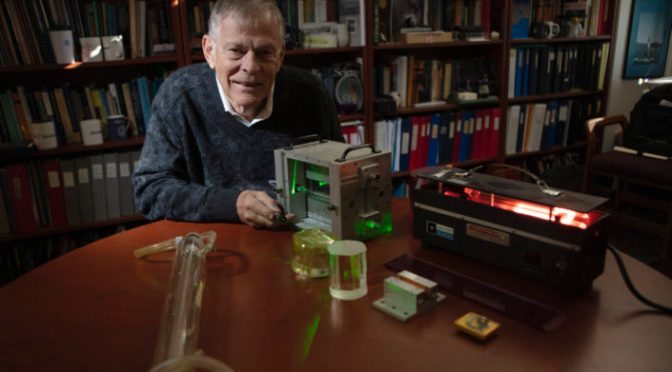
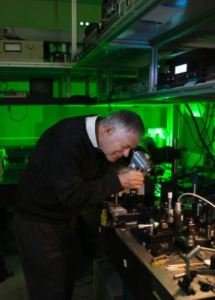 Byer also helped develop the quietest, most stable laser in the world, called the diode-pumped YAG laser. YAG lasers are today found in everything from communications satellites to green handheld laser pointers, which Byer co-developed with two of his graduate students and cites as one of his favorite inventions (he had joined Stanford in 1969). YAG lasers also form the main beams of the gravitational wave-detecting instrument, LIGO, which in 2015 achieved the most precise measurement ever made by humans when its antenna detected the tenuous spacetime fluctuations generated by two colliding black holes 1.3 billion light-years away.
 One summer morning in 1964, Byer drove the hour from Berkeley down to Mountain View for a job interview at a California company called Spectra Physics. He walked in to find an empty lobby but could hear clapping and cheering in the back of the building. After politely waiting for several minutes, he followed the commotion to a darkened room filled with men whose jubilant faces were illuminated by a rod of red-orange light that seemed to float above an instrument-strewn table
 A SELECTION of three essential articles read aloud from the latest issue of The Economist. This week, Hong Kong is not the only part of China’s periphery to resent

 Democratic presidential contenders backed the Donald Trump impeachment inquiry during the fifth televised debate on Wednesday, saying his efforts to press Ukraine to investigate the former vice-president Joe Biden was an example of his administration’s corruption. The debate came hours after a senior US diplomat gave explosive testimony that directly implicated the president in a quid pro quo deal with Ukraine.
 The Grand Challenge Prize is looking for bold, audacious innovations, ideas that can really change aging. We’re looking in science, in technology and engineering, in policy, social sciences, behavioral sciences, economic policy, in traditional medical science and health care, and in work focused on specific diseases. It’s really very broad. We’re looking for innovative thinking that can have global impact. The prizes are going to roll out on three levels. There will be 450 Catalyst Prizes awarded over a three-year period. The first of the three yearly calls will be in January 2020. Once it’s announced, there will be six weeks to submit your idea — just the idea, it doesn’t require any pilot work — and a two-page application. They’ll be reviewed within four months and prizes announced by July. The Catalyst Award is intended as seed funding to get the idea into its earliest stages of development. They’re relatively small in dollar amount, about $50,000 each, but they will give access to an annual meeting bringing together world experts in these fields.
 Benjamin Thompson brings you the latest science news. This week, an antibiotic that targets difficult to treat bacteria, and a roundup of the latest science news.