
Library of Congress · November/December 2026
Codices, Cookbooks & Kubrick
This issue of LCM, from a new gallery of the early Americas to a teenage Stanley Kubrick behind the camera
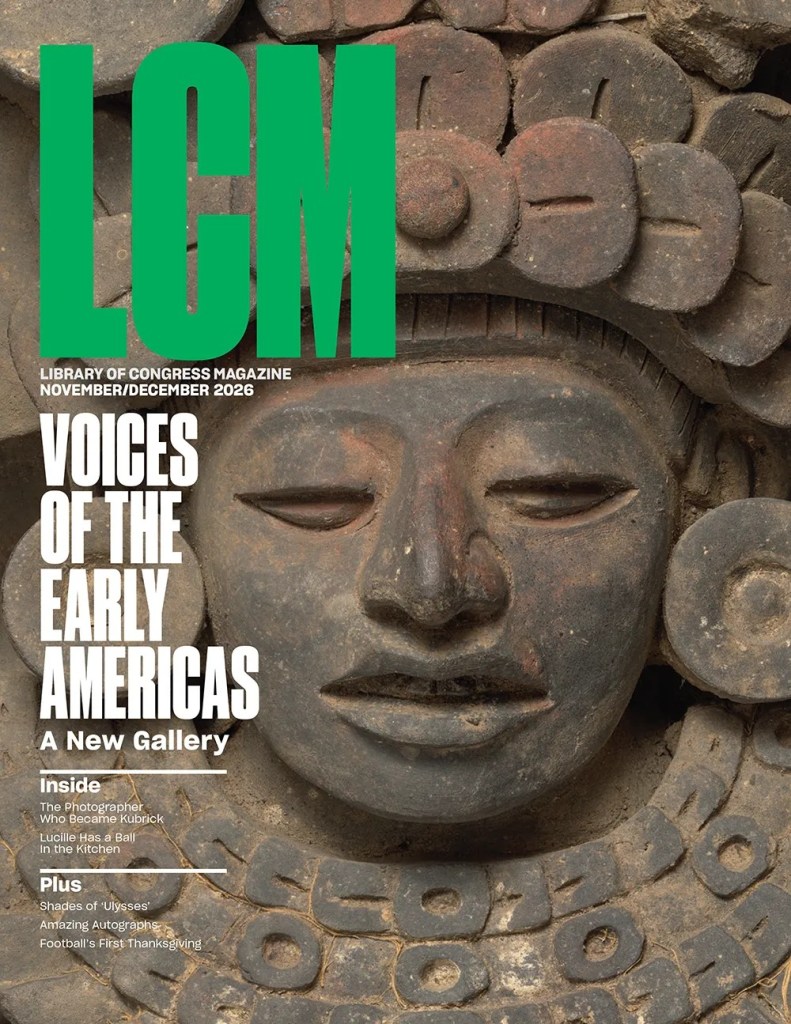
The holiday issue of Library of Congress Magazine opens a new permanent gallery and a good many drawers. A Zapotec artist’s ceramic effigy urn, shaped in Oaxaca some 1,500 years ago, graces the cover and announces the lead story: “Voices of the Early Americas,” the Library’s new home for the ancient and colonial Americas. Around it, the issue finds Lucille Ball and Desi Arnaz swapping recipes, a teenage Stanley Kubrick learning to see through a magazine camera, Theodore Roosevelt on the worst day of his life, and Peter the Great signing a letter simply “Peter.”
It is an issue about what people leave behind: a cookbook’s margin notes, a contact sheet, a black X in a diary. Here is what is inside, with our notes on why each piece is worth your time.
The Cover
Voices of the Early Americas
The cover story · By Neely Tucker
The Library has opened a permanent gallery in the Jefferson Building devoted to the Indigenous civilizations of the Americas and what happened when Europe arrived. Built largely on the Jay I. Kislak Collection and paid for mainly by the Kislak Family Foundation, it runs from roughly 3,000 years ago into the 21st century, in four roughly chronological periods. Towering screens, an artifact wall showing many objects for the first time and immersive displays turn Maya, Aztec, Inca and Taíno history, and the arrival of Spanish, Portuguese, French, British, Dutch and African peoples, into a walk-through story. It expands an earlier Kislak exhibition into something far more ambitious.
Features
Lucille Has a Ball in the Kitchen
Feature · By Ellie Hart
Fans remember the “I Love Lucy” episode in which Lucy and Ethel bake a loaf of bread as long as a sofa. The real Lucille Ball and Desi Arnaz were far better cooks. Their papers in the Library’s Music Division hold two cookbooks and a happy muddle of recipes, handwritten, typed or clipped from newspapers. Their copy of “The Settlement” cookbook is annotated in both their hands, and their own homemade book, its cover stamped “Cash,” runs to stuffed peppers, persimmon cake and cheese blintzes. Lucy’s typed “Sunday Night Special” is there too.
The Photographer Who Became Kubrick
Feature · By Neely Tucker
Before “Dr. Strangelove,” “2001: A Space Odyssey” and “The Shining,” Stanley Kubrick was a prodigy at Look magazine. He sold the magazine his first picture while still in high school, joined as an apprentice at 17 and was a star staffer by 19, photographing film stars and social-issue stories in place of going to college. The Library’s Look Magazine Photograph Collection holds 100 of his assignments, with 150 images online, and Tucker argues they show a great photographer in the making, with the eye for composition and light that would define his films.
From the Collections
Football’s First Thanksgiving
Trending
Thanksgiving football is 150 years old. In November 1876, Harvard, Yale, Princeton and Columbia agreed on common rules, splitting the difference between Harvard’s rugby-style game and the soccer played elsewhere. Days later, on Thanksgiving, Yale met Princeton at Elysian Fields in Hoboken, New Jersey, in the first game under the new rules, and a holiday ritual began.
Shades of ‘Ulysses’
Technology
James Joyce wanted the cover of “Ulysses” to match the blue of the Greek flag, a nod to Homer’s “Odyssey,” and sent a flag to his friend, the painter Myron Nutting, to get the mix right. A century later, the Library’s Preservation Research and Testing Division set out to identify exactly which pigments produced that famous blue. The varying shades of the Library’s copies record decades of differing exposure to light.
Beethoven, Poe and Bonaparte
Off the Shelf
John Davis Batchelder gathered more than 1,800 autographs, from the Renaissance to the mid-20th century, now in the Manuscript Division. Among them is a 1707 letter from Peter the Great, flowery French greetings followed by a plain Cyrillic “Peter,” and a signed note from Franz Schubert with a few bars of music. The collection is a roll call of the people who shaped Western politics, art, science and music.
‘The Light Has Gone Out of My Life’
Online Offerings
On February 14, 1884, Theodore Roosevelt’s wife, Alice, and his mother, Mittie, died within hours of each other. He marked the day in his diary with a heavy black X and one line: “The light has gone out of my life.” That diary, the treasure of the Roosevelt Papers, is now online for the first time in full-color, high-resolution images.
A Mystery Mapmaker
Page from the Past
In 1677 the Boston engraver John Foster cut the woodblock for “A Map of New England,” the first map printed in England’s North American colonies, for a book on King Philip’s War, also called Metacom’s War. Soon afterward, an unknown hand copied it in pen and ink. That copy, now in the Geography and Map Division, charts the war’s battles and the colonists’ claims alongside Indigenous lands, settlements, rivers and coast.
Mesoamerica Up Close
Matthew Robb, Mesoamerican Specialist
My Job
Robb guides researchers to the Library’s holdings on the Maya, Aztec, Olmec and Zapotec worlds of Mexico and Central America, from the reference desk of the Hispanic reading room to photo shoots of objects. A Ph.D. in art history and a museum curator by training, he grew up in a family of teachers and museum people. His brother has worked at the Library for more than 30 years.
Mesoamerican Marvels
Curator’s Picks
Robb picks favorites from the Kislak Collection. One is a stone mask from Teotihuacan: he has spent 20 years counting such masks and is up to about 550, and this one’s missing inlays reveal how hard it was to make stone look like soft skin. Another is the Oztoticpac Land Map, a 16th-century legal record of a Nahua nobleman’s estate that even shows him grafting European fruit trees onto Mexican stock.
Around the Library
The Kislak legacy. The Kislak Family Foundation also funds a $100,000 annual literacy prize through the Library. The first, in 2024, went to a network of Māori-language immersion schools in New Zealand. The 2025 prize went to Literacy Mid-South in Memphis, Tennessee. (Read more)
A Kluge Prize for Nussbaum. The philosopher Martha C. Nussbaum of the University of Chicago will receive the 2026 John W. Kluge Prize for Achievement in the Study of Humanity.
Great conversations in print. “Speaking of America,” from Duke University Press and the Library, collects 19 conversations from David M. Rubenstein’s Congressional Dialogues series.
New fellows. Jennifer Marine and Nisarg Patel won the Library’s 2026–27 stereoscopic research fellowships, and the Arlington, Virginia, STEM teachers Daniel Bernhardt and Kirsten Salonga are its new Albert Einstein educator fellows. (News Briefs)
The Last Word
Cortés, Reconsidered
Last Word · By John Schwaller
The historian John Schwaller, a professor emeritus at the University at Albany and a former holder of the Library’s Kislak Chair, closes the issue with Hernán Cortés, a figure so reviled in Mexico that no public statue honors him. Eight Kislak paintings of the 1519 invasion, the Huexotzingo Codex and court records against Cortés’s son, he writes, let Indigenous and colonial voices complicate the old story of the conquest.
Before You Close the Issue
A recipe card, a signature, a black X in a diary: what do the small things people leave behind tell us that the history books cannot?
Drawn from Library of Congress Magazine, Vol. 15, No. 6, November/December 2026, published free by the Library’s Office of Communications.
— The Editors, Intellicurious —

