
Tag Archives: Nature

Environment: The Grand Canyon Is Losing Its River

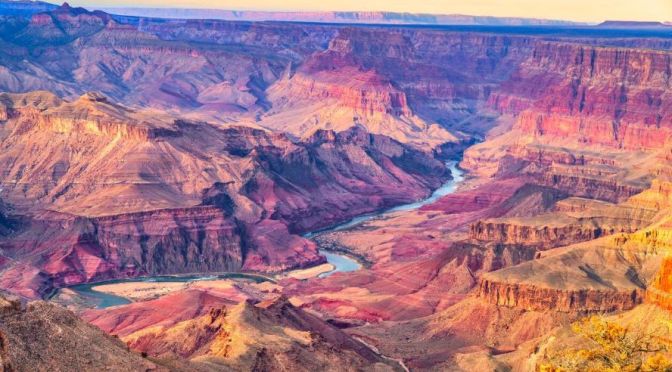
Long shadows are in the foreground of a view of the reddish canyon walls, which loom on either side and ahead. The sky is blue with ribbed white clouds.

The New York Times (June 6, 2023) – Down beneath the tourist lodges and shops selling keychains and incense, past windswept arroyos and brown valleys speckled with agave, juniper and sagebrush, the rocks of the Grand Canyon seem untethered from time. The oldest ones date back 1.8 billion years, not just eons before humans laid eyes on them, but eons before evolution endowed any organism on this planet with eyes.

The Grand Canyon, a Cathedral to Time, Is Losing Its River

Written and photographed by Raymond Zhong, who joined scientists on a 90-mile raft expedition through the canyon.

About half a dozen people with orange life jackets ride a blue raft on a murky, brownish and somewhat choppy Colorado River. Rust-colored canyon walls loom on either side and ahead of them. Three other rafts are in the distance.

Since 1963, the Glen Canyon Dam has been backing up the Colorado for nearly 200 miles, in the form of America’s second-largest reservoir, Lake Powell. Engineers constantly evaluate water and electricity needs to decide how much of the river to let through the dam’s works and out the other end, first into the Grand Canyon, then into Lake Mead and, eventually, into fields and homes in Arizona, California, Nevada and Mexico.


Spend long enough in the canyon, and you might start feeling a little unmoored from time yourself.

A spring that looks like a narrow waterfall cascades out of a hole in a canyon wall down into a calm part of the Colorado River. The canyon walls are rust-red.
North Canyon, and a spring at Vasey’s Paradise.

The immense walls form a kind of cocoon, sealing you off from the modern world, with its cell signal and light pollution and disappointments. They draw your eyes relentlessly upward, as in a cathedral.

You might think you are seeing all the way to the top. But up and above are more walls, and above them even more, out of sight except for the occasional glimpse. For the canyon is not just deep. It is broad, too — 18 miles, rim to rim, at its widest. This is no mere cathedral of stone. It is a kingdom: sprawling, self-contained, an alternate reality existing magnificently outside of our own.

And yet, the Grand Canyon remains yoked to the present in one key respect. The Colorado River, whose wild energy incised the canyon over millions of years, is in crisis.

Read more

Nature: White-Tailed Deer, Cades Cove, Great Smoky Mountains Of Tennessee

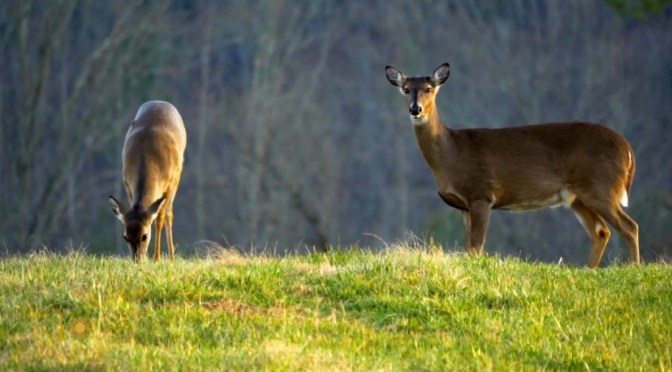
CBS Sunday Morning (April 30, 2023) – This Sunday morning we visit Cades Cove in Great Smoky Mountains National Park in Tennessee.

Cades Cove is an area in the Great Smoky Mountains National Park that was formerly home to many settlers before the national park was established. It has a long, rich history that is still standing for exploration by visitors today.

The Cades Cove loop is open to visitors from sunrise to sunset daily, with a special vehicle-free Wednesday during the summer to allow for bikers and hikers to enjoy the loop safely. Read on to learn more about Cades Cove, including information on the area’s location, history and landmarks.

Videographer: Scot Miller

Nature: The Hummingbird Effect In Costa Rica (PBS)

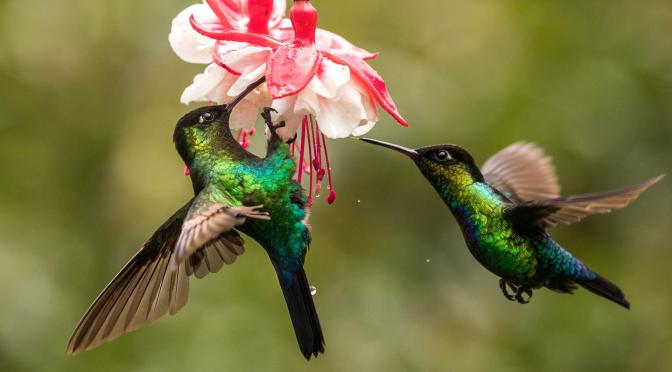
Nature on PBS (April 12, 2023) – Discover how tiny hummingbirds influence their many flowering kingdoms and their ripple effects on macaws, quetzals, monkeys, tapirs and more. Set in the exotic landscapes of Costa Rica.

Costa Rica’s motto is Pura Vida – Pure Life – and this deceptively small country is bursting with some of the most spectacular wildlife and pristine ecosystems in the world. All this diversity thrives, in part, thanks to one surprising little creature: hummingbirds.

Venture across Costa Rica’s wild and rugged landscapes, from volcanic peaks to coastal jungle to misty cloud forests, and discover the nation’s dazzling diversity of hummingbirds. There are more than 50 species of hummingbirds here, and they play an outsize role in maintaining some of the richest and wildest environments on Earth.

The Hummingbird Effect premiered on April 12, 2023.

Wonderlands: The Blue Mountains Of Australia

Into the Wild Films (April 11, 2023) – Just 50km west of Sydney Australia, is the spectacular natural wonderland of the Greater Blue Mountains. Known best for the Three Sisters, Echo Point, Scenic World and Wentworth Falls, this documentary explores the natural wonders hidden beyond these grand panoramas.

From the incredible display of the Superb Lyrebird to the underwater world of the Sydney Spiny Crayfish. Descend into its deep dark slot canyons before flying like a bird over the Blue Gum Forest. Discover its rare and ancient Wollemi Pines and explore its mysterious sandstone pagoda landscapes. Witness temperature inversions creating seas of clouds before marveling at the carnivorous plants that inhabit the sheer cliff faces. This is the Blue Mountains as you’ve never seen it before.

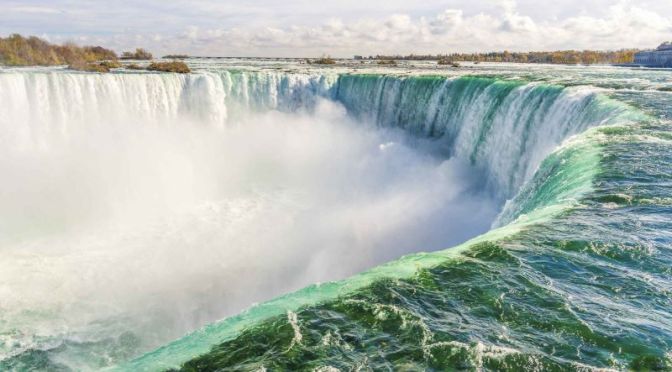
Nature: The Changing Seasons At Niagara Falls

Nature on PBS (April 6, 2023) – From fall to winter, watch as Niagara Falls transforms with the seasons. “Niagara Falls“ premieres April 19, 2023, at 8|7c on PBS.

America’s oldest state park, open 365 days a year, 24 hours a day, brings you closer than you ever thought possible to the grandeur of the Falls. Niagara Falls State Park is always the trip of a lifetime — any time of the year — making it “a park for all seasons.”

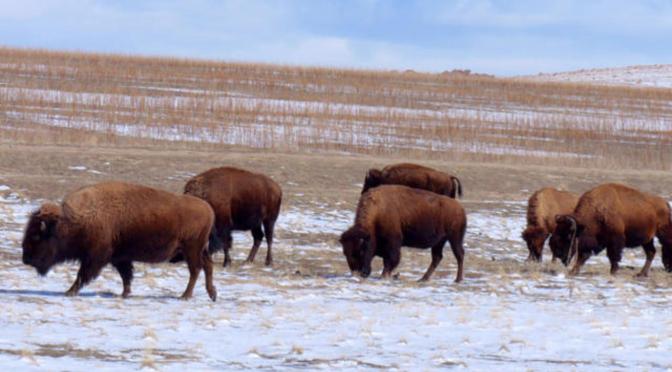
Views: Bison In Antelope Island State Park, Utah

CBS Sunday Morning (April 2, 2023) – We leave you this Sunday morning with Bison still enjoying the snow at Utah’s Antelope Island. Videographer: Lee McEachern.

Antelope Island State Park in Utah is home to free-ranging bison, mule deer, bighorn sheep, pronghorn (antelope), and many other desert animals. Millions of birds congregate along the shores surrounding the island, offering unparalleled opportunities for birding. Year-round Interpretive opportunities round out the Antelope Island experience.

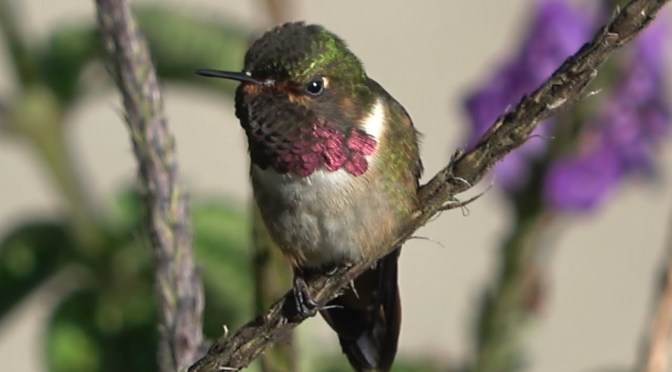
Costa Rica Views: The Tiny ‘Volcano Hummingbird’

Nature on PBS (March 27, 2023) – No bigger than a human thumb, the volcano hummingbird exists only in the Talamancas.

The volcano hummingbird (Selasphorus flammula ) is a very small  hummingbird, native to the Talamancan montane forests of Costa Rica and western Panama.

This tiny endemic bird inhabits open brushy areas, paramo, and edges of elfin forest at altitudes from 1850 m to the highest peaks. It is only 7.5 cm long. The male weighs 2.5 g and the female 2.8 g. The black bill is short and straight.

The adult male volcano hummingbird has bronze-green upperparts and rufous-edged black outer tail feathers. The throat is grey-purple in the Talamanca range, red in the Poas-Barva mountains and pink-purple in the Irazú-Turrialba area, the rest of the underparts being white. The female is similar, but her throat is white with dusky spots. Young birds resemble the female but have buff fringes to the upperpart plumage.

The female volcano hummingbird is entirely responsible for nest building and incubation. She lays two white eggs in her tiny plant-down cup nest 1–5 m high in a scrub or on a root below a south or east facing bank. Incubation takes 15–19 days, and fledging another 20–26.

Ecuador Views: Tortoises In The Galápagos Islands

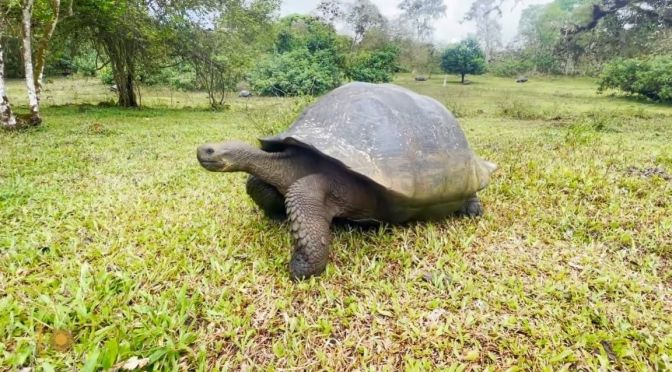
CBS Sunday Morning (March 19, 2023) – We leave you this Sunday with giant tortoises on Santa Cruz Island, in Ecuador’s Galápagos National Park. Videographer: Alan Golds.

There are 13 living species of Galápagos tortoises, which are also sometimes called giant tortoises. These reptiles are among the longest-lived of all land vertebrates, averaging more than a hundred years. The oldest on record lived to be 175. They are also the world’s largest tortoises, with some specimens exceeding five feet in length and reaching more than 500 pounds.

Giant tortoises were once so abundant on the Galápagos archipelago off Ecuador that the Spanish sailors who explored the region in 1535 named the string of islands for them. (The Spanish word for tortoise is galápago.) Although the islands were once thought to be home to at least 250,000 tortoises, only about 15,000 remain in the wild today.

Conservation: The Farne Islands And Long Nanny In Northumberland, UK

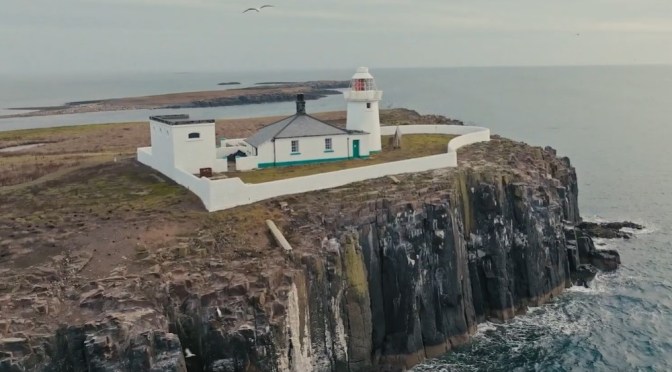
National Trust (March 13, 2023) – In the first episode of The Wild Life, a new series of nature films from the National Trust, presenter Levison Wood explores one of England’s most important seabird colonies. The Farne Islands, off the Northumberland coast, have been cared for by the National Trust since 1925 and are a breeding site for 23 species of seabird, including 43,000 puffin pairs.

The islands are also home to grey seals with around 2,000 pups born every autumn. With an introduction from presenter Julia Bradbury, this film explores the Inner Farne, where you’ll see dive-bombing terns, a medieval chapel and a Victorian lighthouse. Levison finds out what life is like for the rangers who had to deal with the devastating impact of bird flu. He also learns more about the work being done to maintain and protect the area’s fragile ecosystem, address the impact of climate change, protect bird nests and monitor species.

Parts of the Farne Islands may be closed to the public and landing on the islands may not be possible due to bird flu. If closures are in place, you can still experience the islands on a boat tour. Please check the website before you visit: Farne Islands | Northumberland | National Trust With your support we can continue to care for coastal places like The Farne Islands.

Donate today and help protect wildlife and nature for future generations. https://www.nationaltrust.org.uk/supp…