
HUMANWARE · Winter 2026/2027 · Issue 4
Maman, Microscopes & Mornings
A nine-metre spider, two Nobel laureates and Sir Richard Branson on how to live long and well
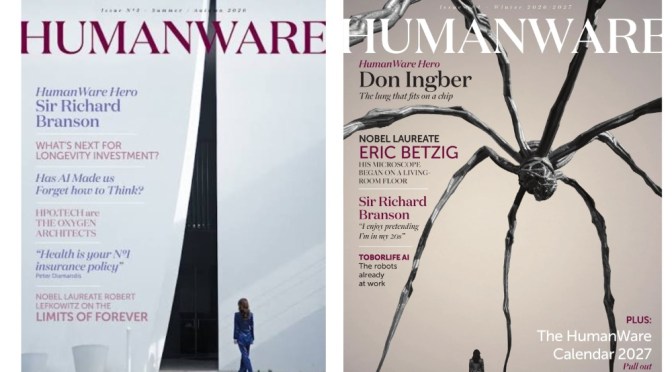
HUMANWARE, the magazine of The HumanWare Project, writes about longevity, neuroscience and the science of living well, and promises “a future worth getting excited about”. Its Winter 2026/2027 edition, Issue 4, arrives with a nine-metre spider on the cover, a new website, two Nobel laureates and a return visit to Sir Richard Branson on Necker Island. Alongside it, the project’s latest filmed conversation finds the Nobel laureate Randy Schekman explaining why we probably won’t live to 150, however much billionaires spend, and a new feature shows how to train the brain like a muscle.
Here is the issue, with our notes on the threads that run through it.
The Cover
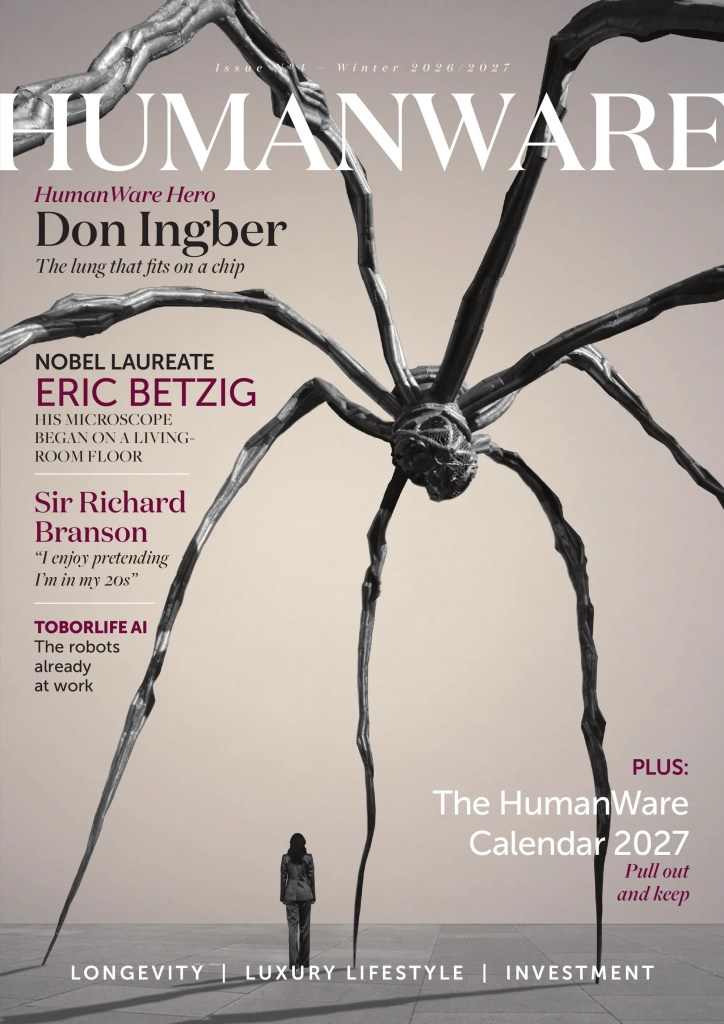
Cover · Louise Bourgeois, 1999
The cover star is Maman, the French-American artist Louise Bourgeois’s nine-metre bronze and steel spider, first shown at the opening of Tate Modern in 2000. Bourgeois called it an ode to her mother, Joséphine, who repaired tapestries in the family workshop in Paris. Why a giant spider should front a magazine about longevity, the editors say, becomes clear the moment you open it. Every HUMANWARE issue has its own spine colour; this one is cinnamon ochre.
Cover photo: Louise Bourgeois, Maman, 1999 © 2026 The Easton Foundation/ARS, NY and DACS, London.
Inside the Winter Edition
Winter 2026/2027 · Profile
This edition’s Hero has spent five decades pursuing an idea that first came to him in an undergraduate art class. His story, and his name, are saved for the print edition.
2. Eric Betzig: Walking Away, Coming Back
Winter 2026/2027 · Interview
The Nobel laureate Eric Betzig left science for a decade, then returned to build the invention that won him the 2014 chemistry prize, a super-resolution microscope that sees far finer detail inside cells than was once thought possible.
3. Sir Richard Branson Returns
Winter 2026/2027 · Necker Island
The Issue 3 Hero is back, speaking from his home on Necker Island about pretending he is still in his twenties, and why his favourite day of the year is 1 April.
4. The 2027 HumanWare Calendar
Winter 2026/2027 · Guide
A curated guide to the coming year’s must-attend longevity, health and technology events.
The Featured Conversation
5. A Nobel Prize Winner on Why We Age and How Long We Can Live
With Randy Schekman · In conversation with Méline Liu
Randy Schekman shared the 2013 Nobel Prize in Physiology or Medicine for discovering how cells package and ship their molecules, work that now underpins how about a third of the world’s insulin is made, by yeast in giant fermentation vats. A professor at UC Berkeley and founding editor of eLife, he tells HUMANWARE’s editor-in-chief how it began: as a young teenager he cycled to the police station to report that he was running away from home, because his mother kept borrowing the money he was saving for a microscope. He got his $100 and a second-hand Bausch & Lomb, which now sits in the Nobel Museum in Stockholm.
He recalls the 1:20am call from Stockholm, when his wife, then living with dementia, woke first and called out that this was it; the demanding mentor Arthur Kornberg, who teased him for taking a ski weekend; and his habit of avoiding crowded fields. He is blunt about the science of today. Exosomes, he argues, mostly help cells maintain and repair themselves rather than ferrying cargo into other cells, a view he admits makes him unpopular in the field. Stem-cell therapies for Parkinson’s show early promise. And ageing is a failure of many systems, not one: he doubts we will live to 150, sees a natural limit around 120, and would rather have a naturally long, healthy life than extra years of suffering.
His advice to the young: be willing to take risks, picture exactly what you want to understand, and above all, focus. The best students, he adds, know what to do next without being told; two of his have won Nobels of their own, including David Baker.
The views on ageing and treatment are Schekman’s own; this is not medical advice.
Featured Article
6. The Muscle You Forgot to Train: Sophie Hascher on Neurofeedback for the High-Performing Brain
HUMANWARE · Neuroscience
High performers would never skip the gym, yet rarely train the organ that makes every decision. Sophie Hascher, a London neuroscientist and PhD candidate at Birkbeck, University of London, working with the University of Technology Sydney, founded Brain Flow Elite to change that. Her method starts with a quantitative EEG: a saline cap maps brainwaves at rest, in focus and under stress, where raised theta may signal fatigue and excess high beta chronic stress.
Training then turns into a game. Clients levitate a monk, steer a ship or watch a favourite show, all controlled by their brainwaves; when they drift towards stress, the sound drops and the screen dims, and over time the brain learns to default to calmer, focused states. Unlike talk therapy, Hascher says, the before and after can be measured. A calm brain, she argues, makes better decisions, because stress dampens the prefrontal cortex, and deliberate downtime is as productive for the mind as recovery is for athletes. After a five-day programme, HUMANWARE’s founder Méline Liu saw her cognition score rise from 69 to 75 and focus from 61 to 66. Hascher recommends at least ten sessions for early change, and offers a free tool for tense meetings: two slow, deep breaths.
Neurofeedback’s evidence base is still debated by researchers, and the scores above come from one person’s programme rather than a controlled trial.
From the Last Issue
7. Sir Richard Branson and the Discipline of Turning Up
HUMANWARE · Issue 3 Hero
At 76, the Virgin founder still starts most days before six on Necker Island with a cold plunge, competitive tennis against players who can beat him and, wind permitting, an hour of kitesurfing. He credits the habit, kept for four decades, with sustaining a career that ran from records to airlines to space. He makes no claim to reverse ageing: looking after the body keeps it at bay only to an extent, he says, because nature wins in the end. The profile also follows Virgin Active’s turn towards “social wellness clubs”, and catalogues the flops, from Virgin Cola to Virgin Brides, born of the same appetite for risk that produced his hits.
A New Home
8. A New Home for The HumanWare Project
The new website
The project’s new site organises its stories into eight sections, Neuroscience, Longevity, Tech, Future, Investment, Places, Lifestyle and People, each broken into topics such as sleep, memory, mood, awe and attention. Every story shows its reading time, podcast episodes sit alongside the writing, and new stories will arrive every week.
The Threads
Mothers and microscopes. A spider sculpted as an ode to a mother who mended tapestries, and a teenager whose mother kept borrowing his microscope fund. (Cover, 5)
Long games. A Hero who has chased one idea for fifty years, a laureate who left science for a decade and came back, and a founder who has kept the same morning ritual for forty. (1, 2, 7)
Honest about ageing. Schekman doubts we will reach 150; Branson says nature wins in the end. Both put the quality of our years above their number. (5, 7, 3)
Training the invisible. Neurofeedback that rewards a calmer brain, Branson’s fitness treated as infrastructure, and Schekman’s single word of advice: focus. (6, 7, 5)
Seeing smaller. Schekman’s pawn-shop microscope and Betzig’s prize-winning one: two careers built on looking harder at cells. (5, 2)
Before You Close the Issue
If a Nobel laureate doubts we will reach 150, and a 76-year-old adventurer says nature wins in the end, what would you change to make your own years better rather than simply more?
Drawn from HUMANWARE’s Winter 2026/2027 announcement, its profile of Sir Richard Branson, its feature on Sophie Hascher and its conversation with Randy Schekman. Visit the homepage at thehumanwareproject.com.
— The Editors, Intellicurious —

