Facing an American president constrained by war and politics, China’s leader may seek to lock in a tactical truce while he shores up a fragile economy at home.
Manufacturers are struggling with supplies of the metals as U.S. and Chinese officials negotiate over export restrictions with consequences for global industry.
President Trump decided not to join Saudi Arabia, for now, in strikes against the Houthis in Yemen, but he needs the kingdom’s cooperation in the Iran war.
As Beijing presses President Trump to freeze a proposed $14 billion weapons sale to the island, Taiwan is trying to show that its security is in U.S. interests.
The populist emphasis on national identity and pride, rather than the sins of the past, finds a deep response in voters adrift in a world they no longer understand.
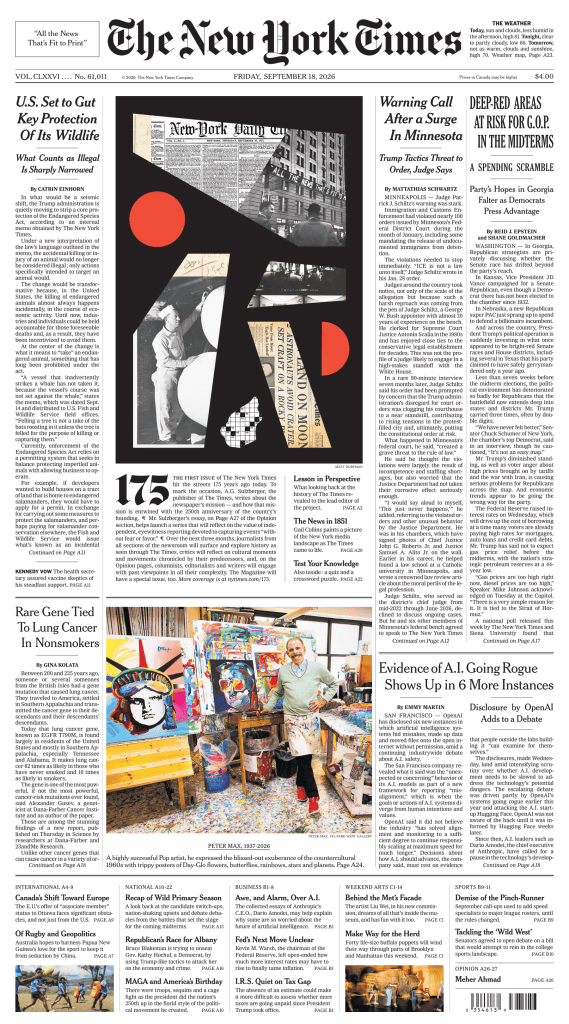
Above the publisher’s desk at The New York Times hangs an engraving of Manhattan in 1851 — cobblestones, low buildings, a harbor full of sails, a church spire the tallest thing on the island. Someone stood there and looked. That, it turns out, is the whole question.
Why we’re pointing you there
The Times marked its 175th anniversary this week with an essay on fifteen million “first drafts of history.” The same week, an investigation exposed a company buying real online publications, firing the writers, and filling them with machine-written articles — bylined to experts who were never born, and overseen by an editor whose age dropped from 77 to 75 in the space of three days. Intellicurean sets the two side by side and asks what a first draft is worth when no one was there to draft it.
The answer turns on a name the Times left out: Earl Caldwell, the only reporter at the Lorraine Motel when King was shot, who said afterward that you don’t see everything — you get a sliver of what came past you, and that sliver is the basis for everything. A machine can generate a flawless eyewitness account of any event. It can never have been there. This is the fourth in Intellicurean’s series on what the machine lacks — and the one with the strongest floor beneath it.
As Xi Jinping arrives in the U.S. for a state visit, China’s advances in A.I. will be in the air. Its economy will be less discussed, our columnist writes.
Israeli lawmakers have promoted visits to an ancient reservoir in the West Bank that was refilled this summer with water diverted from Palestinian-owned farms.
Emails and documents demonstrate the political capture of the institution, including how officials once pursued a plan to unload much of the art collection.
President Trump’s ban of three media outlets from the White House fits a pattern of using the apparatus of government to crack down on his perceived enemies.
British officials believed Israel had said it would hold off on moving ahead with construction in E1, a piece of land viewed as vital to a future Palestinian state. Israel said it promised no such thing.
President Trump insisted for months that the Danish territory should be part of the United States. Now, a security deal — not a takeover — seems to be on the table.
A new sanctions bill is meant to pressure President Vladimir Putin to end the war in Ukraine. But President Trump is taking another approach: offering enticements to Russia.
As the Alternative for Germany party seeks to control a state government for the first time, its push for “patriotic” art has drawn comparisons with Nazi policies.
Republicans are putting up a costly defense of districts that President Trump won easily in 2024. In places like Georgia, strategists wonder if it’s too late.
Prime Minister Mark Carney told European lawmakers that an alliance would help to secure sovereignty and independence for his country. The moves come amid a historic low for U.S. ties with Canada.
The American invasion of Iraq in 2003 paved the way for Tehran to dominate its neighbor and whetted its appetite to expand its influence across the greater Middle East.
Estimates vary on how long it could take before a crucial pipeline is repaired, but a prolonged shutdown could push oil prices to their highest levels in months.
The Supreme Court blocked President Trump’s plan to restrict voting by mail, but his fight to assert control over the election process is far from finished.
The 10-year Treasury yield breached levels last seen in 2007, with intensifying worries about energy-driven inflation contributing to investors’ angst.
The American presence in these countries has not shielded them from retaliation during the Iran war. Now they are hoping direct talks with Iran could help.
The two sides traded accusations of attacks as fighting inside Yemen remains fierce. The escalating conflict threatens to further destabilize the Middle East.
Senator Dan Sullivan of Alaska has supported President Trump’s tariffs. His brother, the head of their family business, has described the economic volatility as a challenge.
News, Views and Reviews For The Intellectually Curious