Tag Archives: Science Magazine

Science Podcast: Fish Farming, Skin Microbes

These days, about half of the protein the world’s population eats is from seafood. Staff Writer Erik Stokstad joins host Sarah Crespi to talk about how brand-new biotech and old-fashioned breeding programs are helping keep up with demand, by expanding where we can farm fish and how fast we can grow them.

Sarah also spoke with Jan Claesen, an assistant professor at the Cleveland Clinic’s Lerner Research Institute, about skin microbes that use their own antibiotic to fight off harmful bacteria. Understanding the microbes native to our skin and the molecules they produce could lead to treatments for skin disorders such as atopic dermatitis and acne. Finally, in a segment sponsored by MilliporeSigma, Science’s Custom Publishing Director and Senior Editor Sean Sanders talks with Timothy Cernak, an assistant professor of medicinal chemistry and chemistry at the University of Michigan, Ann Arbor, about retrosynthesis—the process of starting with a known chemical final product and figuring out how to make that molecule efficiently from available pieces. 
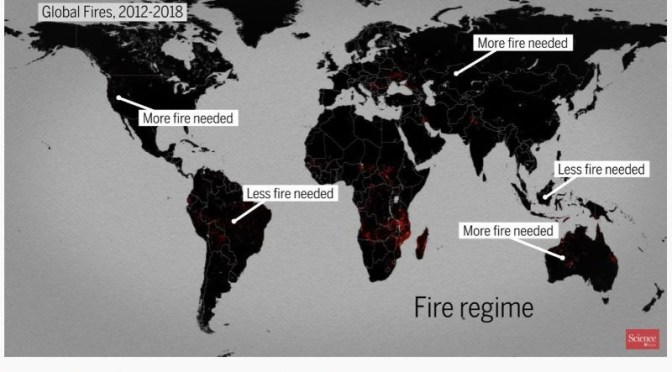
Ecology: Wildfires Kindle Natural Biodiversity

Raging fires throughout the U.S. and Australia over the past year have put vulnerable species at risk. But not all blazes are devastating—in fact, fire can promote biodiversity. In grasslands, fires prevent trees and roots from taking hold. This allows grazing animals the space and vegetation they need to thrive. As the pattern of wildfires changes, a new review in Science outlines effective ways to let natural fires burn, while preventing out-of-control blazes. Watch to learn how a few of these techniques have been applied around the world.

Read the research: https://scim.ag/3pIRjv7

Science Podcast: Extreme Heat & The Human Body, Future Of Cooling Fabrics

This week the whole show focuses on keeping cool in a warming world. First up, host Sarah Crespi talks with Senior News Correspondent Elizabeth Pennisi about the latest research into how to stay safe when things heat up—whether you’re running marathons or fighting fires.

Sarah also talks with Po-Chun Hsu, assistant professor of mechanical engineering and materials science at Duke University, about the future of cooling fabrics for everyday use. It turns out we can save a lot of energy and avoid carbon dioxide emissions by wearing clothing designed to keep us cool in slightly warmer buildings than we’re used to now. But the question is, will cooling clothes ever be “cool”? Visit the whole special issue on cooling. 

Science Podcasts: New Gravitational Waves, Black Hole Mergers & Arctic Animal Tracking

First up, host Sarah Crespi talks with Staff Writer Adrian Cho about new gravitational wave detections from the first half of 2019—including 37 new black hole mergers. With so many mergers now recorded, astrophysicists can do different kinds of research into things like how new pairs of black holes come to be and how often they merge.

Sarah also talks with Sarah Davidson, data curator at the Max Planck Institute of Animal Behavior, about results from an Arctic animal tracking project that includes 3 decades of location information on many species, from soaring golden eagles to baby caribou taking their first steps. The early results from the Arctic Animal Movement Archive show that researchers can use the database as a baseline for future Arctic investigations and to examine the effects of climate on ecosystems in this key region. 

Science Podcasts: Citizen ‘Minipublics’, Zoologist Charles Turner & Cooking

First up, host Sarah Crespi talks to News Intern Cathleen O’Grady about the growing use of citizens’ assemblies, or “minipublics,” to deliberate on tough policy questions like climate change and abortion. Can random groups of citizens do a better job forming policy than politicians? 

Next, we feature the latest of a new series of insight pieces that revisit landmark Science papers. Sarah talks with Hiruni Samadi Galpayage Dona, a Ph.D. student at Queen Mary University of London, about Charles Turner, a Black zoologist who published multiple times in Science in the early 1900s. Despite being far ahead of his time in his studies of animal cognition, Turner’s work was long overlooked—due in large part to the many difficulties facing a Black man in academia at the turn of the century. Finally, in our monthly books segment, host Kiki Sanford chats with author Pia Sorensen about her new book: Science and Cooking: Physics Meets Food, From Homemade to Haute Cuisine. 

Science Podcasts: Covid-19 Vaccine Ethical Issues, Upcycling Plastic Bags

First up, host Sarah Crespi talks with Staff Writer Jon Cohen about some tricky ethical questions that may arise after the first coronavirus vaccine is authorized for use in the United States. Will people continue to participate in clinical trials of other vaccines? Will it still be OK to give participants placebo vaccines? 

Next, producer Meagan Cantwell talks with Bert Weckhuysen, a professor at Utrecht University, about a process for taking low-value plastic like polyethylene (often used for packaging and grocery bags) and “upcycling” it into biodegradable materials that can be used for new purposes.