
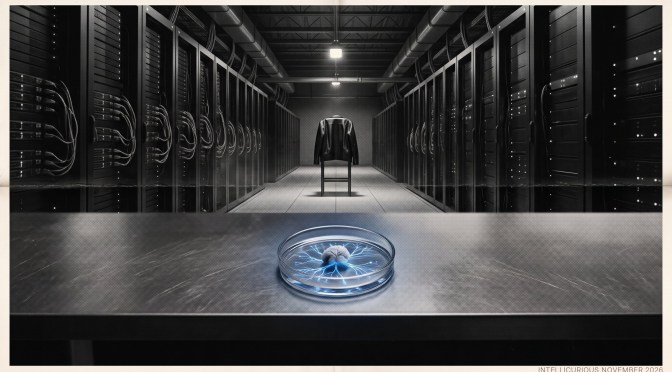
Page 33
Twenty Watts vs. Trillions
The week the face of the AI boom fell, Science ran a story about computers made of human neurons.
IThe Front Page
Page 33 is a place, not a page number. Every weekly has one. It sits past the cover and past the lead features, in the long middle of the issue where serious things are filed and left. Each Saturday this series goes there and brings one story back up to the front.
This week the covers agreed on two things. The first was that American politics had moved. The Washington Examiner asked why Texas turned blue, the Guardian Weekly led with the midterm results, and the New Statesman was already wondering what MAGA becomes after Trump. The second was that the man who personified the AI boom was finished.
- The New York Times · Nov. 12Jensen Huang’s fate at Nvidia is on the line
- The New York Times · Nov. 13The Fall of Jensen Huang
- Washington Examiner · Nov. 18Why Texas turned blue
- Guardian Weekly · Nov. 13The U.S. midterm results
- New Statesman · Nov. 13MAGA after Trump
Neurons in a dish are the newest computing machines
Science · Nov. 12 · News
Brain organoids grown from stem cells are being wired up to compute, and neurons remain far more efficient than chips. Nobody yet knows why.
The fall took five days. On Sunday, November 8, Nvidia’s board opened an independent investigation after reports that Jensen Huang had been the target of a foreign intelligence effort, and the same day he told employees he had been unfaithful to his wife. The woman, a businesswoman who shares his surname but is no relation, is suspected by American intelligence officials of spying for China, a claim Beijing calls a smear. On Monday the president said the FBI was looking into it, and the shares fell. By Wednesday The Wall Street Journal was reporting that the board was preparing to push him out. On Thursday morning the Times front page said his fate was on the line and reported an alleged second relationship, with an executive who reported to him. Before the day was out he had resigned, and the finance chief, Colette Kress, was running the company for now. On Friday the Times ran an interactive called “The Fall of Jensen Huang.”
It deserved the front page. Huang co-founded Nvidia in 1993 and ran it for more than three decades, and nearly every AI lab and cloud giant runs on what it sells. Our first investigative file, Cloud Cover, argued that how a boom is financed decides what its bust will cost, and that Nvidia had become the boom’s banker as well as its armorer. This week offered a cruder lesson. A trillion-dollar architecture can turn on one man’s private judgment.
But every one of those stories was about who. Who knew, who should have reported what, who runs the company now. None of them touched the question underneath the boom, which is what thinking costs.
IIThe Fold
That question ran inside Science. In the issue dated November 12, under the headline “Neurons in a dish are the newest computing machines,” the journal’s news section reported on a field that until recently would have sounded like a pitch for a horror film. The researchers call it organoid intelligence. Its raw material is brain organoids, miniature models of the brain grown from human stem cells.
Organoids were never meant to compute. Scientists grew them to study how brains develop and how they fail in disease. But past a certain size and intricacy, the tissue starts talking to itself in electrical pulses, and a small community of researchers wants to put that chatter to work. Last month they gathered for the first International Conference on Organoid Intelligence. Some of them, Science reported, think tomorrow’s server farms might be grown rather than built.
There are two ways to make tissue compute. In the first, called reservoir computing, the neurons are left largely as they are. Researchers stimulate them, record the storm of electrical activity that comes back, and train an ordinary algorithm to read it. In the second, closed-loop computing, the neurons themselves are asked to learn, changing how they fire until they get better at the job.
The demonstrations are still small. In October a team at the University of Bristol reported that forebrain organoids, each less than a millimeter across and holding about 10,000 neurons, could relay the patterns of Braille letters picked up by a tactile sensor. The organoids lived on electrode arrays run by the Swiss company FinalSpark, and the team worked with them over the internet. On its own, each organoid let a decoder identify the right letter between 59 and 67 percent of the time. Combined, three of them reached 83 percent. An Australian company, Cortical Labs, whose neurons learned to play the video game Pong in 2022, now sells a biological computer called the CL1 for $35,000, or rents one for $300 a week.
None of this threatens Nvidia’s order book. What makes the story matter is a single clause in Science’s account. Neurons, the journal noted, are orders of magnitude more efficient than semiconductor chips, “for reasons that are not fully understood.”
IIIThe Turn
Hold that clause against the week’s front pages. The constraint on the AI boom is increasingly not chips or talent but electricity. The International Energy Agency estimates that the world’s data centers used about 485 terawatt-hours in 2025, and in its base case it expects that to nearly double by 2030. Consumption in data centers built for AI grew by half in 2025 alone. The buildout that Cloud Cover traced is, at bottom, a wager that intelligence must be bought the expensive way, with more chips, more power and more debt.
The human brain runs on roughly 20 watts, about as much as a dim light bulb. It is the standing proof that the expensive way is not the only way, and nobody can yet say why. That gap in understanding may be the most valuable unknown in the whole AI economy. This week it ran in the news pages of a science weekly while the newspapers watched the boardroom.
The honest version of the story needs its caveats, and the researchers supply most of them. The Bristol team was careful to say what it had not shown. “We did not demonstrate learning or long-term changes in the organoids,” said Tianyi Liu, the Bristol doctoral student who led the study. The efficiency of the neuron is not yet the efficiency of the machine. Keeping tissue alive takes incubators, pumps, gases and nutrient feeds. An earlier organoid system that recognized speech needed a carbon dioxide incubator and other power-hungry equipment simply to stay alive, and the neurons in a CL1 last about six months. Then there are the ethical questions. Experts broadly agree that today’s organoids are not conscious or anywhere near it, but leading researchers have warned that commercialization is outrunning the rules meant to govern it.
So the claim is not that petri dishes will replace the data center. It is narrower and more unsettling than that. The efficiency is real, it lives in the tissue, and no one yet knows where. Whoever finds out, whether they grow the answer in a dish or copy it into silicon, will reprice everything the covers were nervous about this week. The buildout assumes that thinking stays expensive. A twenty-watt explanation would undo that assumption.
There is a symmetry in the week that no single issue could show. The front pages were about the frailty of human judgment at the top of the silicon economy. Page 33 was about the unreasonable competence of human neurons at the bottom of a new one. Both were stories about the human brain. Only one of them was about its future.
· 33 ·
Found in Science, issue of November 12, 2026, News: “Neurons in a dish are the newest computing machines”, by Sara Reardon (online November 9). Listed on Intellicurious in Science Magazine, November 12, 2026. “Page 33” is our name for the inside of an issue, not the article’s printed page.
The Front Page Covers: the Intellicurious listings for the week of November 9, including The New York Times, November 12 and November 13. The board’s investigation and Huang’s message to staff: NVIDIA board statement, as reported. The FBI and Tuesday’s share fall: Reuters, via the New Straits Times. The Journal’s report: Cointelegraph. The resignation: Nvidia’s CEO transition announcement, November 12, 2026.
The Fold University of Bristol, “Mini brain organoids ‘reading’ Braille”, and the paper by Tianyi Liu, Hemma Philamore and Benjamin Ward-Cherrier in Frontiers in Artificial Intelligence; single-organoid scores via Earth.com; FinalSpark. Cortical Labs’ CL1: IEEE Spectrum and HotHardware.
The Turn International Energy Agency, Key Questions on Energy and AI (April 2026), with figures via Industrial Info Resources. The speech-recognizing organoid and its incubator: Big Think / Freethink. Liu’s caveat: Tech Xplore. Consciousness and governance: Singularity Hub. See also Intellicurious Investigates, File No. 001, Cloud Cover.
Method Events are as reported through November 13, 2026. Where a figure comes from a secondary report, that report is named above.
Disclosure This column was researched and drafted with Claude, the AI models made by Anthropic.
Credits Researched and drafted with Claude Opus 5.5.

