Category Archives: News

Top New Science Podcasts: The Struggle To Reopen Labs After Covid-19 And Arsenic In Drinking Water

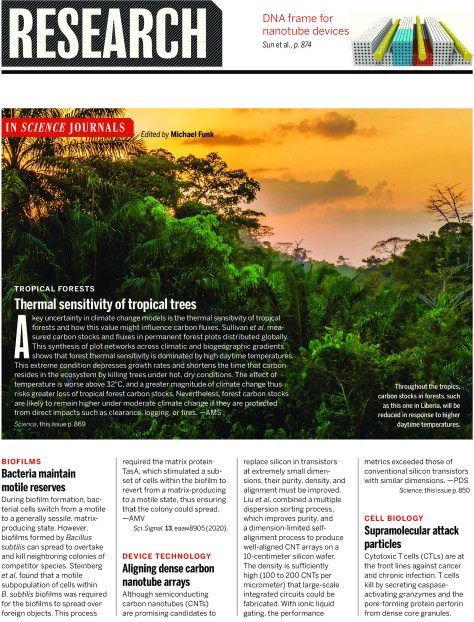
science-magazine-podcastsOnline News Editor David Grimm talks with producer Joel Goldberg about the unique challenges of reopening labs amid the coronavirus pandemic. Though the chance to resume research may instill a sense of hope, new policies around physical distancing and access to facilities threaten to derail studies—and even careers. 

Despite all the uncertainty, the crisis could result in new approaches that ultimately benefit the scientific community and the world. Also this week, Joel Podgorski, a senior scientist in the Water Resources and Drinking Water Department at the Swiss Federal Institute of Aquatic Science and Technology, joins host Sarah Crespi to discuss the global threat of arsenic in drinking water. Arsenic is basically present in all rocks in minute amounts. Under the right conditions it can leach into groundwater and poison drinking water. Without a noticeable taste or smell, arsenic contamination can go undetected for years. The paper, published in Science, estimates that more than 100 million people are at risk of drinking arsenic-contaminated water and provides a guide for the most important places to test.
New Science Podcast: New Artificial Eyes, Elephant Seals And Disk-Galaxies

nature-podcastsThis week, crafting an artificial eye with the benefits of a human’s, and understanding how disk-galaxies formed by peering back in time.

In this episode:

00:45 Biomimetic eye

Researchers fabricate an artificial eye complete with a human-like retina. Research Article: Gu et al.News and Views: Artificial eye boosted by hemispherical retina

09:27 Research Highlights

Dazzling elephant seals to avoid predation, and helping blind people ‘see’ through brain stimulation. Research Highlight: Mighty seals humbled by prey that flickers and flashesResearch Highlight: Blind people ‘read’ letters traced on their brains with electricity

11:36 Early disk-galaxy

There’s an open question about how disk-galaxies form, but now new observations are pointing to an answer, from the very early Universe. Research Article: Neeleman et al.News and Views: Galaxy disk observed to have formed shortly after the Big Bang

17:47 Pick of the Briefing

We pick our highlights from the Nature Briefing, including a HIV ‘vaccine’, and incredibly hardy bacteria. Science: Long-acting injectable drug prevents HIV infectionsQuanta Magazine: Inside Deep Undersea Rocks, Life Thrives Without the Sun

Politics Monday: Tamara Keith And Amy Walter On Latest In Washington (PBS)

NPR’s Tamara Keith and Amy Walter of the Cook Political Report join Judy Woodruff to discuss the latest political news, including the escalating rhetorical war between President Trump and former President Obama, former Vice President Joe Biden’s campaign strategy and polarization and conspiracy theories related to the coronavirus pandemic.

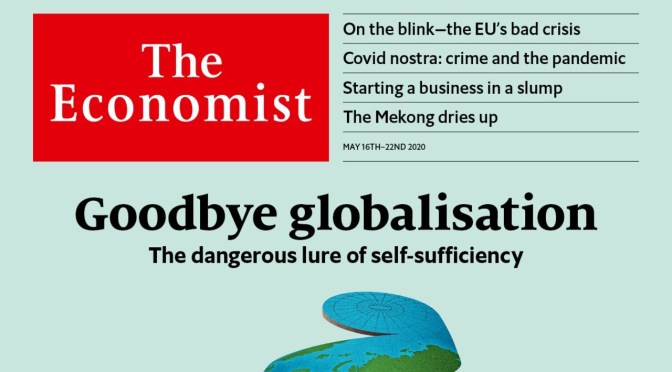
International: Has Covid Killed Globalization, European Disunion & Mike Pompeo (The Economist)

The Economist Editors Picks Podcast logoA selection of three essential articles read aloud from the latest issue of The Economist. This week, has covid-19 killed globalisation? Why the European Union is having a bad crisis (10:55) and how Mike Pompeo is confusing leadership with bashing his opponents (19:20). Zanny Minton Beddoes hosts.
 

Top New Podcasts: “The World Reopens” From Pandemic (Monocle 24)

Monocle on Sunday PodcastsMonocle’s editor in chief, Tyler Brûlé, discusses the weekend’s top stories with his guests. Topics include how the coronavirus outbreak is being felt in Switzerland, the UK and Japan. 

From Milan: Salone highlights, interviews and a daily running guide.

Political News: “Shields & Brooks” On The Latest In Washington (PBS Video)

Syndicated columnist Mark Shields and New York Times columnist David Brooks join Judy Woodruff to discuss the week’s political news, including former Vice President Joe Biden’s response to an allegation of sexual assault, which U.S. officials Americans trust during the pandemic, a new proposal for more coronavirus relief and an insider trading investigation of prominent senators.

Top New Science Podcasts: Inequality In Pandemics, Hawaii’s Mauna Kea Volcano Earthquakes

science-magazine-podcastsContributing Correspondent Lizzie Wade talks with host Sarah Crespi about the role of inequality in past pandemics. Evidence from medical records and cemeteries suggests diseases like the 1918 flu, smallpox, and even the Black Death weren’t indiscriminately killing people—instead these infections caused more deaths in those with less money or status. 

Also this week, Aaron Wech, a research geophysicist for the U.S. Geological Survey at the Alaska Volcano Observatory, joins Sarah to talk about recordings of more than 1 million earthquakes from deep under Hawaii’s Mauna Kea volcano, which hasn’t erupted in 4500 years. They discuss how these earthquakes, which have repeated every 7 to 12 minutes for at least 20 years, went undetected for so long.

Top New Science Podcasts: Image Manipulation, Tully Monster & Air Pollution

nature-podcastsThis week, Elisabeth Bik tells us about her work uncovering potential image manipulation, and a new route for particulate pollution formation.

In this episode:

00:45 Seeing double

Elisabeth Bik spends her days identifying duplicated images in science papers. She tells us about her efforts, and why they’re important. Feature: Meet this super-spotter of duplicated images in science papersNews: Publishers launch joint effort to tackle altered images in research papers

08:11 Research Highlights

New insights on the mysterious Tully Monster, and how football fans can stoke air pollution. Research Highlight: Unmasking the Tully Monster: fossils help to tackle a decades-old mysteryResearch Highlight: The meaty link between a city’s football matches and its foul air

10:29 Understanding air pollution

Particulate pollution is a serious threat to human health, but the way that new particles form is poorly understood. This week, new research suggests a new mechanism for it to happen. Research article: Wang et al.News and Views: Airborne particles might grow fast in cities

15:09 Pick of the Briefing

We pick some highlights from the Nature Briefing, including the closest discovered black hole to Earth, and how wriggly worms are helping physicists model microscopic processes. National Geographic: Closest black hole to Earth found ‘hiding in plain sight’Physics: Worm Viscosity

Subscribe to Nature Briefing, an unmissable daily round-up of science news, opinion and analysis free in your inbox every weekday.