
From a Wall Street Journal online article:
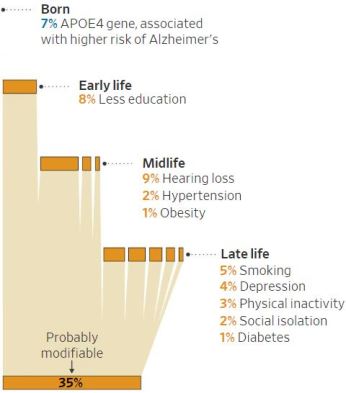
Dementia is a complicated disease that has multiple causes and risk factors, some of which remain unknown. Nevertheless, there is increasing evidence that people—even those who inherit genes that put them at greater risk of developing Alzheimer’s in later life—can improve their chances by adopting lifestyle changes.
“It’s not just about running three times a week,” says Sarah Lenz Lock, executive director of AARP’s Global Council on Brain Health. “Instead, it’s about a package of behaviors, including aerobic exercise, strength training, a healthy diet, sleep and cognitive training.”
When it comes to battling dementia, the unfortunate news is this: Medications have proven ineffective at curing or stopping the disease and its most common form, Alzheimer’s disease. But that isn’t the end of the story. According to a recent wave of scientific studies, we have more control over our cognitive health than is commonly known. We just have to take certain steps—ideally, early and often—to live a healthier lifestyle.
In fact, according to a recent report commissioned by the Lancet, a medical journal, around 35% of dementia cases might be prevented if people do things including exercising and engaging in cognitively stimulating activities. “When people ask me how to prevent dementia, they often want a simple answer, such as vitamins, dietary supplements or the latest hyped idea,” says Eric Larson, a physician at Kaiser Permanente in Seattle and one of a group of scientists who helped prepare the report. “I tell them they can take many common-sense actions that promote health throughout life.”
To read more: https://www.wsj.com/articles/what-science-tells-us-about-preventing-dementia-11574004600

 This proposed agency could work like a seal of approval, like the Energy Star program run by the Environmental Protection Agency, for new software, apps, and vendors that will be handling sensitive health information. Just like dishwashers evaluated by Consumer Reports, apps that handle personal health information should have a similar unbiased review process.
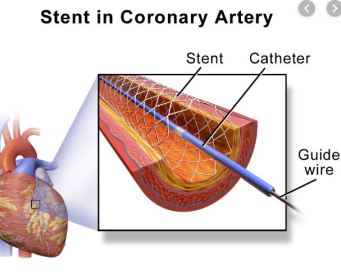 “For patients with severe but stable heart disease who don’t want to undergo these invasive procedures, these results are very reassuring,” said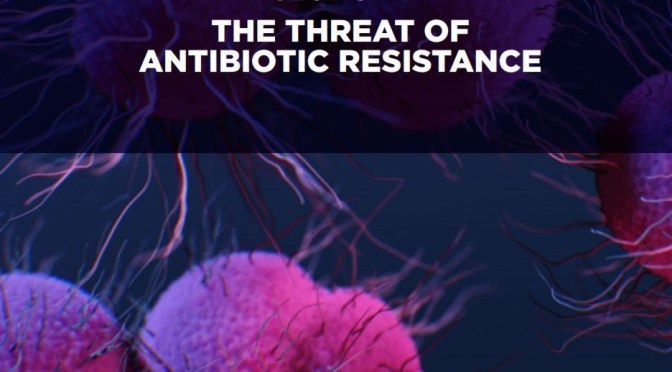
 More than 2.8 million antibiotic-resistant infections occur in the United States each year, and more than 35,000 people die as a result. In addition, nearly 223,900 people in the United States required hospital care for C. difficile and at least 12,800 people died in 2017.
 An obscure think tank in Boston is getting drug companies to lower their prices – using something called a QALY. WSJ’s Denise Roland explains what a QALY is, and why it’s controversial.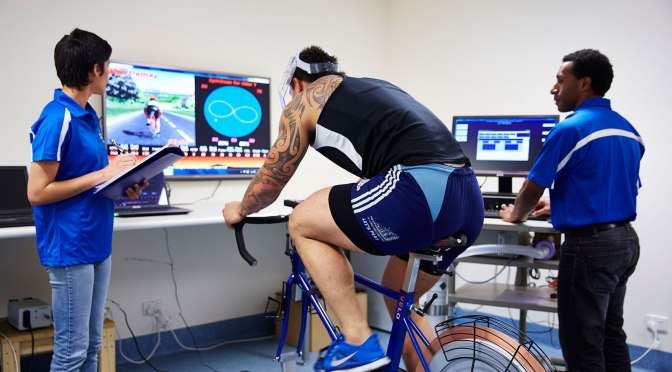

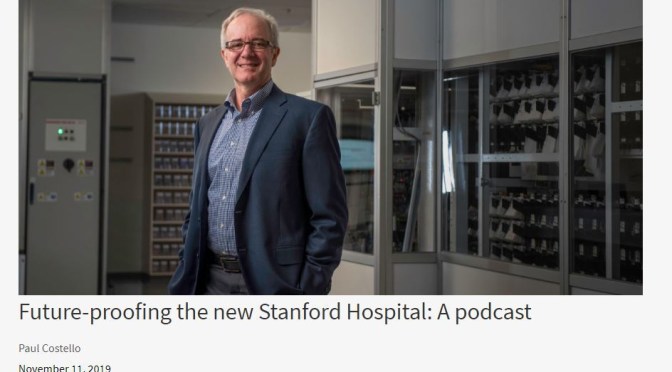
 “A simple example would be copper and fiber wires. When you’re putting wires in a new facility, it’s easier to put in many more than you need that moment because putting them in 5 years from now or 10 years from now is quite hard. Something like 85 percent of our copper wires and fiber optic cables are dark right now because we know we’re going to need them in the future.”
 One of the immune system’s jobs is to protect us from harmful bacterial. And the beneficial organisms that we refer to as probiotics contribute to this effort in a number of ways. In the gut, a robust population of beneficial bacteria can help crowd out harmful bacteria, making it harder for them to thrive. In addition, probiotic bacteria can influence the activity of our own immune cells, regulating inflammation, barrier function, and cell-to-cell signaling.
 Hear this week’s science news, with Nick Howe and Shamini Bundell. This week, a new 3D printer allows quick shifting between many materials, and understanding the link between gut microbes and liver disease.
 Copenhagen’s legendary bicycle setup has been propelled by all of these aspirations, but the critical element is the simplest: People here eagerly use their bicycles — in any weather, carrying the young, the infirm, the elderly and
  Intellicurious