
Top Art Exhibition · December 2026
In Vienna, a portrait filed for decades under “anonymous” returns as the work of Gian Lorenzo Bernini
Bernini: Painter and Sculptor, at the Palais Lobkowitz from December 2 to April 4, 2027, asks what happens when the greatest sculptor of the Baroque picks up a brush. It is our exhibition of the month.
“The best time to render the mouth is when he has just spoken or is just about to begin speaking.”
Gian Lorenzo Bernini, as recorded by Paul Fréart de Chantelou, Paris, 1665
I
The Storeroom
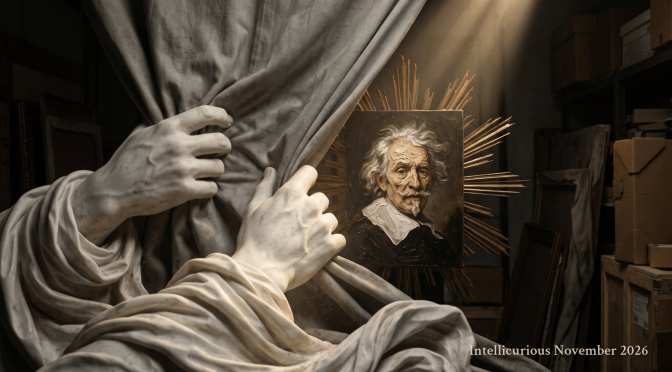
For most of the last four decades, one of the rarest pictures in Vienna was not on a wall. The Kunsthistorisches Museum had catalogued its Portrait of an Old Man as the work of an anonymous seventeenth-century Roman painter, and in 1989, with no name anyone would stand behind, it went into storage. It is a modest canvas, about sixty-two centimetres by forty-eight: a white-haired man in black, a broad white collar, a face lit from the left against a brown dark. Pictures like it fill the reserve collections of every great museum. Most of them stay there.
This one comes out on December 2, under a new name. Research at the museum now gives the head to Gian Lorenzo Bernini, the sculptor and architect who gave Rome the colonnade of St Peter’s Square, and the canvas is the centrepiece of Bernini: Painter and Sculptor, which the Kunsthistorisches Museum stages at the Palais Lobkowitz until April 4, 2027. Building work at the museum’s main house sent the show across the old city to the palace that holds the Theatre Museum. The detour suits it. This is a story about a famous man seen through an unfamiliar door.
II
Paint Built Like Clay
We think of Bernini in marble: Apollo turning to Daphne as her fingers break into leaves, Saint Teresa swooning in her chapel, the river gods of Piazza Navona. Yet he also painted, chiefly portraits and heads, and only a few of his once numerous portrait paintings survive. That is why a single new one matters out of all proportion to its size.
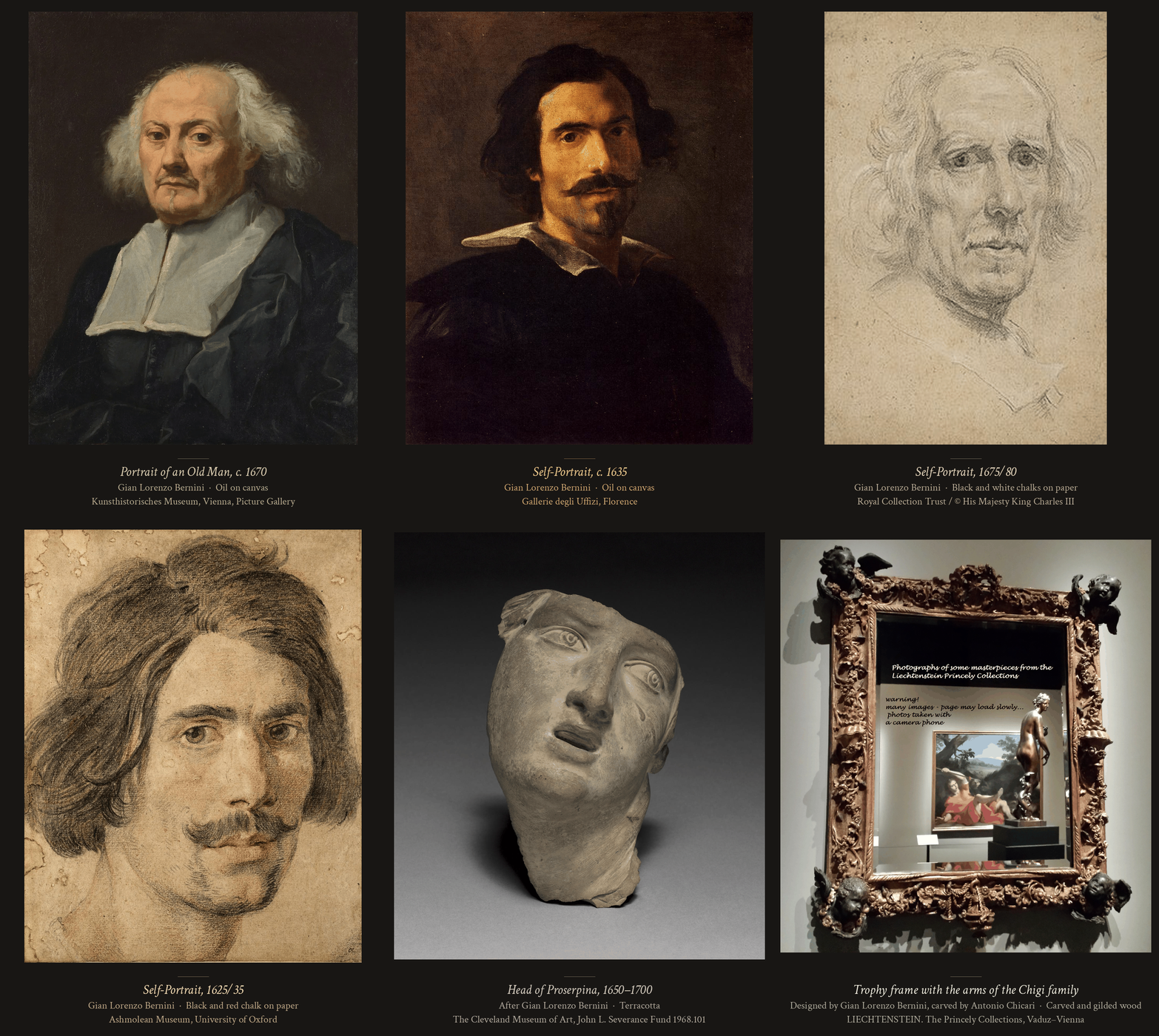
The case for his hand rests on looking. The curator, Gudrun Swoboda, points to the way the face is built up in short, bristled strokes, the paint handled less like a film of colour than like something modelled. She points to the mouth, which recalls the mouth of Bernini’s marble bust of Louis XIV, carved in Paris in 1665. She points to the sense of space around the head, to its anatomical precision, and to a collar, cut and hairstyle that belong to Rome around 1670. And she sets the canvas beside a late self-portrait drawing in the Royal Collection, made between 1675 and 1680, in which the same loose white hair and the same weathered, watchful gaze appear in chalk.
The attribution is candid about its limits, which makes it more persuasive, not less. Swoboda gives the finely painted head and collar to Bernini. The weaker black garment and shoulder may be by another hand, perhaps one of his sons, a division that a recent scientific examination supports. It is a familiar arrangement in a busy workshop: the master takes the face, where the likeness lives, and leaves the cloth to others. Look at the picture with that in mind and it seems almost to divide before your eyes, a living head set on a costume.
III
Faces Across a Lifetime
Around the portrait the museum has gathered about ten international loans, and the confirmed ones make an argument of their own. Two are self-portrait drawings that bracket a career. From the Ashmolean Museum in Oxford comes a head in black and red chalk, made between 1625 and 1635: a young man with a dark mane and a curled moustache, staring straight out, the red chalk warming cheek and lip. From the Royal Collection comes the old man’s answer, in black and white chalks, half a century on: the hair gone white and loose, the face thinned, the eyes still fixed on the mirror.
Between them hangs the Uffizi’s Self-Portrait of about 1635, oil on canvas, among the best known of his paintings. It is quick, dark and sure of itself, a face drawn out of shadow in very few strokes, and it shows what the Vienna attribution asks us to believe: that the man who could make marble look soft could also make paint look solid.
And there is marble. The Bust of Pope Clement X, lent by the Gallerie Nazionali di Arte Antica in Rome, dates from about 1676, when Bernini was in his late seventies. One hand is raised, the other holds a folded paper; the vestments are cut into brocade, and the beard and moustache stand out in curls. Placed near the painted old man, the bust makes the exhibition’s point at a glance. In stone, Bernini had to suggest colour through shadow and texture. In oil, he found sculpture in the brushstroke. The same hand was solving the same problem from both sides.
IV
The Chigi Question
Who is the old man? The museum does not say for certain, and neither should we. Swoboda has suggested Mario Chigi, brother of Pope Alexander VII, a former military commander and Bernini’s most important patron in his later years. The Chigi pontificate brought Bernini some of his greatest commissions, the colonnade of St Peter’s Square among them.
The dates come close without closing. Mario Chigi died in 1669; the painting is placed around 1670. A portrait finished at the end of a life, painted in its memory, or a likeness of someone else entirely: the canvas does not tell. Earlier, the name of Baciccio, the painter who worked alongside Bernini, was proposed for the picture. Now the master himself has been. The exhibition is honest enough to leave the sitter’s name an open question, and that honesty is part of its pleasure.
V
The Month’s Exhibition
December brings larger exhibitions, and louder ones. This one is built around a single canvas and about ten loans, and that is its strength. It offers something museums can rarely offer: a fresh attribution argued in public, with the evidence on the wall. Visitors can test the case for themselves, walking from the chalk faces to the painted one and back, deciding whether the paint really behaves like clay. Few exhibitions let the audience join the scholarship. This one practically asks them to.
It also changes our picture of Bernini. The architect of St Peter’s Square, the sculptor who carved a tear onto Proserpina’s cheek, was also a painter of faces, quick and searching and private. The Vienna portrait is a reminder that the most public artist of the Baroque kept a smaller, quieter practice, and that some of it may still be waiting in the storerooms.
Bernini: Painter and Sculptor is at the Palais Lobkowitz, Lobkowitzplatz 2, Vienna, from December 2, 2026, to April 4, 2027.
Go for the old man. Stay for the conversation between paint and stone.
Sources: Kunsthistorisches Museum, Bernini: Painter and Sculptor and press images and loans; Artsy, “Rare Bernini Painting Discovered in Vienna Museum Storeroom”; The Art Newspaper, “Newly discovered Bernini painting to be unveiled at Vienna museum”, August 20, 2026.
On the epigraph: Bernini’s remark on portraiture, recorded by Paul Fréart de Chantelou in his diary of the artist’s visit to Paris in 1665, quoted in English translation; wording differs between translations.
On the images: the animated sequence was compiled by Intellicurious from images of the works, with credits on each frame. The Head of Proserpina (1650–1700, after Bernini, terracotta) is in The Cleveland Museum of Art. Featured image: Gian Lorenzo Bernini, Portrait of an Old Man (c. 1670). Oil on canvas. Kunsthistorisches Museum, Vienna, Picture Gallery.

