
An Intellicurious Appreciation · Essay of the Week
The Book, but for Philosophy
Sheon Han’s New Yorker essay on the Stanford Encyclopedia of Philosophy, and why we think it is one of the finest pieces of the year
First published in The New Yorker, Fri Nov 27, 2026, as “The Monumental Achievement of the Stanford Encyclopedia of Philosophy”, by Sheon Han. This appreciation is laid out, with affection, in the style of an S.E.P. entry.
How did a modest website, with the winking address plato.stanford.edu, become the most trusted reference work in philosophy, and a quiet authority on the meaning of life? Sheon Han goes looking for the people behind it and finds an office at Stanford grandly titled the Metaphysics Research Lab, a volunteer army of scholars and a set of editorial rules as exacting as any argument. His essay is at once a history, a portrait and a love letter to careful thought. Here is our guide to it.
1. The Book
The mathematician Paul Erdős liked to imagine a heavenly book holding the most beautiful proof of every theorem. As a college junior, Han realised he had found its philosophical equivalent online. His first entries were humbling: an article on “Forgiveness” that made his own earnest term paper look thin, and one on the Sorites Paradox, the ancient puzzle of when a heap of sand stops being a heap, that left him puzzled and intrigued in equal measure. That, he suggests, is the paradigmatic philosophical state.
What hooks him is the range. There is an entry for every kind of reader, the unhappy, the procrastinating, the believer and the atheist, and the encyclopedia delights in referring to itself: you can look up “Definitions”, or learn the meaning of meaning. Unlike Wikipedia’s rabbit holes, Han writes, an S.E.P. entry is demanding, and that is exactly its pleasure.
2. A Birch That Became a Redwood
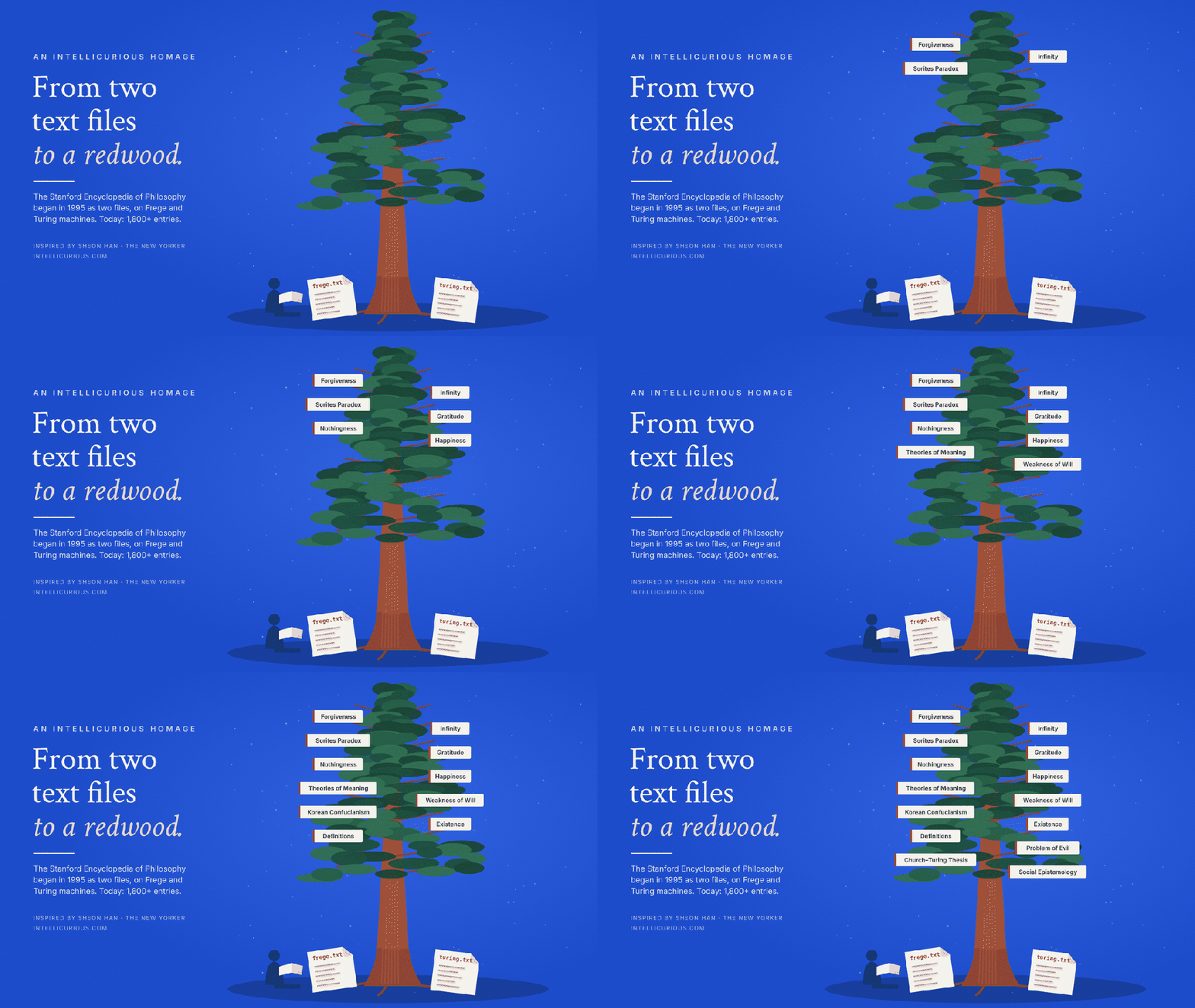
In 1995 the philosopher John Perry suggested a simple online dictionary of philosophy to Ed Zalta, a Stanford researcher who was good with computers. Zalta imagined something far bigger: a dynamic, peer-reviewed encyclopedia that could keep pace with the field, as printed references, still missing Kripke, Putnam and Rawls, had failed to do. It began as two text files, on Turing machines and Gottlob Frege. Perry still marvels at what grew from it: “I thought I’d planted a birch tree. It turned out to be a redwood.”
Zalta, a metaphysician, classical pianist and Sierra backpacker who once advised Neal Stephenson on his novel Anathem, works from Cordura Hall 202, home of the grandly named Metaphysics Research Lab. Joined in 1998 by Uri Nodelman and Colin Allen, he and his colleagues wrote their own software, including an automated system for nagging authors, and output jumped from 32 entries in 2000 to 104 the next year. Today there are more than 1,800, all written, edited and coded by philosophers.
3. How an Entry Is Made
Five executive editors and nearly two hundred volunteer subject editors decide when a topic has matured enough to deserve an entry and who should write it. Authors aim for about 12,000 words and a self-contained account, rather than outsourcing explanation through links as Wikipedia does; drafts are peer-reviewed, revised and approved by the board, then updated every four or five years. An invitation to write one is now a mark of professional standing, cited in tenure cases. Some authors never manage to fit the form; others, like Mark Balaguer, treat it as a kind of lecture notes for a first-year graduate student.
4. What It Leaves Out
Han contrasts the S.E.P. with Borges’s Library of Babel, infinite and useless because it excludes nothing. The encyclopedia’s value lies as much in what its editors leave out as in what they let in. They decline original research disguised as reference, and try, carefully, to widen philosophy beyond traditions descended from Plato and Aristotle. Han’s own route to the lab began with a tweet announcing a new entry on Korean philosophy, a tradition he realised he knew nothing about, though he is Korean himself.
5. The Room and the Dinner Party
Could someone locked in a room with only the S.E.P. become a good philosopher? Han puts the question to the encyclopedia itself, and then, fittingly, to people. The Kant scholar R. Lanier Anderson reminds him that Kant, for all his famous routine, lived in a busy port city and loved dinner parties: philosophy feeds on conversation and counter-argument, which no solitary reader can supply. The editor Hannah Kim offers the essay’s guiding image: the encyclopedia is a map of the scholarly landscape, and the point of a map is to send you outside. Han ends, as he must, with the entry on “Gratitude”.
6. Why This Essay Matters
In an age of five-minute explainers and confident chatbots, Han’s essay is a reminder of what slow, collective, checked knowledge looks like, and of the unglamorous labour behind it: volunteer editors, nagging scripts, rounds of peer review. It is also a model of the form it celebrates, curious, generous and exact, moving from a single student’s delight to a portrait of an institution without losing its warmth. For a site called Intellicurious, it reads almost like a mission statement.
Bibliography
Han, Sheon, 2026, “The Monumental Achievement of the Stanford Encyclopedia of Philosophy”, The New Yorker, 27 November.
Stanford Encyclopedia of Philosophy, Edward N. Zalta and Uri Nodelman (eds.), Metaphysics Research Lab, Stanford University, plato.stanford.edu.
Start where Han started: Forgiveness · Sorites Paradox · Korean Confucianism
Also mentioned in the essay, and waiting at plato.stanford.edu: Happiness · Weakness of Will · The Problem of Evil · Hiddenness of God · Theories of Meaning · Nothingness · The Church-Turing Thesis · Social Epistemology · Epistemic Self-Doubt · Gratitude
Before You Close the Entry
If the encyclopedia is a map, where would you go first? Pick one entry tonight and read it to the end, bibliography and all.
Drawn from Sheon Han’s essay in The New Yorker, November 27, 2026. Our summary is our own; the reporting and writing are Han’s. Visit the homepage at newyorker.com.
— The Editors, Intellicurious —

