

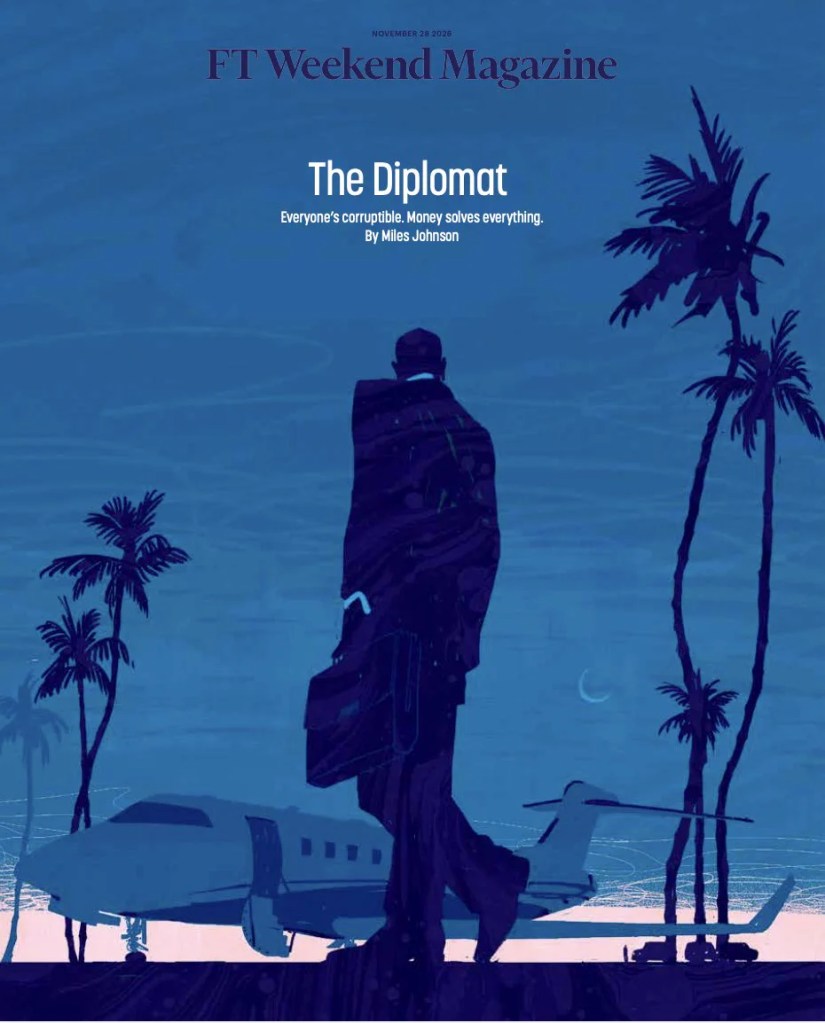
FT Weekend Magazine · 28 November 2026
Traffickers, Tribunals & Tunnels
The hunt for the man called Uncle, a war-crimes court under siege, and Marc Brunel’s escape to New York
This weekend’s FT Weekend Magazine is about people who slip through borders and the institutions that try to catch up with them. Miles Johnson tells the story of a trafficker who outran the law for two decades on diplomatic passports. Simon Kuper visits a war-crimes court that has never been busier or more besieged. And Harriet Clarfelt follows her ancestor, Marc Brunel, as he flees the French Revolution for New York.
Around them: Tim Harford on two investment booms, Jancis Robinson’s Christmas fizz, Jay Rayner in St Andrews and the weekend’s puzzles. Here is the issue, with our notes on the threads that run through it.
The Cover Story
By Miles Johnson · Cover Story · Investigation
Content note: drug trafficking, arms dealing and references to war crimes.
Just before dawn on 15 December 2011, a private jet at La Romana airport in the Dominican Republic was loaded with more than a tonne of cocaine. A local general had been bribed $1mn to keep watch. But one of the pilots was working undercover for the US Drug Enforcement Administration, filming everything with a camera hidden in a key chain. Agents seized the drugs and the traffickers. Missing was the man who had directed the shipment from thousands of miles away, known on the wiretaps only as “Uncle.”
Johnson follows John Post, a Newark-born DEA agent who treated every small arrest as bait for a bigger catch, and his undercover partner Miguel Carrera. Their two-man team from one of the agency’s smallest offices identified Uncle as Ali Koleilat. He was a Lebanese-born trafficker who, by his own account, flew Liberia’s Charles Taylor to meet Muammer Gaddafi and brokered a planeload of Iranian weapons for Taylor’s collapsing regime. For two decades he evaded justice with real diplomatic passports issued under false names.
In 2014 an old contact lured Koleilat from his diplomatic haven in Morocco. On his third trip to the airport he finally boarded, and Belgian police were waiting when he landed in Brussels. After co-operating with US prosecutors he received eight years, a sentence that shocked some agents. Now free and, he says, retired, he met Johnson in Rotterdam. Post’s one regret is that he never turned Koleilat into an informant: “We could have made some serious cases with that guy.”
Koleilat’s accounts of his dealings with Taylor, Gaddafi and Syrian-linked networks are his own or those of former US officials. He told the FT he never requested the 2014 plot to kidnap Belgian diplomats in exchange for his release.
The Features
2. The Little Court That’s Never Been Busier. Or Under More Pressure
By Simon Kuper · International Justice
Content note: genocide, war crimes and atrocity crimes.
On Monday, Rodrigo Duterte, the former president of the Philippines, enters the dock in The Hague, charged with crimes against humanity over a so-called war on drugs that killed thousands of mostly poor Filipinos. It is the biggest trial in the International Criminal Court’s history. The court is also pursuing Vladimir Putin, Benjamin Netanyahu and leaders of the Taliban, and its sister court, the ICJ, has just ruled that Myanmar committed genocide against the Rohingya.
Kuper writes that the ICC has also never been under such pressure. Secretary of State Marco Rubio has threatened to dismantle it, nine of its judges and three prosecutors are under US sanctions, and last month Washington sanctioned the court itself. He traces the road from Nuremberg, where his great-uncle Leo Kuper’s hopes for a genocide tribunal long lay dormant, and is frank about the court’s record since 2003. It has 10 convictions for atrocity crimes, all of Africans, none of a head of government. Its chief prosecutor, Karim Khan, was voted out this year over misconduct allegations that he denies.
His case for hope is that the court is adapting, replacing American technology with European suppliers, while national courts from Ukraine to Germany, and even America, take up its work. War crimes have no statute of limitations. As the lawyer Philippe Sands sees it, international justice is in its infancy: “1945 was last week, in effect.”
The criticisms of the Trump administration here are Kuper’s and those of scholars he quotes; the administration says the court has no authority over Americans. Israel rejects the genocide accusation in South Africa’s pending ICJ case.
3. Marc Brunel’s American Dream
By Harriet Clarfelt · History · Family
In July 1793, with the Terror under way and his royalist views a likely death sentence, the 24-year-old Marc Brunel fled France from Le Havre aboard a ship called Liberty. He had left his own passport on shore and copied a fellow passenger’s so skilfully that the guards were fooled. In New York he surveyed the wilds of the north of the state, worked on a canal scheme linking the Hudson with Lake Champlain, designed for Aaron Burr and, in 1796, became an American citizen.
A letter of introduction from Alexander Hamilton carried him to England in 1799. There he was reunited with his fiancée, Sophia Kingdom, who had survived imprisonment in a convent during the Terror. He went on to build the Thames Tunnel, and their son, Isambard Kingdom Brunel, built the Great Western Railway and the Clifton Suspension Bridge.
Clarfelt, an FT reporter in New York descended from Isambard’s daughter Florence, set out after the birth of her American-born daughter. In the Brunel Museum’s archives she found the family’s forgotten American chapter, and in her own expatriate life a quiet echo of his.
The Columns
4. AI vs the Railways: A Tale of Two Investment Booms
By Tim Harford · Column
Harford sets today’s rush of investment into artificial intelligence beside the great railway boom, and asks what one era of speculative building can teach the other.
By Miranda Green · Life & Arts
As the season of indulgence begins, Green asks a deceptively simple question about the small rewards we allow ourselves.
Food & Drink
6. The Best Champagne and Sparkling Wine for Christmas 2026
By Jancis Robinson · Wine
Robinson picks the bottles of champagne and other sparkling wine worth opening over the holidays.
7. ‘Still Thinking About That Soup!’
By Jay Rayner · Restaurant Review
Rayner reviews Ondine in St Andrews, and comes away with a soup he cannot forget.
8. The Secret to Succulent Roast Chicken
Jessica Filbey · Recipe
Jessica Filbey of Canteen cooks chicken in milk for tender, fragrant meat and crisp golden skin, served with cheesy polenta and cavolo nero. Sunday lunch, sorted.
Puzzles & Games
The crossword. FT Weekend Magazine Crossword No. 821.
The quiz. Round on the Links, which tests your ability to draw connections, takes in Simon and Garfunkel, The Shining and Barbarossa. Last week’s solutions are here.
Quick games. Binary Puzzle, Word Circle and Mini Crossword, each No. 137.
From Recent Issues
9. My Mother’s Murder and the Verdict That Shocked a Nation
Life & Arts · 20 November
Content note: murder.
The journalist Daphne Caruana Galizia was murdered in Malta in 2017. In September, the man on trial for her killing was acquitted, a verdict that horrified her family. Then, one of her sons writes, they looked closer.
10. Forget Sancerre. The Loire’s Reds Deserve More Attention
By Jancis Robinson · Wine
From crunchy young Cabernet Francs to mature Bourgueils, Robinson finds Loire reds of real freshness and character.
11. A Turner Masterpiece Returns to Rome
Art · J.M.W. Turner
“Rome, from Mount Aventine,” valued at £50mn ahead of its December auction, offers a window on Turner’s fascination with Italy.
12. Juno, Kensington: A Parade of Culinary Flops
By Jay Rayner · Restaurant Review
London has no shortage of fine Italian cooking, Rayner writes; he found none of it at Juno.
The Threads
Escape artists. A trafficker who crossed borders on borrowed identities and diplomatic passports, and an engineer who fled the Terror on a copied passport aboard a ship called Liberty. (1, 3)
Justice, slow and uncertain. An eight-year sentence that stung the agents who chased Koleilat, a war-crimes court with no head of government yet convicted, and an acquittal that sent a murdered journalist’s family back to the evidence. (1, 2, 9)
Booms in steel and silicon. Harford’s railway mania meets today’s AI spending spree, and Brunel’s son built one of the railway age’s great lines. (4, 3)
Seasonal pleasures. Green asks whether you deserve a treat; Robinson, Rayner and Filbey supply them. (5, 6, 7, 8, 10)
Before You Close the Issue
Koleilat bought his way across borders for 20 years; Brunel forged his way across one to save his life. When does slipping past the rules make you a villain, and when a hero?
Drawn from FT Weekend Magazine, 28 November 2026, and recent FT Magazine pieces. Visit the homepage at ft.com.
— The Editors, Intellicurious —

