
From a Journal of the American College of Cardiology:
Observational data suggest associations between marijuana and a broad range of adverse cardiovascular risks. Marijuana is becoming increasingly potent, and smoking marijuana carries many of the same cardiovascular health hazards as smoking tobacco. Synthetic cannabinoids have been linked to more sustained and deleterious pharmacodynamic effects.
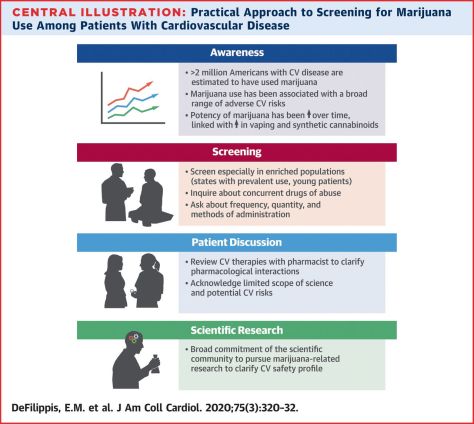
Marijuana use is increasing as more states are legalizing cannabis for both medicinal and recreational purposes. National survey data estimate that >2 million Americans with established cardiovascular diseases currently use or have used marijuana in its variety of forms, including inhalation and vaping. Cannabinoid receptors are distributed in multiple tissue beds and cells, including platelets, adipose tissue, and myocytes.
Highlights
-
• We estimate that >2 million U.S. adults who have reported ever using marijuana have cardiovascular disease.
-
• Observational studies have suggested an association between marijuana use and a range of cardiovascular risks.
-
• Marijuana is becoming increasingly potent, and smoking marijuana carries many of the same cardiovascular health hazards as smoking tobacco.
-
• Few randomized clinical trials have been conducted or are planned to explore the effects of marijuana on cardiovascular risk.
-
• Screening and testing for use of marijuana are encouraged in clinical settings, especially in the care of young patients presenting with cardiovascular disease.


 replicating a

 Smartphone app-based platforms for urine testing could improve adherence to albumin creatinine ratio (ACR) testing. One study showed screening of at-risk patients almost doubled with a home urine test kit that uses a smartphone camera to easily and accurately quantify ACR from a user-performed urine dipstick. If independently validated in a large, diverse population, this low-cost strategy could change the often dim trajectory for individuals with declining kidney function.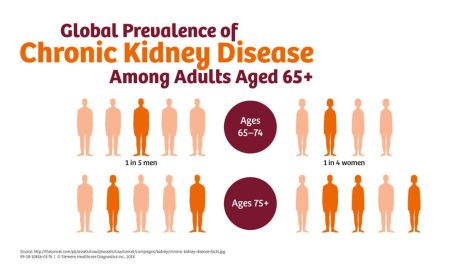
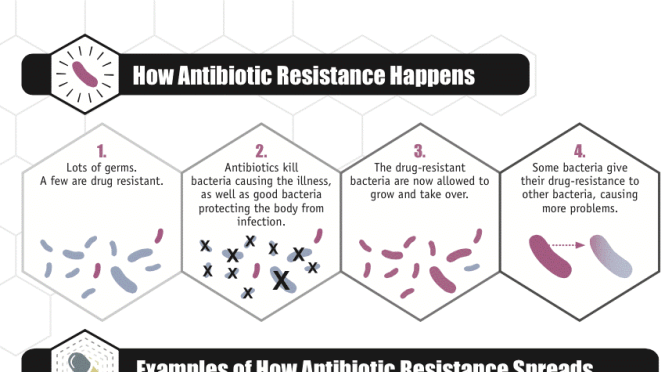
 “We were able to show that if you can stop the plasmid from replicating, then most of the bacteria lose the plasmid as the bacteria grow and divide. This means that infections that might otherwise be hard to control, even with the most powerful antibiotics available, are more likely to be treatable with standard antibiotics.”
 “Amyloid is important in initiating disease, but the actual damage in the brain is probably due to the accumulation of tau,” Holtzman told MedPage Today. “Normally, tau protein is inside cells, but there is more and more evidence suggesting that its spread to different parts of the brain is responsible for the progression of Alzheimer’s disease.”
 “Our data showed that rates of accelerating blood pressure elevation were significantly higher in women than men, starting earlier in life,” said Cheng, the Erika J. Glazer Chair in Women’s Cardiovascular Health, who also serves as director of Cardiovascular Population Sciences at the Barbra Streisand Women’s Heart Center. “This means that if we define the hypertension threshold the exact same way, a 30-year old woman with high blood pressure is probably at higher risk for cardiovascular disease than a man with high blood pressure at the same age.”
 Intellicurious